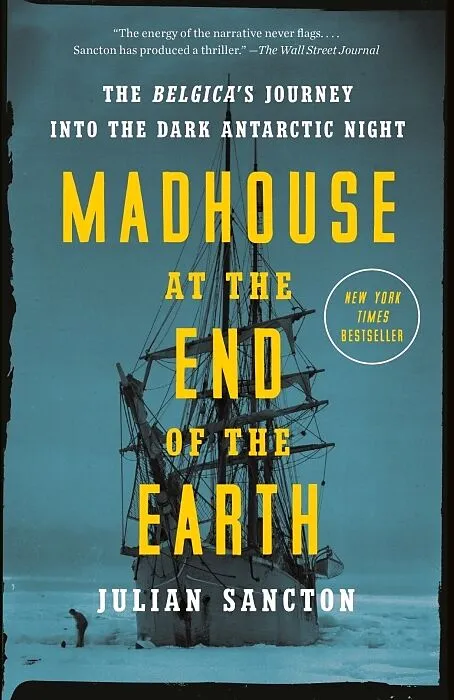
Madhouse at the End of the Earth
Beschreibung
“A grade-A classic.”—The Sunday Times “A vivid horror story . . . thrillingly recounted.”—The New York Review of Books “As soon as you finish, you want to read it again.”—Daily Mail “Madhouse at the E...Format auswählen
- Kartonierter EinbandCHF 19.50
- Kartonierter EinbandCHF 35.90

Wird oft zusammen gekauft
Andere Kunden kauften auch
Beschreibung
“A grade-A classic.”—The Sunday Times
“A vivid horror story . . . thrillingly recounted.”—The New York Review of Books
“As soon as you finish, you want to read it again.”—Daily Mail
“Madhouse at the End of the Earth [is an] exquisitely researched and deeply engrossing account of the Belgica’s disastrous Antarctic expedition. Sancton uses . . . an extraordinary treasure trove . . . to tease out the personalities and fears and rivalries of his subjects [in] his increasingly harrowing descriptions of life on the Belgica.”***—The New York Times
“An extraordinary tale of ambition, folly, heroism and survival, superbly told by Julian Sancton, who has rescued the Belgica’s story from relative obscurity and brought it to magnificent life . . . [a] splendid, beautifully written book.”—The Spectator
“I started reading Madhouse at the End of the Earth . . . and I couldn’t stop. [It] reads like an adventure novel [and] is so detailed you can almost smell and taste it.”—Bon Appétit
“Locked down, I craved perilous adventure. Julian Sancton’s Madhouse at the End of the Earth delivered. The Belgica’s 1897 South Pole expedition is pure horror. Clueless captain, rat-infested ship frozen into the ice, scurvy, darkness, hunger, insanity . . . terrific stuff.”—The New Statesman, “Books of the Year”
“At once a riveting survival tale and a terrifying psychological thriller, Madhouse at the End of the Earth is a mesmerizing, unputdownable read. It deserves a place beside Alfred Lansing’s immortal classic Endurance.”—Nathaniel Philbrick, New York Times bestselling author of In the Heart of the Sea and Valiant Ambition
“Madhouse is that rare nonfiction gem—an obscure but important history transformed by deep research and note-perfect storytelling into a classic thriller. Reading this book is as much an adventure as the very story it tells.”**—Walter Isaacson, New York Times bestselling author of Leonardo da Vinci and *Steve Jobs
“Madhouse at the End of the Earth has it all: idealism, ingenuity, ambition, explosives, flimflammery, a colorful cast, a blank map, a three-month-long night, penguins (and medicinal penguin meat). . . . A riveting tale, splendidly told.”—Stacy Schiff, Pulitzer Prize–winning author of The Witches and Cleopatra
“A generation before Shackleton’s Endurance, an adventure every bit as bold and dreadful took place at the bottom of the world, led by a band of unimaginably colorful and resolute explorers. A wild tale, so well told and immersively researched.”—Hampton Sides, nationally bestselling author of In the Kingdom of Ice
“With meticulous research and a novelist’s keen eye, Sancton has penned one of the most enthralling—and harrowing—adventure stories in years.”—Scott Anderson, New York Times bestselling author of Lawrence in Arabia and The Quiet Americans
Autorentext
Julian Sancton is the New York Times bestselling author of Madhouse at the End of the Earth and a senior features editor at The Hollywood Reporter. His work has appeared in Vanity Fair, National Geographic, Esquire, The New Yorker, and GQ, among other publications. He has reported from every continent, including Antarctica, and lives in Larchmont, New York.
Klappentext
NEW YORK TIMES BESTSELLER • The “exquisitely researched and deeply engrossing” (The New York Times) true survival story of an early polar expedition that went terribly awry—with the ship frozen in ice and the crew trapped inside for the entire sunless, Antarctic winter
“The energy of the narrative never flags. . . . Sancton has produced a thriller.”—The Wall Street Journal
**
In August 1897, the young Belgian commandant Adrien de Gerlache set sail for a three-year expedition aboard the good ship Belgica with dreams of glory. His destination was the uncharted end of the earth: the icy continent of Antarctica.
But de Gerlache’s plans to be first to the magnetic South Pole would swiftly go awry. After a series of costly setbacks, the commandant faced two bad options: turn back in defeat and spare his men the devastating Antarctic winter, or recklessly chase fame by sailing deeper into the freezing waters. De Gerlache sailed on, and soon the Belgica was stuck fast in the icy hold of the Bellingshausen Sea. When the sun set on the magnificent polar landscape one last time, the ship’s occupants were condemned to months of endless night. In the darkness, plagued by a mysterious illness and besieged by monotony, they descended into madness.
In Madhouse at the End of the Earth, Julian Sancton unfolds an epic story of adventure and horror for the ages. As the Belgica’s men teetered on the brink, de Gerlache relied increasingly on two young officers whose friendship had blossomed in captivity: the expedition’s lone American, Dr. Frederick Cook—half genius, half con man—whose later infamy would overshadow his brilliance on the Belgica; and the ship’s first mate, soon-to-be legendary Roald Amundsen, even in his youth the storybook picture of a sailor. Together, they would plan a last-ditch, nearly certain-to-fail escape from the ice—one that would either etch their names in history or doom them to a terrible fate at the ocean’s bottom.
Drawing on the diaries and journals of the Belgica’s crew and with exclusive access to the ship’s logbook, Sancton brings novelistic flair to a story of human extremes, one so remarkable that even today NASA studies it for research on isolation for future missions to Mars. Equal parts maritime thriller and gothic horror, Madhouse at the End of the Earth is an unforgettable journey into the deep.
Leseprobe
Chapter 1
Why Not Belgium?
August 16, 1897
ANTWERP
The river Scheldt wound languidly from northern France through Belgium, taking a sharp westward turn at the port of Antwerp, where it became deep and wide enough to accommodate oceangoing ships. On this cloudless summer morning, more than twenty thousand people flocked along the city’s riverfront to salute the departure of the Belgica and exult in its glory. Freshly painted steel gray, the 113-foot-long, three-masted steam whaler, fitted with a coal-powered engine, was headed to Antarctica to chart its unknown coasts and collect data on its flora, fauna, and geology. But what drew the crowds today was not the promise of scientific discovery so much as national pride: Belgium, little Belgium, a country that had declared its independence from Holland sixty-seven years earlier and was thus younger than many of its citizens, was staking a claim to the next frontier of human exploration.
At ten o’clock, the vessel weighed anchor and sailed at a regal pace in the direction of the North Sea, so freighted with coal, provisions, and equipment that her deck floated just a foot and a half above the water. Escorted by a flotilla of yachts that carried government officials, well-wishers, and press, the Belgica paraded before the city. She glided past the flag-bedecked townhouses lining the waterfront, past the flamboyant Gothic cathedral that dominated the skyline, past Het Steen, the fortress that had loomed over the river since the Middle Ages. From a pontoon, a military band played “La Brabançonne,” Belgium’s national anthem, a theme as grand as the country was small. Cannons fired in tribute…