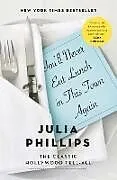
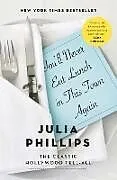
You'll Never Eat Lunch in This Town Again
Beschreibung
“The Hollywood memoir that tells all . . . Sex. Drugs. Greed. Why, it sounds just like a movie.”-- The New York Times Every memoir claims to bare it all, but Julia Phillips’s actually does. This is an addictive, gloves-off exposé from ...Format auswählen
- Kartonierter EinbandCHF 24.70

Wird oft zusammen gekauft
Andere Kunden kauften auch
Beschreibung
“The Hollywood memoir that tells all . . . Sex. Drugs. Greed. Why, it sounds just like a movie.”-- The New York Times Every memoir claims to bare it all, but Julia Phillips’s actually does. This is an addictive, gloves-off exposé from the producer of the classic films The Sting, Taxi Driver, and Close Encounters of the Third Kind --and the first woman ever to win an Academy Award for Best Picture--who made her name in Hollywood during the halcyon seventies and the yuppie-infested eighties and lived to tell the tale. Wickedly funny and surprisingly moving, You’ll Never Eat Lunch in This Town Again takes you on a trip through the dream-manufacturing capital of the world and into the vortex of drug addiction and rehab on the arm of one who saw it all, did it all, and took her leave. Praise for You'll Never Eat Lunch in This Town Again “One of the most honest books ever written about one of the most dishonest towns ever created.” -- The Boston Globe “Gossip too hot for even the National Enquirer . . . Julia Phillips is not so much Hollywood’s Boswell as its Dante.” -- Los Angeles Magazine “A blistering look at La La Land.” --USA Today “One of the nastiest, tastiest tell-alls in showbiz history.” --People
“One of the most honest books ever written about one of the most dishonest towns ever created.”—The Boston Globe
“Gossip too hot for even the National Enquirer . . . Julia Phillips is not so much Hollywood’s Boswell as its Dante.”—Los Angeles Magazine
“A blistering look at La La Land.”—USA Today
“One of the nastiest, tastiest tell-alls in showbiz history.”***—People
“The Hollywood memoir that tells all . . . Sex. Drugs. Greed. Why, it sounds just like a movie.”—The New York Times*
Autorentext
Julia Phillips
Leseprobe
Prologue
House Lights Dim Before Titles
The Sting had been nominated, two months before, in ten categories, including Cinematography, Editing, Actor, Screenplay, Director, and Best Picture. The Exorcist, which had garnered an equal number of nominations, had been released the same day, two days before Christmas. It had received an enormous amount of initial publicity; even The New York Times carried pictures of people lined up in the cold to get in.
Warners had been far too cautious in its release of The Exorcist. It had opened in only twenty-four theaters. At 90/10 deals, Leo Greenfield kept reminding us. But then, he was the guy who told us, based on the first week’s figures, that our picture would gross maybe fifteen mil. We had opened in 220 theaters, with 70/30 deals, and kept widening the release. Warners waited a good six weeks until they went wide. But The Exorcist was only a three-week picture; the audience lost interest before it was available.
The Sting, on the other hand, had staying power. It had hung in, week after week, and it had opened in ten times the number of theaters. Not only was The Sting racking up some very impressive figures, but people had started to notice that it was an excellent movie. It certainly didn’t send you out in the street unsure whether to hit a church or a bar, as The Exorcist did. And Warners had a crack at The Sting and turned us down.
We’d made damn sure John Calley and Dick Shepherd came to the one screening Universal permitted us before the release of the picture. As they were walking out, I collared Calley, because I knew how much it annoyed him, and asked him how he liked the picture.
“I’m going home to slash my wrists,” he said. Good. Supercilious motherfucker.
It would be them or us tonight at the Awards.
Michael and Tony had spent weeks aggravating over whether The Sting would win for Best Picture or not. They had practiced speeches, how they would stand up, their walks to the stage. I hadn’t dared to contemplate the possibility of winning. I was not a big believer in the power of positive thinking, although I had gone to college with Norman Vincent Peale’s daughter. Didn’t wanna put a mojo on it; didn’t wanna tempt the evil eye.
I translated all my anxiety into finding a dress. Joel Schumacher was my fashion consultant. We agreed I was a New York girl, most comfortable in black, and since so many Californians dressed in colors, that I would probably stand out. Where I got the chutzpah to think I might stand out at such a gathering I don’t know. We traipsed from store to store and I would try something on and I would say, “Now if I win . . .” and then see if the dress was comfortable to walk in, and he would pull at a strap and say, “Now, when you win . . .” We finally settled on a black spaghetti-strap number by Halston at Giorgio’s, a long strand of pearls, and a double feather boa made up of guinea hen and black ostrich feathers.
I was still, six months after Kate’s birth, a little wide in the hip. Joel was adamant that I should wear beautiful black sandal-heels but I couldn’t find any tall enough. I needed height. I ended up buying a pair of giant platform shoes from Fred Slatten. Black satin with rhinestones. They stayed hidden under the dress and they definitely gave me height. They also filled me with the quiescent fear that I might actually fall off them on global TV. A toss-up, looks or safety. The hips won out.
Trancas, California
April 2, 1974
I wake with a shudder at six thirty. The sun creates hot bounce on the sky/sea horizon. It is quite a sight, but I take this view for granted. Without pausing a moment in sincere appreciation, I automatically pop a diet pill. Bad move. Within twenty minutes, I’m dancing around the sandy living room, neatening up. I run along the beach, take a perfunctory dip in the freezing-cold Pacific, race indoors for a brief hot shower.
When I hit the bedroom, Michael is standing on his head, yoga-style, in the corner of the room. “I gotta pick up my tuxedo,” Michael says, still upside down. The veins in his temples explode and contract on each syllable. Upstairs, I hear Kate’s first baby-musings for the day. Sonya heats formula in the kitchen. I can smell it. I don’t know how Kate can stand that shit.
“Good, that’ll give me time to be nervous all by myself. Maybe Sonya could take Kate out for a while.” As in: I. NEED. MY. SPACE . . .
Within the hour, they’re toast. I lay out some coke on a small mirror. Secret stash. Mine. Michael doesn’t even know I have it . . . that’s how it’s gotten. I chop it lightly with a razor. It falls apart like butter. This is good coke. Smooth. I do a hit, then another. I roll a joint and smoke it out on the deck. Less than a hundred yards from me, the ocean beats down in heavy waves against the sand. I pace, my heart beating in triple time to the waves.
I watch the postal van ease its way toward our mailbox, and I vault over the deck and scramble down the hill to meet it. The mailman has a stack, bills mostly, junk mail addressed to Occupant. Sandwiched between the telephone bill and the latest issue of Time is a small blue envelope. The handwriting addressing Michael and Julia Phillips is familiar. I tear open the envelope as I return to the house, yelling “Thanks” over my shoulder to the mailman’s wishes for our good luck that night. The letter is short and pithy, my favorites:
Dear Michael & Julia:
In a few days, you will be getting cards and letters and telegrams from everyone, so I wanted to get in what I had to say now. The important thing to remember is that you are nice sweet people. You are about to have a lot of temptation thrown your way, so try…