
IHR WARENKORB IST AKTUELL LEER.
Haben Sie noch nichts passendes gefunden? Stöbern Sie durch unser komplettes Sortiment.
Oder melden Sie sich an bzw. registrieren Sie sich.
- Kostenlose Lieferung
- Kauf auf Rechnung
- Ex Libris Tiefpreis
- Filiallieferung und 650+ Abholorte
- Rabatt-Bons als Club-Mitglied
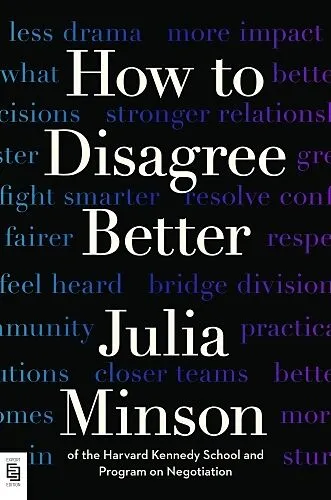
How to Disagree Better
Beschreibung
Celebrated Harvard Kennedy School Professor and behavioral scientist Julia Minson has devoted her career to understanding the psychology of disagreement and its relevance to negotiations, conflict-resolution, and decision-making. In this revolutionary book, Mi...Format auswählen
- Kartonierter EinbandCHF 25.10
- Livre ReliéCHF 31.60

Wird oft zusammen gekauft
Andere Kunden kauften auch
Beschreibung
Celebrated Harvard Kennedy School Professor and behavioral scientist Julia Minson has devoted her career to understanding the psychology of disagreement and its relevance to negotiations, conflict-resolution, and decision-making. In this revolutionary book, Minson reveals the counterintuitive secret to living a life of less drama and more impact How many times have you tried to resolve a dispute by overwhelming someone with a flood of facts, appealing to your counterpart’s emotions, or pointing out the hypocrisy of their arguments only to end up in an even deeper disagreement than when you started? Julia Minson’s two decades of research into the science of disagreement uncovers two insights that can change every disagreement: persuasion doesn’t work nearly as well as we think it does, and displaying receptiveness to opposing views is the key to not only preventing conflict, but also to forging stronger relationships and making better decisions. The science shows that receptive individuals don’t just fight less, they also get more done--they are better negotiators, better peacemakers, and yes, better influencers than the rest of us. Through original research and case studies, By practicing receptiveness, you’ll see your conflicts soften, your conversations deepen, and your relationships grow stronger. You will create a richer, wiser, kinder life for yourself and for those around you--and you will find them agreeing with you a little more often, too.
Autorentext
Julia Minson is a Professor at the Harvard Kennedy School. She is a behavioral scientist with extensive research experience in conflict, communication, negotiations, and decision making. Her primary line of research addresses the “psychology of disagreement”—how do people engage with opinions, judgments, and decisions that are different from their own? Her work on receptiveness to opposing views and related topics has been published in top academic outlets in the social sciences and covered by the popular press including CNN, TIME, The Atlantic, The Washington Post, and The New York Times.
Zusammenfassung
**NATIONAL BESTSELLER
In this "brilliant" (Arthur Brooks) and "both timely and timeless" (Adam Grant) book, pioneering Harvard Kennedy School professor and behavioral scientist Julia Minson reveals the counterintuitive secret to a life of less drama and more impact.**
We are in a disagreement crisis. The average person would rather go to the dentist than have a twenty-minute conversation with someone that they strongly disagree with. Yet disagreement is both inevitable and essential for everything from navigating decisions at home to running innovative and agile companies to governing democratic societies.
In How to Disagree Better, Minson brings to bear her decades of research into understanding the psychology of disagreement and its relevance to negotiations, conflict resolution, and decision-making, revealing the hidden skill that all the best mediators and negotiators share: displaying receptiveness to opposing views.
The science shows that receptive individuals don’t just fight less, they also get more done—they are better decision-makers, better peacemakers, and yes, better influencers than the rest of us. Through original research and case studies, How to Disagree Better will show you why traditional persuasion strategies don’t work as well as you think they do, how you can bridge division and reach better outcomes simply by utilizing receptiveness strategies, and that disagreeing better is a skill all of us can learn to apply at home, at work, and with our neighbors.
Leseprobe
1Disagreement, Conflict, and What's Wrong with Everyone Around YouHere is a poorly kept and perpetually embarrassing secret about my academic career-my passion for the science of disagreement did not come from observing the harm that violent conflict sows in the world or studying the academic literature and identifying theoretical gaps that needed filling. My passion for disagreement was primarily fueled by my years as a competitive ballroom dancer, training with, competing with, and regularly fighting with my partner and later husband, Ryan.I began ballroom dancing as a little girl in Russia. This might seem strange to many American readers, but in Eastern Europe in the eighties, taking ballroom dancing lessons was as common as taking ballet or tap lessons is in the United States. All the little girls wanted to do it, and all the little boys were forced into dancing with their sisters. By the time I had met my husband, I had thousands of hours of training and years of competitive experience under my belt. Ryan, who had never danced a step in his life, wanted to learn to dance because he had grand plans to flirt with a woman he expected to see again at a friend's wedding. I was his teacher.My husband has an infuriating quality. He is just good at things-not necessarily amazing, but notably above average at almost everything, especially things that require physical coordination and musicality. When it came to dancing, he improved quickly because of his talent and interest-and also because his teacher (soon his girlfriend) had endless time and energy for teaching him. We practiced during every available hour and on every patch of hardwood we could find. I quickly came to realize that I had more fun dancing with this complete beginner than with my competition partner. As weeks turned into months, I decided that I would rather break up the competitive partnership I was involved in and dance with Ryan, even if that meant going back to the basics.There are several unique aspects to ballroom dancing that make it the perfect microcosm for the study of conflict. First of all, the two partners are in perpetual intimate physical contact. The front of your body is literally plastered to your partner's, meaning that you can feel their most minute movements, down to their breath and their heart rate. Good physical contact improves your ability to lead and follow-to coordinate your movements wordlessly and instantaneously. Indeed, after dancing together for years, I could move my body in response to Ryan's much more quickly than it took my conscious brain to understand what was happening. And when everything worked, when we moved in complete harmony, when we felt in sync with the music and with each other-it was like telepathy. To this day, few experiences I have had compare to this feeling of "oneness."But of course, it didn't always work. One of us would lose our balance, move too slowly, stretch too far or not far enough, and the other person would get annoyed. And the finely honed sense that allowed us to feel each other's every movement also allowed us to feel each other's every mood. I'd get upset with his tightened grip on my back, he'd get upset that I was upset, and the magic would dissolve in an instant. Left in its place was another couple glaring at each other across several feet of empty dance floor.Like every dance partnership, when things went badly, we tried to diagnose the cause. Predictably, the cause was the other person. His claim that I had moved too slowly was met with my claim that he had not provided enough momentum. When I said he miscounted the rhythm, he said I was the one who started counting from the wrong measure. When he said I was leaning too far back, I said that he was not counterbalancing enough with his own weight. In fact, every practice, two hours a day, seven days a week, featured a dozen instances where we were both absolutely sure that the other person caused the problem and was simply failing to acknowledge it.This state of nearly perpetual conflict on the dance floor was especially baffling since we knew each other and the choreography as well as any two people possibly could. We were in love and rarely fought about anything outs…