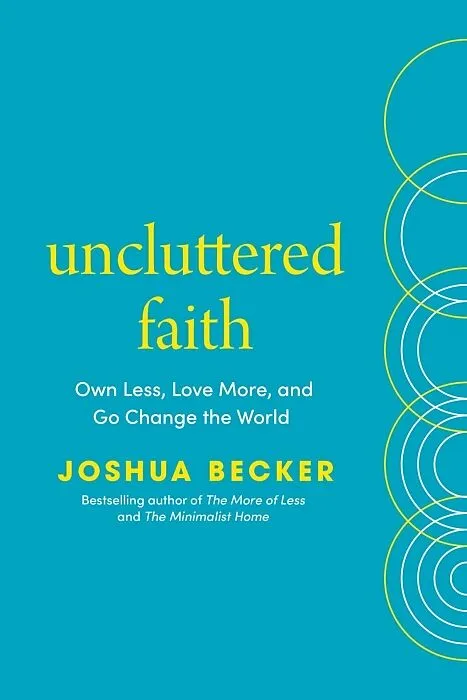
Uncluttered Faith
Beschreibung
A transformative guide to experiencing the fullness of God''s promises through the power of minimalism--from the bestselling author of Joshua Becker;weaves together personal stories, biblical teachings, and practical advice to help you let go of consumerism an...Format auswählen
- Fester EinbandCHF 28.40

Wird oft zusammen gekauft
Andere Kunden kauften auch
Beschreibung
A transformative guide to experiencing the fullness of God''s promises through the power of minimalism--from the bestselling author of Joshua Becker;weaves together personal stories, biblical teachings, and practical advice to help you let go of consumerism and worldly possessions and to instead embrace the great joy Jesus offers. This positive and compelling book serves as both a personal and collective call to action, urging you to own less, love more, and realize your full potential in God''s kingdom. Rooted in the teachings of Jesus, <Uncluttered Faith< is more than a guide for personal growth; it casts a bold vision for the Church to collectively embrace minimalism and reach its full potential. You will be left with a desire to minimize your possessions so you can experience all that God offers and accomplish the good work for the kingdom God has prepared for you, ultimately leading to a life that is not only personally fulfilling but also impacts eternity.
Autorentext
Joshua Becker, the bestselling author of The More of Less and The Minimalist Home, is the founder of Becoming Minimalist, a website dedicated to inspiring others to find more life by owning less. His websites have inspired millions around the world to consider the practical benefits of owning fewer possessions. His work has appeared in Forbes, The Wall Street Journal, The New York Times, Christianity Today, and on numerous other outlets. Becker and his family live in Peoria, Arizona.
Klappentext
INSTANT NEW YORK TIMES BESTSELLER • ECPA BESTSELLER • A transformative guide to experiencing the fullness of God's promises through the power of minimalism—from the bestselling author of The More of Less and The Minimalist Home.
Consumerism competes for our attention daily—from social media influences to ads on streaming services to our friends’ latest purchases. This obsession with storing up possessions is not new; Jesus taught His followers about it thousands of years ago, and those same lessons are meant for us today. Possessions seem to promise fulfillment, but we find instead that material abundance hinders us from living joyfully and realizing our fullest potential. Even more, they become distractions that leave us empty and separated from the true source of life—Jesus Himself!
You can break this cycle today. In Uncluttered Faith, Joshua Becker, bestselling author and founder of Becoming Minimalist, shows how the Bible has shaped his understanding of the minimalism movement he sparked around the world. Using biblical truth, personal stories, practical exercises, and modern research studies, Becker explains how
● owning less allows you to focus more on your faith and relationship with God, leading to greater joy, fulfillment, and purpose in life
● generosity is not just a spiritual practice but also a practical lifestyle choice that can help you reduce busyness and create more time for meaningful activities
● minimalism helps you prioritize people over possessions, allowing you to invest deeply in your relationships and contribute effectively to your community
More than just a personal growth guide, Uncluttered Faith presents a bold vision for the Church to collectively embrace minimalism and achieve its full potential. Experience Jesus’s teachings in a new way and begin owning less to unlock a richer, more fulfilling spiritual life.
Leseprobe
1
The Way to Unlock God’s Blessings
It was rainy when Amy Slenker-Smith pulled her car into a parking spot at Target in the Washington, D.C., suburb where she lived. She cinched her raincoat closer around her, then hustled around the car to get her infant son, Zack, from the back seat so they could head into the store and buy the stuff on her list.
She’d done this same shopping excursion many times. A thirtysomething mom at the time, she worked fifty hours a week, did the daycare dash every Monday through Friday, and stopped at Target at least once a week so she could bring more stuff into her home. All in all, the actions of a typical middle-class woman.
But this day would go differently.
Over the previous months, Amy had been reevaluating her life and commitments. It had taken Amy and her husband, Steve, several years to conceive Zack. With that in mind, she had said to herself, We worked too hard to have a child for me to just see him briefly in the mornings and put him to bed in the evenings. So, she and Steve had begun a journey of removing the excess from their life so they could be more available for their son.
And now she found herself in the Target parking lot, raindrops wetting her long brown hair. Just as she was about to drag Zack out of his seat, she stopped and just stood beside her car, staring at the giant discount store with its red-and-white bull’s-eye logo prominent on the façade.
“Suddenly it hit me: There is nothing inside that store I truly need today,” Amy remembers. “There is nothing that’s going to add any value to my life. Even worse, it means I’ll have less time at home with my husband and son.”
So, she got back into her car and drove away, buying nothing.
From this point on, Amy was unstoppable in decluttering and de-owning everything she could. She used evenings, weekends, and Zack’s nap times to do the work. Along the way she read everything she could find about living a simpler life. The process changed her entire life. Today, she is a Becker Method certified declutterer and gives advice to others at her website, Simply Enough.
“Now what I try to share with others,” Amy told me, “is that your stuff, your time, and your money are heavily intertwined. I learned that I wanted to use my time and my money differently.”
But Amy’s story doesn’t end there. Around that same time, Amy and Steve had reconnected with their faith and had begun attending church again and growing spiritually. “Minimalism freed me to become a more available mother. It also freed me to focus on my relationship with God in a different, more intentional way. We had less stuff but more God,” she says.
I wonder how many Christians are like Amy on that rainy day at Target—their lives cluttered with so much stuff, so focused on buying, storing, and maintaining things, that it squelches their happiness and frustrates their purpose. My guess is that, here in the United States and in many other affluent lands, this is almost a universal problem among my fellow believers. One with immense, incalculable costs.
Owning more seems to be the target we’re all aiming for when it comes to happiness, maybe without even realizing it. But what if that’s the wrong goal?
What if we need to turn and go another way?
For more than fifteen years, I’ve been promoting the virtues of minimalism and owning less. I define minimalism as “the intentional promotion of the things we most value and the removal of everything that distracts us from it.” Minimalism looks different from one person to another, but it is something that everyone can benefit from.
To clear up a possible misunderstanding, this book is called Uncluttered Faith not because it is about believing less, as in abandoning unwanted doctrines or picking and choosing one’s version of God. It is about intentionally uncluttering the physical possessions in our lives so that our faith can be uncluttered and unfettered, and we can reach our full potential through Christ.
In Uncluttered Faith I am making the case that my fellow Christians—all my brothers and sisters in Christ—need minimalism. Not because it is a trendy topic or because we’re se…