Beschreibung
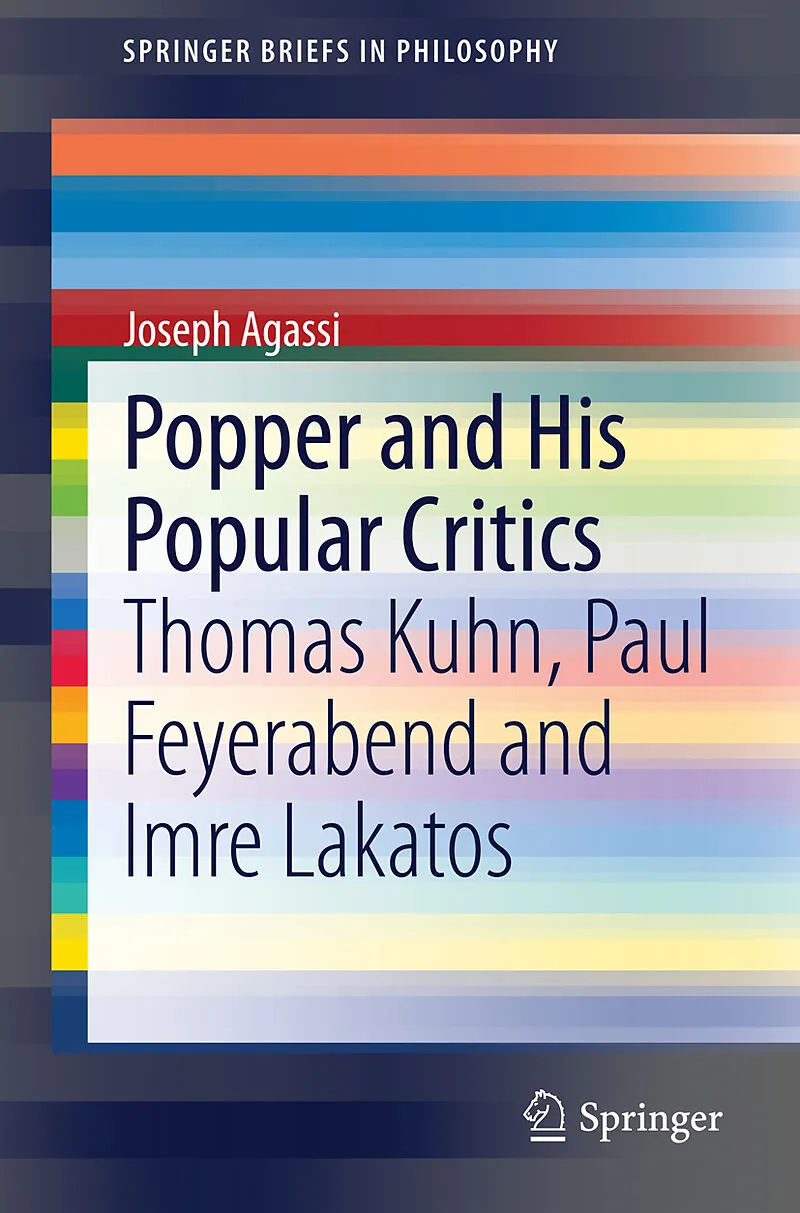
This volume examines Popper's philosophy by analyzing the criticism of his most popular critics: Thomas Kuhn, Paul Feyerabend and Imre Lakatos. They all followed his rejection of the traditional view of science as inductive. Starting from the assumption that ...
This volume examines Popper's philosophy by analyzing the criticism of his most popular critics: Thomas Kuhn, Paul Feyerabend and Imre Lakatos. They all followed his rejection of the traditional view of science as inductive. Starting from the assumption that Hume's criticism of induction is valid, the book explores the central criticism and objections that these three critics have raised. Their objections have met with great success, are significant and deserve paraphrase. One also may consider them reasonable protests against Popper's high standards rather than fundamental criticisms of his philosophy. The book starts out with a preliminary discussion of some central background material and essentials of Popper's philosophy. It ends with nutshell representations of the philosophies of Popper. Kuhn, Feyerabend and Lakatos. The middle section of the book presents the connection between these philosophers and explains what their central ideas consists of, what the critical arguments are, how they presented them, and how valid they are. In the process, the author claims that Popper's popular critics used against him arguments that he had invented (and answered) without saying so. They differ from him mainly in that they demanded of all criticism that it should be constructive: do not stop believing a refuted theory unless there is a better alternative to it. Popper hardly ever discussed belief, delegating its study to psychology proper; he usually discussed only objective knowledge, knowledge that is public and thus open to public scrutiny.
Discusses Popper's recent critics rather than the Wittgenstein-style critics Refutes the critics' exaggerations of Popper's views Is born out of perennial attempts to navigate between dogmatism and relativism Includes supplementary material: sn.pub/extras
Autorentext
Dr. Abraham Meidan,Ph.d., is the Founder and Chief Executive Officer at Hashavshevet Ltd. and at WizSoft Inc. In addition to the this role, Dr. Meidan serves as the Chairman of Targetech Innovation Center. Dr. Meidan also serves as the Chairman of Afeka, Tel-Aviv Academic College of Engineering and a Director of the Tel-Aviv Technological College. As well as this he was formerly the Director of Optiway Ltd. Prior to founding his software companies, Dr. Meidan served as a Lecturer at the Tel Aviv University. Dr. Meidan holds a Ph.D. from the Tel Aviv University and is an expert in logic. Joseph Agassi Ph, d. is an Israeli academic who specializes in logic, scientific method, and philosophy. He studied at the London School of Economics. He has taught at Boston University, the University of Illinois, the University of Hong Kong and the London School of Economics. He is currently professor of Philosophy, Tel-Aviv University, and York University Toronto. He is a fellow of the American Association for the Advancement of Science, Royal Society of Canada, and the World Academy of Art and Science.
Klappentext
This volume examines Popper s philosophy by analyzing the criticism of his most popular critics: Thomas Kuhn, Paul Feyerabend and Imre Lakatos. They all followed his rejection of the traditional view of science as inductive. Starting from the assumption that Hume s criticism of induction is valid, the book explores the central criticism and objections that these three critics have raised. Their objections have met with great success, are significant and deserve paraphrase. One also may consider them reasonable protests against Popper s high standards rather than fundamental criticisms of his philosophy. The book starts out with a preliminary discussion of some central background material and essentials of Popper s philosophy. It ends with nutshell representations of the philosophies of Popper. Kuhn, Feyerabend and Lakatos. The middle section of the book presents the connection between these philosophers and explains what their central ideas consists of, what the critical arguments are, how they presented them, and how valid they are. In the process, the author claims that Popper's popular critics used against him arguments that he had invented (and answered) without saying so. They differ from him mainly in that they demanded of all criticism that it should be constructive: do not stop believing a refuted theory unless there is a better alternative to it. Popper hardly ever discussed belief, delegating its study to psychology proper; he usually discussed only objective knowledge, knowledge that is public and thus open to public scrutiny.
Inhalt
Introduction.- Preface.- Acknowledgement.- A. Prelims.- A1. On Human Rules about God's World A2. In search for Rules.- A3. Rules against Mock-Criticism.- A4. Rules against excessive defensiveness.- A5. Against the Bouncers in the Gates of Science.- A5. Duhem, Quine and Kuhn.- B. Popper and his Popular Critics.- B1. Karl Raimund Popper B2. Kuhn's Way.- B3. Feyerabend's Proposal B4. Imre Lakatos.- B5. A Touch of Malice.- C. In a Nutshell.- C1. The Essential Popper.- C2. Kuhn on Pluralism and Incommensurability.- C3. Paul Feyerabend and Rational Pluralism.- C4. Lakatos on the Methodology of Scientific Research Programs.- C5. Epilogue: Civilization and its Self-Defense.- D. References.- D1. Appendix 1: The Biological Base of Dogmatism.- D2. Appendix 2: Popper on Explanation.- D3. Bibliography.- D4. Index of names.- D5. Index of Subjects.
Tief- preis