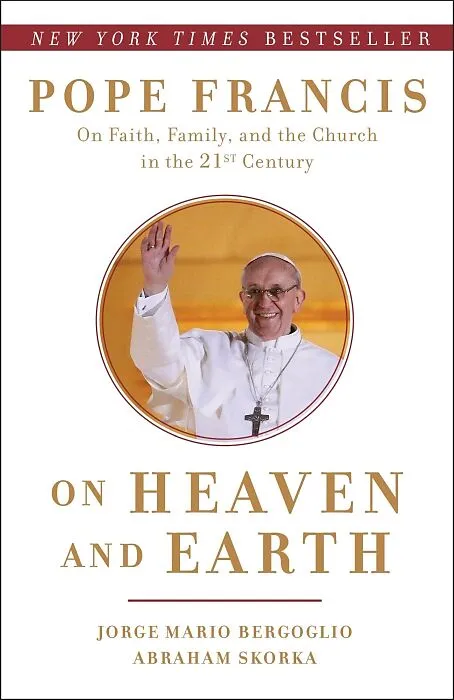
On Heaven and Earth
Beschreibung
Zusatztext This remarkable book wonderfully demonstrates the warm and positive relationship Pope Francis has developed with Jews and Judaism. These honest and respectful exchanges between then-Cardinal Jorge Bergoglio and Argentinian Rabbi Abraham Skorka on a ...Format auswählen
- Kartonierter EinbandCHF 24.30

Wird oft zusammen gekauft
Andere Kunden kauften auch
Beschreibung
Zusatztext This remarkable book wonderfully demonstrates the warm and positive relationship Pope Francis has developed with Jews and Judaism. These honest and respectful exchanges between then-Cardinal Jorge Bergoglio and Argentinian Rabbi Abraham Skorka on a wide range of sensitive and complex topics - God! religion! fundamentalism! politics! and the Holocaust - is a model not only for Jews and Catholics but for all those seeking productive interfaith dialogue in helping to repair a broken world. -- Rabbi Eric J. Greenberg! Director! Department of Interfaith Affairs Anti-Defamation League Whether or not they agree with everything that is said! readers of all religious backgrounds will be impressed by the substance and frankness of these conversations between Cardinal Bergolio and Rabbi Skorka. They clearly enact the call of the Second Vatican Council for "fraternal dialogues" between Catholics and Jews. This is how religious leaders should speak to one another: on the basis of sincere friendship and respect. This book will also encourage anyone who wondered if a pope from a non-European country could be personally committed to the Catholic Church's new relationship with Jews. --Philip A. Cunningham! Ph.D.! Professor of Theology and Director of the Institute for Jewish-Catholic Relations! Saint Joseph's University! Philadelphia Informationen zum Autor JORGE MARIO BERGOGLIO , POPE FRANCIS , is the first Latin American to be elected to the chair of Peter. A native of Buenos Aires, Argentina, he was ordained as a priest in 1969. He served as head of the Society of Jesus in Argentina from 1973 to 1979. In 1998 he became the archbishop of Buenos Aires, and in 2001 a cardinal. Following the resignation of his predecessor, Pope Benedict XVI, February 28, 2013, the conclave elected Bergoglio, who chose the papal name Francis in honor of Saint Francis of Assisi. He is the first pope to be a Jesuit, to come from the Americas, and to come from the Southern Hemisphere. ABRAHAM SKORKA is an Argentine rabbi, biophysicist, and book author. He is rector of the Seminario Rabinico Latinoamericano in Buenos Aires, the rabbi of the Jewish community Benei Tikva, a professor of biblical and rabbinic literature at the Seminario Rabinico Latinoamericano, and honorary professor of Hebrew law at the University of Salamanca. Klappentext New York Times Bestseller! From the man who became Pope Francis, Jorge Mario Bergoglio shares his thoughts on religion, reason, and the challenges the world faces in the 21st century with Abraham Skorka, a rabbi and biophysicist. For years Cardinal Jorge Mario Bergoglio, archbishop of Argentina, and Rabbi Abraham Skorka were tenacious promoters of interreligious dialogues on faith and reason. They both sought to build bridges among Catholicism, Judaism, and the world at large. On Heaven and Earth, originally published in Argentina in 2010, brings together a series of these conversations where both men talked about various theological and worldly issues, including God, fundamentalism, atheism, abortion, homosexuality, euthanasia, same-sex marriage, and globalization. From these personal and accessible talks comes a first-hand view of the man who would become pope to 1.2 billion Catholics around the world in March 2013. 1. ON GOD SKORKA : It has been many years since we first met and a brotherly bond has been forged between us. While studying the books of the Talmud, I found one that says that friendship means sharing meals and spending time together, but in the end it points out that the sign of a real friendship is the ability to reveal what is in one's heart to the other person. That is what happened over time with the two of us. I believe that undoubtedly the most important thing that brought us together was, and still is, G-d, who caused our paths to cross and allowed us to open our hearts to ea...
Autorentext
JORGE MARIO BERGOGLIO, POPE FRANCIS, is the first Latin American to be elected to the chair of Peter. A native of Buenos Aires, Argentina, he was ordained as a priest in 1969. He served as head of the Society of Jesus in Argentina from 1973 to 1979. In 1998 he became the archbishop of Buenos Aires, and in 2001 a cardinal. Following the resignation of his predecessor, Pope Benedict XVI, February 28, 2013, the conclave elected Bergoglio, who chose the papal name Francis in honor of Saint Francis of Assisi. He is the first pope to be a Jesuit, to come from the Americas, and to come from the Southern Hemisphere.
ABRAHAM SKORKA is an Argentine rabbi, biophysicist, and book author. He is rector of the Seminario Rabinico Latinoamericano in Buenos Aires, the rabbi of the Jewish community Benei Tikva, a professor of biblical and rabbinic literature at the Seminario Rabinico Latinoamericano, and honorary professor of Hebrew law at the University of Salamanca.
Klappentext
**New York Times Bestseller!
From the man who became Pope Francis, Jorge Mario Bergoglio shares his thoughts on religion, reason, and the challenges the world faces in the 21st century with Abraham Skorka, a rabbi and biophysicist.
**
For years Cardinal Jorge Mario Bergoglio, archbishop of Argentina, and Rabbi Abraham Skorka were tenacious promoters of interreligious dialogues on faith and reason. They both sought to build bridges among Catholicism, Judaism, and the world at large. On Heaven and Earth, originally published in Argentina in 2010, brings together a series of these conversations where both men talked about various theological and worldly issues, including God, fundamentalism, atheism, abortion, homosexuality, euthanasia, same-sex marriage, and globalization. From these personal and accessible talks comes a first-hand view of the man who would become pope to 1.2 billion Catholics around the world in March 2013.
Leseprobe
1. ON GOD
SKORKA: It has been many years since we first met and a brotherly bond has been forged between us. While studying the books of the Talmud, I found one that says that friendship means sharing meals and spending time together, but in the end it points out that the sign of a real friendship is the ability to reveal what is in one's heart to the other person. That is what happened over time with the two of us. I believe that undoubtedly the most important thing that brought us together was, and still is, G-d, who caused our paths to cross and allowed us to open our hearts to each other. Although we broached many topics during our regular conversations, we never spoke explicitly about G-d. Of course, it was always understood that He was present. It would be good to start this exchange, which we plan to leave as a testimony of our dialogue, by discussing Him who is so important in our lives.
BERGOGLIO: What a great word: *path! *In my personal experience with God I cannot do without the path. I would say that one encounters God walking, moving, seeking Him and allowing oneself to be sought by Him. They are two paths that meet. On one hand, there is our path that seeks Him, driven by that instinct that flows from the heart; and after, when we have encountered each other, we realize that He was the one who had been searching for us from the start. The initial religious experience is that of walking: walk to the land that I am going to give you. It is a promise that God makes to Abraham. In that promise, in this, in this walking, an alliance is established that consolidates over time. Because of this I say that my experience with God takes place along the path, both in the search and in allowing myself to be sought, even if it may be by diverse paths-of pain, of joy, of light, or of darkness.
SKORKA: What you have said reminds me of a few biblical verses. For example, when G-d tells Abraham: "Walk in my presence and be blameless?' Or when the prophet…