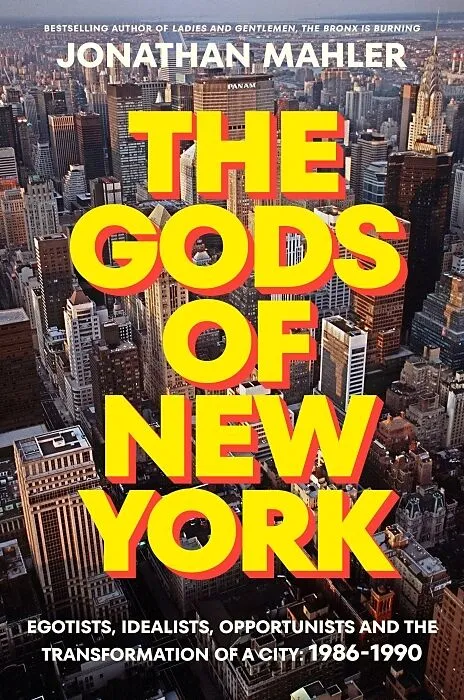
The Gods of New York
Beschreibung
A sweeping chronicle of four years in 1980s New York, a crucible that would transform the city and leave it more divided than ever—a rollicking, real-life <Bonfire of the Vanities< featuring larger-than-life personalities of Donald Trump, Sp...Format auswählen
- Fester EinbandCHF 27.60

Wird oft zusammen gekauft
Andere Kunden kauften auch
Beschreibung
A sweeping chronicle of four years in 1980s New York, a crucible that would transform the city and leave it more divided than ever—a rollicking, real-life <Bonfire of the Vanities< featuring larger-than-life personalities of Donald Trump, Spike Lee, Ed Koch, Al Sharpton, Rudy Giuliani, and countless others
New York City entered 1986 as a city reborn, with record profits on Wall Street sending waves of money splashing across Manhattan and bringing a once-bankrupt, reeling city back to life.
But it also entered 1986 as a city divided. Nearly one-third of the city’s Black and Hispanic residents were living below the federal poverty line. Thousands of New Yorkers were sleeping in the streets—and in many cases addicted to drugs, dying of AIDS, or suffering from mental illness. The manufacturing jobs that had once sustained a thriving middle class had vanished. Long-simmering racial tensions threatened to boil over.
Over the next four years, a singular confluence of events—involving a cast of outsized, unforgettable characters—would widen those divisions into chasms. Ed Koch. Donald Trump. Al Sharpton. The Central Park Five. Spike Lee. Rudy Giuliani. Howard Beach. Tawana Brawley. The Preppy Murder. Jimmy Breslin. <Do the Right Thing<, Wall Street, crack, the AIDS epidemic, and, of course, ready to pour gasoline on every fire—the tabloids. In <The Gods of New York<, Jonathan Mahler tells the story of these convulsive, defining years.
<The Gods of New York <is an exuberant, kaleidoscopic, and deeply immersive portrait of a city in transformation, one whose long-held identity was suddenly up for grabs: Could it be both the great working-class city, lifting up immigrants from around the world <and< the money-soaked capital of global finance? Could it retain a civic culture—a common idea of what it meant to be a New Yorker—when the rich were building a city of their own and vast swaths of its citizens were losing faith in the very systems intended to protect them? New York City was one thing at the dawn of 1986; it would be something very different as 1989 came to a close. This book is the story of how that happened....
Autorentext
Jonathan Mahler is a staff writer for The New York Times Magazine and the author of the bestselling Ladies and Gentlemen, the Bronx Is Burning, which was adapted as an ESPN miniseries, and The Challenge, a New York Times Notable Book. His journalism has received numerous awards and been featured in The Best American Sports Writing. He lives in Brooklyn
Klappentext
NEW YORK TIMES BOOK REVIEW EDITORS’ CHOICE • A sweeping chronicle of four tumultuous years in 1980s New York that changed the city forever—and anticipated the forces that would soon divide the nation—from the bestselling author of Ladies and Gentlemen, the Bronx Is Burning
“A rip-roaring, sweeping, essential work of history . . . a deeply reported and brilliantly observed account of how the modern city was born and why all of us continue to live with the results.”—Jonathan Eig, Pulitzer Prize–winning author of King: A Life
A BEST BOOK OF THE YEAR: The New York Times Book Review, The Economist, The New Yorker, Town & Country
New York entered 1986 as a city reborn. Record profits on Wall Street sent waves of money splashing across Manhattan, bringing a battered city roaring back to life.
But it also entered 1986 as a city whose foundation was beginning to crack. Thousands of New Yorkers were sleeping in the streets, addicted to drugs, dying of AIDS, or suffering from mental illnesses. Nearly one-third of the city’s Black and Hispanic residents were living below the federal poverty line. Long-simmering racial tensions threatened to boil over.
The events of the next four years would split the city open. Howard Beach. Black Monday. Tawana Brawley. The crack epidemic. The birth of ACT UP. The Central Park jogger. The release of Do the Right Thing. And a cast of outsized characters—Ed Koch, Donald Trump, Al Sharpton, Spike Lee, Rudy Giuliani, Larry Kramer—would compete to shape the city’s future while building their own mythologies.
The Gods of New York is a kaleidoscopic and deeply immersive portrait of a city whose identity was suddenly up for grabs: Could it be both the great working-class city that lifted up immigrants from around the world and the money-soaked capital of global finance? Could it retain a civic culture—a common idea of what it meant to be a New Yorker—when the rich were building a city of their own and vast swaths of its citizens were losing faith in the systems meant to protect them? New York City was one thing at the dawn of 1986; it would be something very different as 1989 came to a close. This is the story of how that happened.
Leseprobe
The place is New York, the time is the present, and neither one will ever change. —Paul Auster, Ghosts
At 5:25 in the morning on New Year’s Day, Edward Irving Koch was awakened in his king-sized bed at Gracie Mansion by the knock of a police officer on his door, just as he had been nearly every morning for the past eight years. He did not have a hangover, but he did have a head cold. Still, no runny nose was going to keep him from enjoying the historic day ahead—his historic day. In a matter of hours, he would become the third person in modern history to serve three terms as mayor of New York City. And he’d been reelected in a landslide, with 78 percent of the citywide vote.
Koch’s success was a tribute to him—his wit, work ethic, and unerring political instincts—but also to New York and, really, America. His father, Louis (né Leib), had arrived at Ellis Island in 1909, a Jewish child of peddlers from a dirt-poor hamlet in the Austro-Hungarian Empire. He started as a lowly pants-maker in a Lower East Side sweatshop, even sleeping for a while in the factory, and eventually built a solid middle-class life for his family in a leafy section of the Bronx. His mother, Joyce (née Yetta), was a Jewish immigrant from similarly humble roots who had come to New York in 1912. She also worked in the garment trade before they were married and had their second child, Edward, in 1924.
Koch had benefited from the city’s and country’s largesse, enrolling at the tuition-free City College of New York, in uptown Manhattan, when he was just sixteen before being drafted to serve in World War II in March 1943. Three years and two commendations later, he was back in the city, living with his parents on Ocean Parkway in Brooklyn. Instead of finishing college, he went straight to New York University School of Law, courtesy of the G.I. Bill. At law school, he fell in love with Greenwich Village—its inexpensive restaurants, tree-lined streets, and countercultural ferment. He was no beatnik, but he had progressive ideals. He took up folk guitar and was involved in the Right to Sing Committee, which campaigned against the ban on musicians performing in Washington Square Park. He also fell in love with politics. Koch was now running his own law practice, but at lunchtime during the 1952 and ’56 presidential elections, he could be found atop a soapbox on busy street corners, extolling the virtues of the Democratic candidate, Adlai Stevenson, derided by Republicans as an “egghead.” He soon discovered that he was a natural public speaker—shrill and nasal, but compelling and persuasive.
Koch became active in the local political scene, joining a movement of liberal reformers determined to wrest power away from the city’s entrenched Democr…