
IHR WARENKORB IST AKTUELL LEER.
Haben Sie noch nichts passendes gefunden? Stöbern Sie durch unser komplettes Sortiment.
Oder melden Sie sich an bzw. registrieren Sie sich.
- Kostenlose Lieferung
- Kauf auf Rechnung
- Ex Libris Tiefpreis
- Filiallieferung und 650+ Abholorte
- Rabatt-Bons als Club-Mitglied
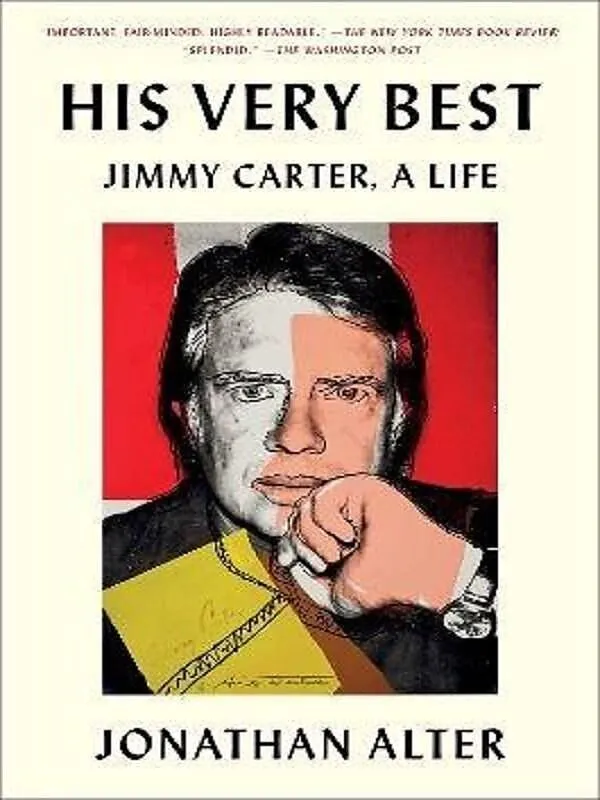
His Very Best
Beschreibung
From one of America's most respected journalists and modern historians comes the highly acclaimed, "splendid" (The Washington Post) biography of Jimmy Carter, the thirty-ninth president of the United States and Nobel Prize-winning humanitarian.Jonathan Alter t...Format auswählen
- BroschiertCHF 25.10

Wird oft zusammen gekauft
Andere Kunden kauften auch
Beschreibung
From one of America's most respected journalists and modern historians comes the highly acclaimed, "splendid" (The Washington Post) biography of Jimmy Carter, the thirty-ninth president of the United States and Nobel Prize-winning humanitarian.Jonathan Alter tells the epic story of an enigmatic man of faith and his improbable journey from barefoot boy to global icon. Alter paints an intimate and surprising portrait of the only president since Thomas Jefferson who can fairly be called a Renaissance Man, a complex figure-ridiculed and later revered-with a piercing intelligence, prickly intensity, and biting wit beneath the patented smile. Here is a moral exemplar for our times, a flawed but underrated president of decency and vision who was committed to telling the truth to the American people.Growing up in one of the meanest counties in the Jim Crow South, Carter is the only American president who essentially lived in three centuries: his early life on the farm in the 1920s without electricity or running water might as well have been in the nineteenth; his presidency put him at the center of major events in the twentieth; and his efforts on conflict resolution and global health set him on the cutting edge of the challenges of the twenty-first."One of the best in a celebrated genre of presidential biography," (The Washington Post), His Very Best traces how Carter evolved from a timid, bookish child-raised mostly by a Black woman farmhand-into an ambitious naval nuclear engineer writing passionate, never-before-published love letters from sea to his wife and full partner, Rosalynn; a peanut farmer and civic leader whose guilt over staying silent during the civil rights movement and not confronting the white terrorism around him helped power his quest for racial justice at home and abroad; an obscure, born-again governor whose brilliant 1976 campaign demolished the racist wing of the Democratic Party and took him from zero percent to the presidency; a stubborn outsider who failed politically amid the bad economy of the 1970s and the seizure of American hostages in Iran but succeeded in engineering peace between Israel and Egypt, amassing a historic environmental record, moving the government from tokenism to diversity, setting a new global standard for human rights and normalizing relations with China among other unheralded and far-sighted achievements. After leaving office, Carter eradicated diseases, built houses for the poor, and taught Sunday school into his mid-nineties.This "important, fair-minded, highly readable contribution" (The New York Times Book Review) will change our understanding of perhaps the most misunderstood president in American history....
Autorentext
Jonathan Alter is an award-winning historian, columnist, and documentary filmmaker. An MSNBC political analyst and former senior editor at Newsweek, he is the author of three New York Times bestsellers: The Center Holds: Obama and His Enemies; The Promise: President Obama, Year One; and The Defining Moment: FDR's Hundred Days and the Triumph of Hope.
Klappentext
From one of America’s most respected journalists and modern historians comes the highly acclaimed, biography of Jimmy Carter, the thirty-ninth president of the United States and Nobel Prize–winning humanitarian.
Leseprobe
Prologue PROLOGUE
JUNE 1979
It was just hours before the first day of summer, and the sunny weather in Washington, DC, was perfect for a leisurely drive in the country. But June 20, 1979, was the wrong day for Wednesday golf or a picnic at Bull Run. That week, more than half of the nation’s gas stations were running out of gas.
The morning’s Washington Post reported that local authorities were inundated with requests for carpools from angry motorists who couldn’t get to work, yet a small collection of harried reporters and dignitaries managed to find transportation to the White House. There the beleaguered president of the United States was preparing yet another announcement that would lead to eye rolling in the press corps and make little news. The only thing that stood out then about this seemingly minor event was its unusual location: the West Wing roof.
The spring and summer gas shortages marked the worst of a depressing 1979, a year that would later see the seizure of American hostages in Iran and the Soviet invasion of Afghanistan. “Gas stations closed up like someone died,” John Updike wrote in his novel Rabbit Is Rich. For a generation bonded to cars the way the next would be to smartphones, this was traumatic. Millions of Americans missed work, canceled vacations, and pointed fingers. Public opinion surveys in June 1979 showed Carter’s approval ratings in the Gallup poll plummeting to 28 percent, the lowest of his presidency and comparable to Richard Nixon’s when he resigned five years earlier. Vice President Walter Mondale later cracked that the Carter White House had gone to the dogs—and become “the nation’s fire hydrant.”
As usual, the president had few options. A month later, he would offer new, ambitious energy goals as part of his infamous “malaise” speech (though he never used the word), in which Carter delivered a jeremiad against empty materialism. But events all year were largely out of his control, wreaking havoc on the American economy. First came a decision by the Organization of Petroleum Exporting Countries (OPEC) to jack up global oil prices by 14.5 percent virtually overnight—an effort to exploit strikes in Iranian oil fields against the teetering shah of Iran. After the shah fled into exile and was replaced in February by the radical Islamic fundamentalist Ayatollah Khomeini, Iranian oil exports to the United States ceased altogether. Over the next eighteen months, oil prices doubled to nearly $40 a barrel. This represented an astonishing thirteenfold increase in a decade. “Energy is our Vietnam,” a White House aide told Newsweek.
By the following year, inflation—driven in large part by energy prices—would pass 12 percent, with unemployment over 7 percent for a combined “misery index” of nearly 20 percent. Yet harder to imagine in the twenty-first century was that interest rates in 1980 hit an eye-popping 19 percent. Even if everything else had gone right for Jimmy Carter in 1979 and 1980—which it most definitely did not—that was a gale-force economic wind blowing in his face as he sought reelection against former California governor Ronald Reagan.
For two years, a clean-energy pioneer named George Szego had been lobbying the Carter White House to take a look at something he’d cobbled together at his little manufacturing company in Warrenton, Virginia. Szego, an engineer who had fought in the Battle of the Bulge, was hard to ignore. After some hesitation, Carter—himself an engineer—handwrote a reference to this emerging technology into a 1978 speech. Now, a year later, he was making good on his pledge to install it.
At one thirty on June 20, the president climbed an inner staircase to the roof of the West Wing, known as the West Terrace, where he emerged into the bright sunlight for an energy announcement that had nothing directly to do with gas lines. “I’ve arranged for this ceremony to be illuminated by solar power,” Carter joked, as the audience squinted into the sun. He proposed $1 billion in federal funding for solar research, a $100 million “solar bank” offering credits to home owners who installed primitive solar units, and a goal of 20 percent of the nation’s energy coming from renewable sources by the year 2000—just one part of his effort to prepare the United States for a greener future.
The event was meant to publicize an energ…