
IHR WARENKORB IST AKTUELL LEER.
Haben Sie noch nichts passendes gefunden? Stöbern Sie durch unser komplettes Sortiment.
Oder melden Sie sich an bzw. registrieren Sie sich.
- Kostenlose Lieferung
- Kauf auf Rechnung
- Ex Libris Tiefpreis
- Filiallieferung und 650+ Abholorte
- Rabatt-Bons als Club-Mitglied
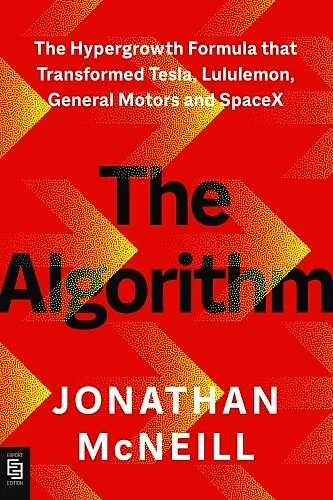
The Algorithm
Beschreibung
From a former President of Tesla comes Jonathan McNeill had already founded and sold six startups when Sheryl Sandberg introduced him to Elon Musk, who was looking for help at Tesla. McNeill was steeped in the lean principles that had made Toyota a global powe...Format auswählen
- Kartonierter EinbandCHF 20.00
- Livre ReliéCHF 26.85

Wird oft zusammen gekauft
Andere Kunden kauften auch
Beschreibung
From a former President of Tesla comes Jonathan McNeill had already founded and sold six startups when Sheryl Sandberg introduced him to Elon Musk, who was looking for help at Tesla. McNeill was steeped in the lean principles that had made Toyota a global powerhouse--principles focused on achieving efficiency and optimization by incrementally improving existing systems and processes. What he learned from Elon at Tesla was its antithesis, an approach that required radical rethinking to explode the status quo, attack complexity, and set seemingly unrealistic goals. Elon called this five-step framework “The Algorithm.”; In this book, McNeill details this tremendously powerful set of tools, which brought Tesla from a production crisis that threatened to derail it to a period of hypergrowth. During his tenure, revenue boomed from $2B to $20B in just 30 months. Since his departure from Tesla, McNeill has used The Algorithm in every enterprise he has worked with to supercharge speed, efficiency, innovation, and growth. Featuring case studies from Tesla and SpaceX, as well as from Lululemon, GM, and companies of various sizes across industries, he reveals how any business can do the same and achieve the unimaginable.
Autorentext
Jon McNeill
Klappentext
From a former President of Tesla comes The Algorithm—the first book written by any of Elon Musk’s direct reports—a transformative guide for leaders, entrepreneurs, and innovators who want to emulate the paradigm-shattering approach Musk used to launch Tesla and SpaceX to meteoric success.
Jonathan McNeill had already founded and sold six startups when Sheryl Sandberg introduced him to Elon Musk, who was looking for help at Tesla. McNeill was steeped in the lean principles that had made Toyota a global powerhouse—principles focused on achieving efficiency and optimization by incrementally improving existing systems and processes. What he learned from Elon at Tesla was its antithesis, an approach that required radical rethinking to explode the status quo, attack complexity, and set seemingly unrealistic goals. Elon called this five-step framework “The Algorithm.”
- Question every requirement.
- Delete every possible step in the process.
- Simplify and optimize.
- Accelerate cycle time.
- Automate. In this book, McNeill details this tremendously powerful set of tools, which brought Tesla from a production crisis that threatened to derail it to a period of hypergrowth. During his tenure, revenue boomed from $2B to $20B in just 30 months. Since his departure from Tesla, McNeill has used The Algorithm in every enterprise he has worked with to supercharge speed, efficiency, innovation, and growth. Featuring case studies from Tesla and SpaceX, as well as from Lululemon, GM, and companies of various sizes across industries, he reveals how any business can do the same and achieve the unimaginable.
Leseprobe
Chapter One
Step 1
Question Every Requirement
To be the world's leading automaker, Tesla needed China, both to make cars and to sell them. This was no mystery. China was already the biggest auto market in the world. And with its powerful supply chains and skilled workers, we had no doubt that a Tesla factory in China would quickly become our most efficient auto plant. Strategically, a Chinese factory was essential.
But there was one problem. The Chinese demanded equity participation in foreign-owned plants. Global manufacturers were eager enough for a foothold in the Chinese market that they readily accepted the condition. General Motors, Microsoft, Airbus, and Volkswagen, among many others, had joint ventures in China. If Tesla built a plant, it seemed that Elon would have to make room for a government-sanctioned partner.
Elon didn't want any part of it. He sent me to Beijing in 2015 with instructions to negotiate a 100 percent Tesla-owned manufacturing plant in China.
He was following the first step of the Algorithm, which is to question every requirement. Rules and regulations can be changed or, in some cases, defied. Each rule, as Elon saw it, limits possibilities, hobbling innovation and boxing in growth. Although in some cases, Elon's zeal in this area can blind him to the value of certain regulations, it never hurts to question them.
When you have a large organization, things that started out as good ideas can become rules, and then those rules can become requirements. So when constrained by rules, we investigate. With a bit of digging, we'd find that what appeared at first to be requirements often turned out to be recommendations, customs, or conventions. Laws had to be obeyed (especially the laws of physics), but not all requirements were laws, and not all of them came from governments. Some of them came from suppliers, telling us what we could and couldn't do with a piece of equipment. But when we drilled down, those instructions were often just what an engineer at that company simply viewed as reasonable, or a best practice. It was not a hard-and-fast rule.
Sometimes, one of our engineers would insist that a new approach was dangerous. Of course we took this seriously-but questioned it at the same time. Were the engineers right? Did they have data to back up their claim?
A corporate culture expands its possibilities if it looks at every "no" as a potential "yes." This can lead to all kinds of breakthroughs, both big and small.
Elon trusted that we'd find a way around the Chinese edict concerning foreign ownership. It was a rule that gave the Chinese government more control. Importantly, it also gave the government rights to the revenue derived from its ownership. But Tesla needed all the cash flow from that market to survive against much larger and better-funded competitors.
From Elon's point of view, there was no reason that Chinese officials couldn't make an exception. My assignment was to find a way for them to make a big one.
Upon landing in Beijing, I met with my colleagues there. Robin Ren, a Shanghai native who went to the University of Pennsylvania with Elon, headed Tesla's operations in China. Tom Zhu, an engineer, ran Tesla's retail business in the country. And Grace Tao, formerly a news anchor in the country, ran government relations. This was an incredible team. They knew the language and the culture, they had critical relationships, and they laid out for me the Chinese government's priorities. The government wanted job growth above all. We could promise lots of jobs. We also had to know what the Chinese were hungry for. The government's recently unveiled five-year plan seemed custom-made for Tesla. It called for development in our core specialties: electric vehicles, batteries, and clean energy. We headed into negotiations with a powerful hand.
I flew over for about a week every month. There were many negotiations in offices, as well as over meals and copious drinks into the night. The process took fourteen months, but we finally won the go-ahead for the first 100 percent foreign-owned auto plant in China. (We retained all of the financial ownership, although the Chinese people, as stipulated by the 1949 Communist Revolution, retained formal ownership of the land the plant would be built on.)
We achieved what no other Western company was able to do-not Apple, not GM, not Ford, not Procter and Gamble. The Tesla China entity would be able to control its own cash flow, without profit sharing, and help to fund the electric vehicle revolution globally.
Zhu oversaw the building of our mammoth plant, Gigafactory Shanghai. The first Model 3s started rolling off its lines in late 2019 (just after I had left the company).
The success in China seemed to prove Elon's point that even with the most firmly established norms, there can be exceptions.
The laws of physics, he'll admit, a…