Beschreibung
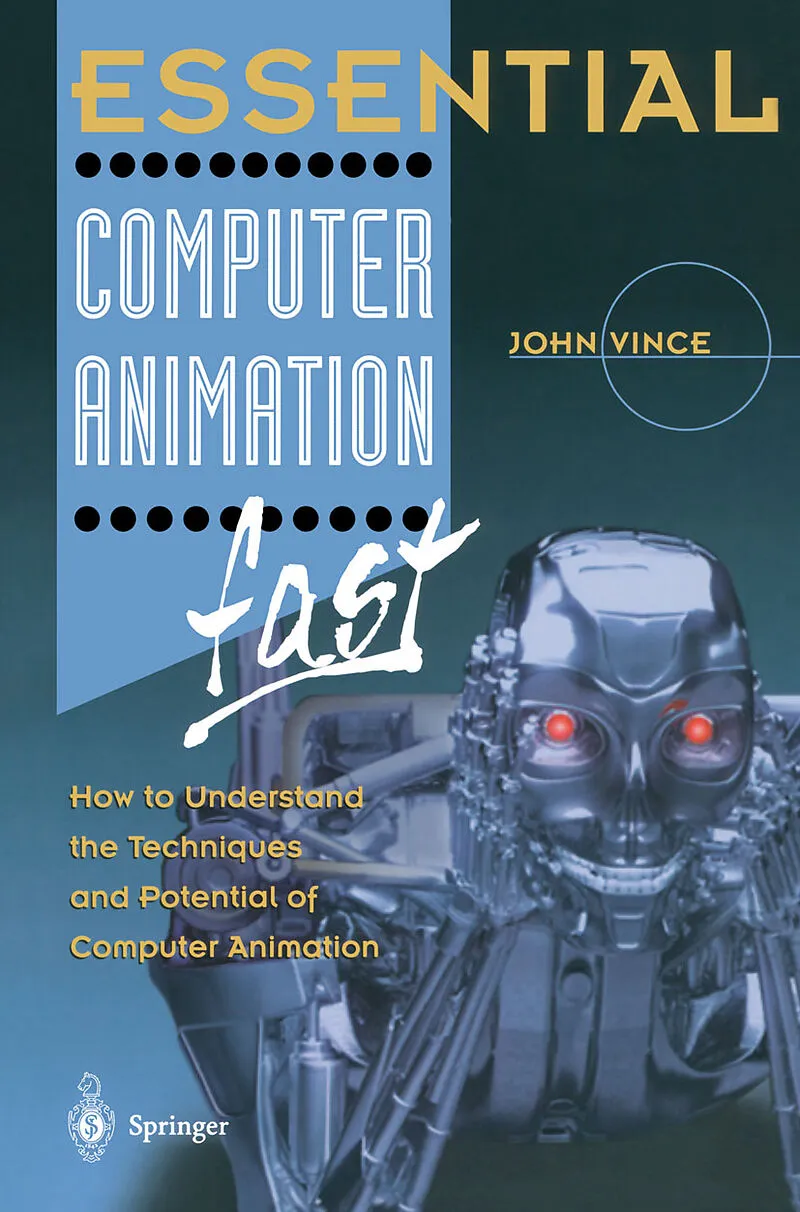
Computer Animation is now worlds away from its early beginnings when programs merely mimicked the hand drawn cartoon process. Its now regularly used for creating wonderful special effects in major movies like Titanic, Toy Story, Antz and Bugs Life. John Vince ...Computer Animation is now worlds away from its early beginnings when programs merely mimicked the hand drawn cartoon process. Its now regularly used for creating wonderful special effects in major movies like Titanic, Toy Story, Antz and Bugs Life.
John Vince tells you all about: The basic principles used in the powerful software products currently available on the market; The terms and processes involved; And in an easy-to-understand way, with no complicated math.
So if you want to learn more about 3D computer animation without being swamped by complex mathematics, then read this book and have fun creating your own animated programs.
Written by the same author as the successful "Essential Virtual Reality fast" Contains 16 pages colour section and extensive monochrome illustrations Provides the novice with a state-of-the-art introduction to computer animation
Autorentext
Professor John Vince began working in computer graphics at Middlesex Polytechnic in 1968. His research activities centered on computer animation software and resulted in the PICASO and PRISM animation systems. Whilst at Middlesex, he designed the UK's first MSc course in Computer Graphics and developed a popular program of short courses in computer animation for television designers. In 1986 he joined Rediffusion Simulation as a Research Consultant and worked on the development of real-time computer systems for commercial flight simulators. In 1992 he was appointed Chief Scientist of Thomson Training Simulation Ltd. In 1995 he was appointed Professor of Digital Media at the National Centre for Computer Animation at Bournemouth University and in 1999 he was made Head of Academic Group for Computer Animation. He was awarded a DSc by Brunel University in recognition of his work in computer graphics. He has written and edited over 45 books on computer graphics, computer animation, computer science and virtual reality, including the following Springer titles: Calculus for Computer Graphics, 2nd edition (2019) Mathematics for Computer Graphics, 5th edition (2017) Imaginary Mathematics for Computer Science, (2018) Foundation Mathematics for Computer Science, 2nd edition (2015) Matrix Transforms for Computer Games and Animation (2012) Expanding the Frontiers of Visual Analytics and Visualization (2012) Quaternions for Computer Graphics (2011) Rotation Transforms for Computer Graphics (2011) Geometric Algebra: An Algebraic System for Computer Animation and Games (2009) Geometric Algebra for Computer Graphics (2008)
Inhalt
1 What is Computer Animation?.- What is computer animation?.- Who should read this book?.- The aims and objectives of this book.- Assumptions made in this book.- How to use the book.- 2 Computer Animation.- Animation and computers.- The history of animation.- Animation and the human visual system.- Computer animation.- 3 3D Computer Graphics.- From computer graphics to computer animation.- Principles of computer graphics.- Cartesian coordinates.- Modeling simple objects.- Modeling curves.- Surface patches.- Procedural modeling.- Laser scanners.- Perspective view.- 3D clipping.- Coordinate systems.- Transformations.- Rendering the image.- Color.- Colored objects.- Light sources.- Illumination models.- Shading models.- Rendering algorithms.- Texture mapping.- Bump mapping.- Environment mapping.- Displacement mapping.- Shadows.- Transparency.- Radiosity.- Ray tracing.- Volumetric lighting.- Shaders.- The RenderMan Shading Language.- Aliasing.- Anti-aliasing.- Conclusion.- 4 Computer Animation Techniques.- Interpolation.- Function curves.- Parameters.- Channels.- Keyframes.- Inbetweening.- Motion paths.- Transformations.- Hierarchical animation.- Hierarchical geometry.- Metamorphosis.- Procedural animation.- Forward kinematics.- Inverse kinematics.- Particle systems.- Physical simulation.- Rotoscoping.- Constraints.- Free-form deformation.- Skeletons.- Conclusion.- 5 Computer Animation Hardware.- Computers.- Motion capture.- Conclusion.- 6 Computer Animation Software.- A generic computer animation system.- Conclusion.- 7 Post-Production Techniques.- Digital images.- Image compositing.- Rendering and compositing.- Interactive and batch processing.- Conclusion.- 8 Computer Animation Applications.- Television graphics.- Computer games.- Commercials.- Multimedia.- Legal.- Computer-aided design.- Virtual environments.- The Internet.- Simulation.- Digital special effects.- Computer-generated films.- Conclusion.- 9 Computer Animation Jobs.- Modeler.- Artist.- Compositor.- Character animator.- Enveloper.- Technical director.- Conclusion.- 10 Animating.- Weight, mass and inertia.- Center of gravity.- Kinetic energy and momentum.- Bouncing and restitution.- Character animation.- Facial animation.- Conclusion.- 11 Conclusion.- Appendix A Useful Web Sites.- Animation software.- Compositing.- Conferences.- Conversion tools.- Digitizing hardware.- Facial animation.- Magazines.- Motion capture.- Plug-ins.- Programming.- Useful companies.- Time-Slice Web sites.- Other Useful Sites.- Appendix B A Renderman Shader.- Appendix C Motion Capture Hardware.- References.