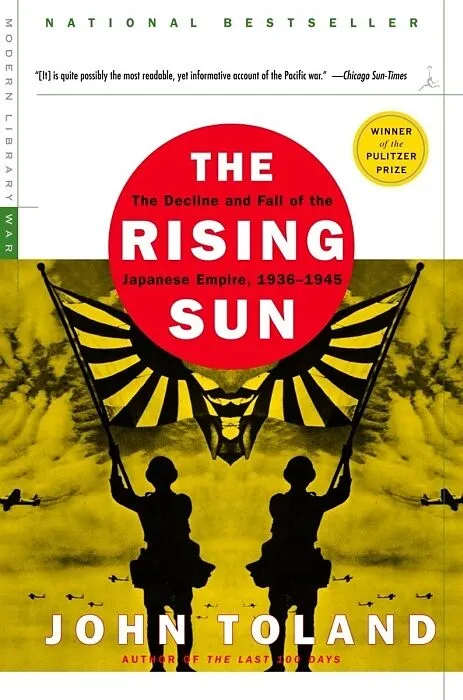
The Rising Sun
Beschreibung
Informationen zum Autor John Toland was one of the most widely read military historians of the twentieth century. His many books include The Last 100 Days; Ships in the Sky; Battle: The Story of the Bulge; But Not in Shame; Adolf Hitler; and No Man's Land . Or...Format auswählen
- Kartonierter EinbandCHF 39.10

Wird oft zusammen gekauft
Andere Kunden kauften auch
Beschreibung
Informationen zum Autor John Toland was one of the most widely read military historians of the twentieth century. His many books include The Last 100 Days; Ships in the Sky; Battle: The Story of the Bulge; But Not in Shame; Adolf Hitler; and No Man's Land . Originally from Wisconsin, he lived in Connecticut for many years with his wife. Klappentext "[The Rising Sun] is quite possibly the most readable, yet informative account of the Pacific war."-Chicago Sun-Times This Pulitzer Prize-winning history of World War II chronicles the dramatic rise and fall of the Japanese empire, from the invasion of Manchuria and China to the atomic bombing of Hiroshima and Nagasaki. Told from the Japanese perspective, The Rising Sun is, in the author's words, "a factual saga of people caught up in the flood of the most overwhelming war of mankind, told as it happened-muddled, ennobling, disgraceful, frustrating, full of paradox." In weaving together the historical facts and human drama leading up to and culminating in the war in the Pacific, Toland crafts a riveting and unbiased narrative history. In his Foreword, Toland says that if we are to draw any conclusion from The Rising Sun, it is "that there are no simple lessons in history, that it is human nature that repeats itself, not history." "Unbelievably rich . . . readable and exciting . . .The best parts of [Toland's] book are not the battle scenes but the intimate view he gives of the highest reaches of Tokyo politics."-Newsweek Leseprobe Gekokujo 1. The sky over Tokyo on the afternoon of February 25, 1936, was dark and foreboding. A thick blanket of snow already covered the city and there was threat of more to come. Three nights earlier more than a foot had fallen, breaking a record of fifty-four years, and causing such a traffic snarl that some theaters had to be turned into temporary hotels for audiences unable to get home. Even under its white cloak of snow, Tokyo looked almost as Western as Oriental. Japan had left much of its feudal past behind to become by far the most progressive, westernized nation of Asia. A few hundred yards from the Imperial Palace with its traditional tile roof was a modern four-story concrete building, the Imperial Household Ministry, where all court business was conducted and the Emperor's offices were located. Just outside the ancient stone walls and moat surrounding the spacious Palace grounds was the same mélange of East and West: a long line of modern structures, including the Imperial Theater and the Dai Ichi Building, as Occidental as the skyline of Chicago, while a few blocks away, in narrow cobblestone streets, were row upon row of geisha houses, sushi stands and kimono stores, and assorted little ramshackle shops, gay even on that cloudy day with their flapping doorway curtains and colorful lanterns. Next to the Palace on a small hill was the not quite completed Diet Building, constructed mainly of stone from Okinawa and looking quasi-Egyptian. Behind this commanding edifice was a cluster of spacious houses, the official residence of government leaders. The largest was that of the Prime Minister. It was two buildings in one, the business part Western in the early Frank Lloyd Wright style, the living quarters Japanese with paper-thin walls, tatami floors and sliding doors. But beneath the peaceful exterior of Tokyo seethed an unrest which would soon spill violently into the snow-covered streets. At one end of the Palace grounds were the barracks of the 1st (Gem) Division. Here authorities were already prepared for trouble after a tip about a military insurrection from a major in the War Ministry: he had learned from a young officer that a group of radicals planned to assassinate several advisers to the Emperor that day. Suspects had been put under surveillance, and important public figures were given emergency b...
Klappentext
"[The Rising Sun] is quite possibly the most readable, yet informative account of the Pacific war."-Chicago Sun-Times
This Pulitzer Prize-winning history of World War II chronicles the dramatic rise and fall of the Japanese empire, from the invasion of Manchuria and China to the atomic bombing of Hiroshima and Nagasaki. Told from the Japanese perspective, The Rising Sun is, in the author's words, "a factual saga of people caught up in the flood of the most overwhelming war of mankind, told as it happened-muddled, ennobling, disgraceful, frustrating, full of paradox."
In weaving together the historical facts and human drama leading up to and culminating in the war in the Pacific, Toland crafts a riveting and unbiased narrative history. In his Foreword, Toland says that if we are to draw any conclusion from The Rising Sun, it is "that there are no simple lessons in history, that it is human nature that repeats itself, not history."
"Unbelievably rich . . . readable and exciting . . .The best parts of [Toland's] book are not the battle scenes but the intimate view he gives of the highest reaches of Tokyo politics."-Newsweek
Zusammenfassung
“[The Rising Sun] is quite possibly the most readable, yet informative account of the Pacific war.”—Chicago Sun-Times
This Pulitzer Prize–winning history of World War II chronicles the dramatic rise and fall of the Japanese empire, from the invasion of Manchuria and China to the atomic bombing of Hiroshima and Nagasaki. Told from the Japanese perspective, The Rising Sun is, in the author’s words, “a factual saga of people caught up in the flood of the most overwhelming war of mankind, told as it happened—muddled, ennobling, disgraceful, frustrating, full of paradox.”
In weaving together the historical facts and human drama leading up to and culminating in the war in the Pacific, Toland crafts a riveting and unbiased narrative history. In his Foreword, Toland says that if we are to draw any conclusion from The Rising Sun, it is “that there are no simple lessons in history, that it is human nature that repeats itself, not history.”
“Unbelievably rich . . . readable and exciting . . .The best parts of [Toland’s] book are not the battle scenes but the intimate view he gives of the highest reaches of Tokyo politics.”—Newsweek
Leseprobe
Gekokujo
1.
The sky over Tokyo on the afternoon of February 25, 1936, was dark and foreboding. A thick blanket of snow already covered the city and there was threat of more to come. Three nights earlier more than a foot had fallen, breaking a record of fifty-four years, and causing such a traffic snarl that some theaters had to be turned into temporary hotels for audiences unable to get home.
Even under its white cloak of snow, Tokyo looked almost as Western as Oriental. Japan had left much of its feudal past behind to become by far the most progressive, westernized nation of Asia. A few hundred yards from the Imperial Palace with its traditional tile roof was a modern four-story concrete building, the Imperial Household Ministry, where all court business was conducted and the Emperor’s offices were located. Just outside the ancient stone walls and moat surrounding the spacious Palace grounds was the same mélange of East and West: a long line of modern structures, including the Imperial Theater and the Dai Ichi Building, as Occidental as the skyline of Chicago, while a few blocks away, in narrow cobblestone streets, were row upon row of geisha houses, sushi stands and kimono stores, and assorted little ramshackle shops, gay even on that cloudy day with their flapping doorway curtains and colorful lanterns.
Next to the Palace on a small hill was the not quite completed Diet Building, constructed mainly of stone from Okinawa and looking quasi-Egyptian. Behind this commanding edifice was a cluster of spacious houses, the official residence of government leade…