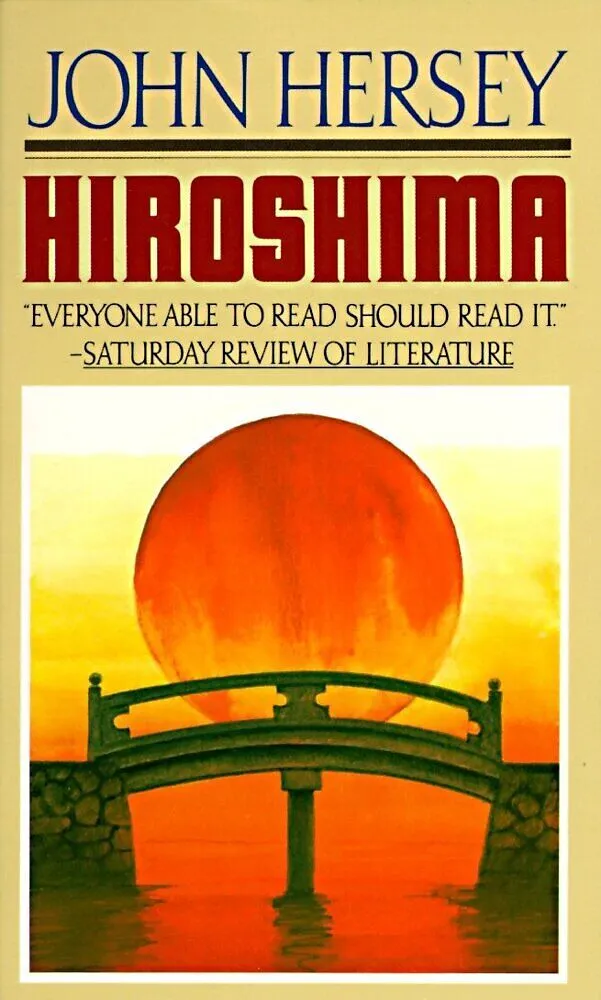
Hiroshima
Beschreibung
Zusatztext Nothing can be said about this book that can equal what the book has to say. It speaks for itself! and in an unforgettable way! for humanity. The New York Times One of the great classics of the war. The New Republic Everyone able to read should read...Format auswählen
- Poche format ACHF 14.10
- Kartonierter Einband (Kt)CHF 17.00

Wird oft zusammen gekauft
Andere Kunden kauften auch
Beschreibung
Zusatztext Nothing can be said about this book that can equal what the book has to say. It speaks for itself! and in an unforgettable way! for humanity. The New York Times One of the great classics of the war. The New Republic Everyone able to read should read it. Saturday Review of Literature Informationen zum Autor JOHN HERSEY was born in Tientsin, China, in 1914 and lived there until 1925, when his family returned to the United States. He studied at Yale and Cambridge, served for a time as Sinclair Lewis's secretary, and then worked several years as a journalist. Beginning in 1947 he devoted his time mainly to writing fiction. He won the Pulitzer Prize, taught for two decades at Yale, and was president of the Authors League of America and Chancellor of the American Academy of Arts and Letters. John Hersey died in 1993. Klappentext On August 6, 1945, Hiroshima was destroyed by the first atom bomb ever dropped on a city. This book, John Hersey's journalistic masterpiece, tells what happened on that day. Told through the memories of survivors, this timeless, powerful and compassionate document has become a classic "that stirs the conscience of humanity" (The New York Times). Almost four decades after the original publication of this celebrated book, John Hersey went back to Hiroshima in search of the people whose stories he had told. His account of what he discovered about them is now the eloquent and moving final chapter of Hiroshima. Zusammenfassung Pulitzer Prize-winning journalist and bestselling author John Hersey's seminal work of narrative nonfiction which has defined the way we think about nuclear warfare. One of the great classics of the war" ( The New Republic ) that tells what happened in Hiroshima during World War II through the memories of the survivors of the first atomic bomb ever dropped on a city. "The perspective [ Hiroshima ] offers from the bomb's actual victims is the mandatory counterpart to any Oppenheimer viewing." GQ Magazine Nothing can be said about this book that can equal what the book has to say. It speaks for itself, and in an unforgettable way, for humanity. The New York Times Hiroshima is the story of six human beings who lived through the greatest single manmade disaster in history. John Hersey tells what these six -- a clerk, a widowed seamstress, a physician, a Methodist minister, a young surgeon, and a German Catholic priest -- were doing at 8:15 a.m. on August 6, 1945, when Hiroshima was destroyed by the first atomic bomb ever dropped on a city. Then he follows the course of their lives hour by hour, day by day. The New Yorker of August 31, 1946, devoted all its space to this story. The immediate repercussions were vast: newspapers here and abroad reprinted it; during evening half-hours it was read over the network of the American Broadcasting Company; leading editorials were devoted to it in uncounted newspapers. Almost four decades after the original publication of this celebrated book John Hersey went back to Hiroshima in search of the people whose stories he had told. His account of what he discovered about them -- the variety of ways in which they responded to the past and went on with their lives -- is now the eloquent and moving final chapter of Hiroshima....
Autorentext
JOHN HERSEY was born in Tientsin, China, in 1914 and lived there until 1925, when his family returned to the United States. He studied at Yale and Cambridge, served for a time as Sinclair Lewis’s secretary, and then worked several years as a journalist. Beginning in 1947 he devoted his time mainly to writing fiction. He won the Pulitzer Prize, taught for two decades at Yale, and was president of the Authors League of America and Chancellor of the American Academy of Arts and Letters. John Hersey died in 1993.
Klappentext
On August 6, 1945, Hiroshima was destroyed by the first atom bomb ever dropped on a city. This book, John Hersey's journalistic masterpiece, tells what happened on that day. Told through the memories of survivors, this timeless, powerful and compassionate document has become a classic "that stirs the conscience of humanity" (The New York Times).
Almost four decades after the original publication of this celebrated book, John Hersey went back to Hiroshima in search of the people whose stories he had told. His account of what he discovered about them is now the eloquent and moving final chapter of Hiroshima.
Zusammenfassung
**Pulitzer Prize-winning journalist and bestselling author John Hersey's seminal work of narrative nonfiction which has defined the way we think about nuclear warfare. “One of the great classics of the war" (The New Republic) that tells what happened in Hiroshima during World War II through the memories of the survivors of the first atomic bomb ever dropped on a city.
"The perspective [Hiroshima] offers from the bomb’s actual victims is the mandatory counterpart to any Oppenheimer viewing." —GQ Magazine
“Nothing can be said about this book that can equal what the book has to say. It speaks for itself, and in an unforgettable way, for humanity.” —The New York Times**
Hiroshima is the story of six human beings who lived through the greatest single manmade disaster in history. John Hersey tells what these six -- a clerk, a widowed seamstress, a physician, a Methodist minister, a young surgeon, and a German Catholic priest -- were doing at 8:15 a.m. on August 6, 1945, when Hiroshima was destroyed by the first atomic bomb ever dropped on a city. Then he follows the course of their lives hour by hour, day by day.
The New Yorker of August 31, 1946, devoted all its space to this story. The immediate repercussions were vast: newspapers here and abroad reprinted it; during evening half-hours it was read over the network of the American Broadcasting Company; leading editorials were devoted to it in uncounted newspapers.
Almost four decades after the original publication of this celebrated book John Hersey went back to Hiroshima in search of the people whose stories he had told. His account of what he discovered about them -- the variety of ways in which they responded to the past and went on with their lives -- is now the eloquent and moving final chapter of Hiroshima.
Leseprobe
ONE
A Noiseless Flash
At exactly fifteen minutes past eight in the morning, on August 6, 1945, Japanese time, at the moment when the atomic bomb flashed above Hiroshima, Miss Toshiko Sasaki, a clerk in the personnel department of the East Asia Tin Works, had just sat down at her place in the plant office and was turning her head to speak to the girl at the next desk. At that same moment, Dr. Masakazu Fujii was settling down cross-legged to read the Osaka Asahi on the porch of his private hospital, overhanging one of the seven deltaic rivers which divide Hiroshima; Mrs. Hatsuyo Nakamura, a tailor s widow, stood by the window of her kitchen, watching a neighbor tearing down his house because it lay in the path of an air-raid-defense fire lane; Father Wilhelm Kleinsorge, a German priest of the Society of Jesus, reclined in his underwear on a cot on the top floor of his order s three-story mission house, reading a Jesuit magazine, Stimmen der Zeit; Dr. Terufumi Sasaki, a young member of the surgical staff of the city s large, modern Red Cross Hospital, walked along one of the hospital corridors with a blood specimen for a Wassermann test in his hand; and the Reverend Mr. Kiyoshi Tanimoto, pastor of the Hiroshima Methodist Church, paused at the door of a rich man s house in Koi, the city s western suburb, and prepared to unload a handcart full of things he had evacuated from town in fear of the massive B-29 raid which everyone expected Hiroshima to suffer. A hundred thousand people were killed by the atomic bomb, and these six were among the survivors. They still wonde…