
IHR WARENKORB IST AKTUELL LEER.
Haben Sie noch nichts passendes gefunden? Stöbern Sie durch unser komplettes Sortiment.
Oder melden Sie sich an bzw. registrieren Sie sich.
- Kostenlose Lieferung
- Kauf auf Rechnung
- Ex Libris Tiefpreis
- Filiallieferung und 650+ Abholorte
- Rabatt-Bons als Club-Mitglied
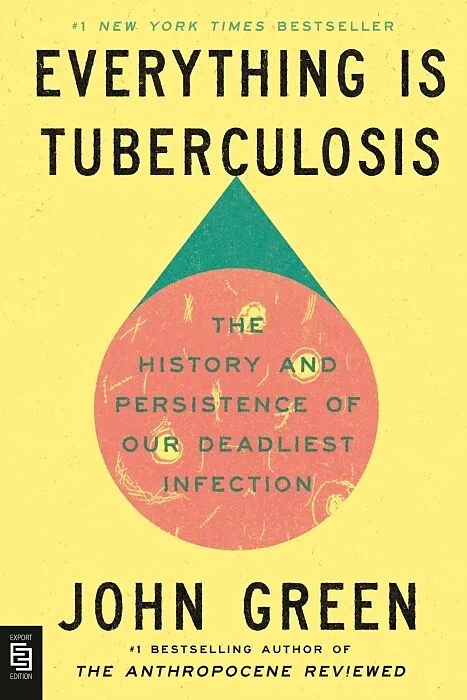
Everything Is Tuberculosis
Beschreibung
Instant #1 John Green, acclaimed author and passionate advocate for global healthcare reform, tells a deeply human story illuminating the fight against the world’s deadliest infectious disease. Tuberculosis has been entwined with humanity for millen...Format auswählen
- Kartonierter EinbandCHF 17.00
- Fester EinbandCHF 29.50
- Kartonierter EinbandCHF 31.60

Wird oft zusammen gekauft
Andere Kunden kauften auch
Beschreibung
Instant #1 John Green, acclaimed author and passionate advocate for global healthcare reform, tells a deeply human story illuminating the fight against the world’s deadliest infectious disease. Tuberculosis has been entwined with humanity for millennia. Once romanticized as a malady of poets, today tuberculosis is seen as a disease of poverty that walks the trails of injustice and inequity we blazed for it. In 2019, author John Green met Henry Reider, a young tuberculosis patient at Lakka Government Hospital in Sierra Leone. John became fast friends with Henry, a boy with spindly legs and a big, goofy smile. In the years since that first visit to Lakka, Green has become a vocal advocate for increased access to treatment and wider awareness of the healthcare inequities that allow this curable, preventable infectious disease to also be the deadliest, killing over a million people every year. In <Everything Is Tuberculosis<, John tells Henry’s story, woven through with the scientific and social histories of how tuberculosis has shaped our world--and how our choices will shape the future of tuberculosis.
Autorentext
John Green is the award-winning, #1 bestselling author of Looking for Alaska, An Abundance of Katherines, Paper Towns, Will Grayson, Will Grayson (with David Levithan), and The Fault in Our Stars. His many accolades include the Printz Medal, a Printz Honor, and the Edgar Award. He has twice been a finalist for the LA Times Book Prize. John was selected by TIME magazine as one of the 100 Most Influential People in the World. With his brother, Hank, John is one half of the Vlogbrothers (youtube.com/vlogbrothers), one of the most popular online video projects in the world. You can join the millions who follow John on Twitter (@johngreen) and tumblr (fishingboatproceeds.tumblr.com) or visit him online at johngreenbooks.com.
John lives with his family in Indianapolis, Indiana.
Klappentext
**#1 New York Times bestseller • #1 Washington Post bestseller • #1 Indie Bestseller • USA Today Bestseller
John Green, award-winning author and passionate advocate for global healthcare reform, tells a deeply human story illuminating the fight against the world’s deadliest infectious disease.**
AN ACCLAIMED BEST BOOK OF 2025: NPR, Scientific American, Science News, Booklist, BookPage, Chicago Sun-Times. Goodreads Readers’ Choice Nonfiction Winner.
Tuberculosis has been entwined with humanity for millennia. Once romanticized as a malady of poets, today tuberculosis is seen as a disease of poverty that walks the trails of injustice and inequity we blazed for it.
In 2019, author John Green met Henry Reider, a young tuberculosis patient at Lakka Government Hospital in Sierra Leone. John became fast friends with Henry, a boy with spindly legs and a big, goofy smile. In the years since that first visit to Lakka, Green has become a vocal advocate for increased access to treatment and wider awareness of the healthcare inequities that allow this curable, preventable infectious disease to also be the deadliest, killing over a million people every year.
In Everything Is Tuberculosis, John tells Henry’s story, woven through with the scientific and social histories of how tuberculosis has shaped our world—and how our choices will shape the future of tuberculosis.
Leseprobe
INTRODUCTION: Gregory and Stokes
Around the turn of the nineteenth century, the Scottish tinkerer and chemist James Watt began working on a new project.
He had already achieved fame and success for making steam engines more efficient, helping to fuel the industrial revolution that would radically reshape human history. The steam engine would lead to everything from air-conditioning to air travel to AirPods, while also unleashing over a trillion tons of carbon dioxide into the atmosphere, reshaping the planet s climate. Watt s innovation carried within it so much power that we named a measurement of power after him. Watt also made other important contributions to the human collection of tools and knowledge, inventing a machine that could copy sculptures and developing new strategies for manufacturing chlorine to bleach textiles.
But Watt hoped this new project would be his most important yet. He became obsessed with finding some kind of chemical solution to treat the lung disease known to physicians as phthisis.
Watt s daughter Jessy had died of phthisis at the age of fifteen in 1794. And now his son, Gregory, was ill with the disease, suffering from the classic symptoms of a persistent cough, night sweats, fever, and the physical wasting of the body that gave the disease its colloquial name: consumption. Gregory was in his early twenties, a skilled orator known for being phenomenally attractive one friend described him as literally the most beautiful youth I ever saw.
In a furious attempt to save Gregory, Watt helped invent a device that delivered nitrous oxide to the lungs, believing that shifting the amount of oxygen available to the body might help it heal. But the treatment proved unsuccessful. After many years of suffering, Gregory died of consumption in 1804 at the age of twenty-seven.
By 1900, phthisis had come to be known by a new name: tuberculosis. My great-uncle Stokes Goodrich was born that year in rural Tennessee. He was raised in a wood-frame house built by my great-grandfather Charles, a country doctor who rode his horse night and day around Franklin County delivering babies and dispensing medicine.
Stokes was a sickly child. In those days and in these ones, too, I suppose it was common to connect illness to some kind of deficiency, failure, or past mistake. A physician might conclude, as one German doctor did in the early eighteenth century, that a woman s life-threatening illness was brought on by a dog which barked loudly at her. For baby Stokes, being given coffee and sweets by a family friend was thought to be the inciting incident. Thereafter, Stokes developed the worst case of typhoid fever I ever saw recover, my great-grandfather later reported in a short memoir he wrote for our family.
In 1918, when Stokes was eighteen, he again nearly died during the Great Influenza pandemic when he became ill while working at a munitions factory. He survived, and in 1920 went to work for Alabama Power and Light, laboring as a lineman. As the 1920s progressed, Stokes experienced frequent bouts of what he hoped might be bronchitis. But the stubborn cough would not go away, and eventually, after coughing up blood, he sought medical attention.
Here is how my great-grandfather reported what happened next: Stokes went to see a fine doctor in Gadsden, Alabama, who X-rayed him and discovered tuberculosis in the apex of his right lung. The X-ray technician who made the film told me, Dr. Goodrich, your son has miliary tuberculosis, and I have never seen a case that lived over two months.
Stokes was placed in a sanatorium in Asheville, North Carolina, one of many American cities that functioned as a tuberculosis colony of sorts. Stokes had the best of care in the sanatorium but steadily grew worse, and on May 18, 1930, pa