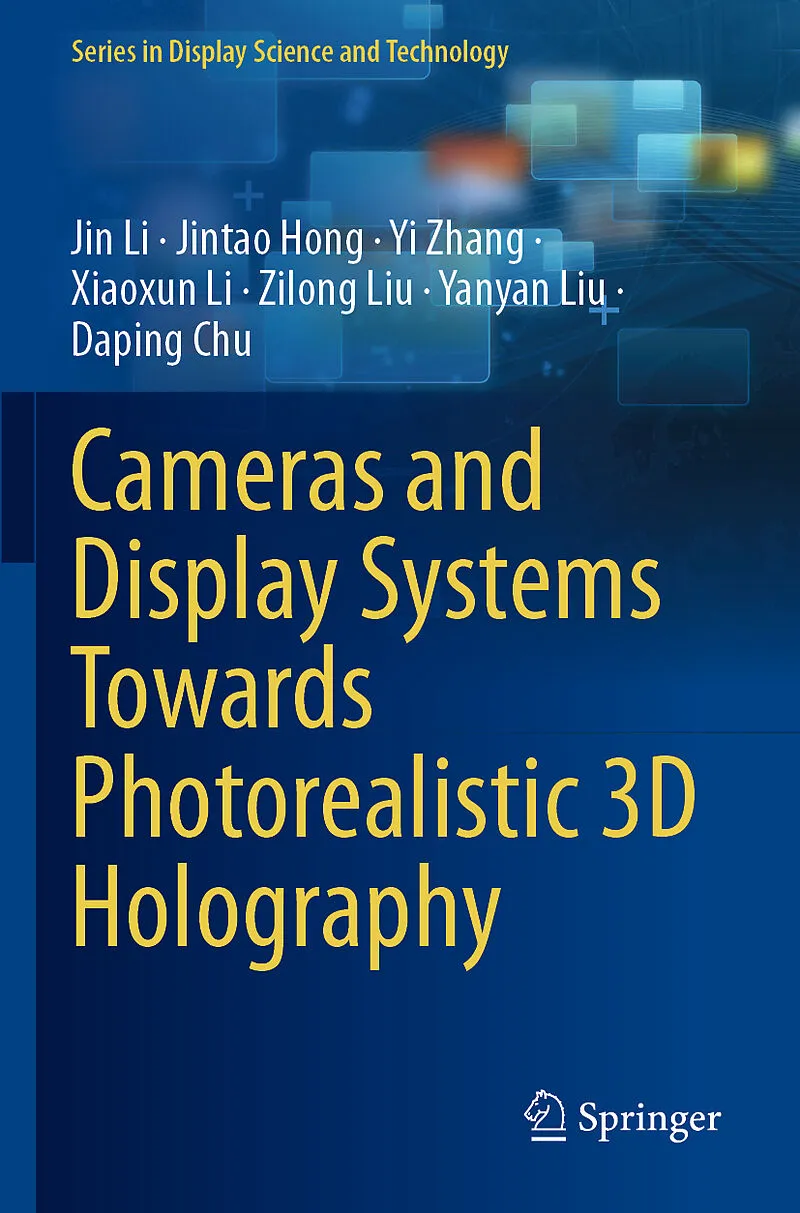
Cameras and Display Systems Towards Photorealistic 3D Holography
Beschreibung
This book presents recent advances in three-dimensional (3D) imaging and display frameworks, encompassing three categories of 3D imaging and display technologies. The first category is nonphotorealistic 3D approaches based on conventional optical cameras to im...Format auswählen
- Kartonierter EinbandCHF 96.10
- Fester EinbandCHF 126.35
- E-Book (pdf)CHF 100.90

Wird oft zusammen gekauft
Andere Kunden kauften auch
Beschreibung
This book presents recent advances in three-dimensional (3D) imaging and display frameworks, encompassing three categories of 3D imaging and display technologies. The first category is nonphotorealistic 3D approaches based on conventional optical cameras to implement 3D stereoscopic observation of a scene. In the context of nonphotorealistic 3D imaging and reconstruction systems, the authors introduce general principles and also demonstrate camera calibration for 3D imaging, smart cameras, and full-link imaging methods using the optical modulation transfer function to improve imaging quality in conventional cameras. The second category is based on light-ray light field technology to achieve photorealistic 3D imaging and displays. In the context of light-ray light field systems, two approaches capable of light-ray light field 3D imaging by utilizing a camera array or a lens array are demonstrated. Accordingly, light-ray light field display approaches comprising head-mounted displays and integral displays are also introduced. The third category is also photorealistic 3D imaging and display technology, which is based on holography (i.e., diffraction or wavefront light field). In the corresponding holographic displays, the authors introduce 3D holographic displays from three elements: algorithms, devices, and systems, involving fast hologram generation algorithms, wide-viewing-angle display systems, and metasurface holography, etc. Including an investigative roadmap for future progress in optical imaging and 3D display systems, this book is essential reading for scientists and engineers in academia and industry who are interested in next-generation imaging and display concepts for 3D visual sensing systems.
Reviews the basics and presents new developments in 3D holographic imaging and displays Includes applications, case studies and emerging research directions. Discusses wider associated technologies such as simulation, devices and interface electronics
Autorentext
Jin Li is currently a professor and the vice dean of the Institute of Artificial Intelligence and Blockchain, Guangzhou University. He received his B.S. (2002) and M.S. (2004) from Southwest University and Sun Yat-sen University, both in Mathematics. He got his Ph.D. degree in information security from Sun Yat-sen University at 2007. His research interests include design of secure protocols in artificial intelligence, cloud computing (secure cloud storage and outsourcing computation), and cryptographic protocols. He served as a senior research associate at Korea Advanced Institute of Technology (Korea) and Illinois Institute of Technology (USA) from 2008 to 2010, respectively. He has published more than 100 papers in international conferences and journals, including IEEE INFOCOM, IEEE TIFS, IEEE TPDS, IEEE TOC, and ESORICS, etc. His work has been cited more than 11000 times at Google Scholar and the H-Index is 40. He served as an associate editor for several international journals, including IEEE Transactions on Dependable and Secure Computing, Information Sciences. He also served as the program chairs in the committee for many international conferences such as CSS 2019, ICA3PP 2018, CSE 2017, IEEE EUC 2017, and ISICA 2015. He received several National Science Foundation of China (NSFC) Grants, including NSFC Outstanding Youth Foundation. Ping Li was born in May 1985 in Baojing Country of Hunan Province. She received her Ph.D. in School of Mathematics at Sun Yat-Sen University in June 2016 (Supervisor Prof. Zheng-An Yao) and joined the Guangzhou University as a postdoctoral fellow from July 2016 to December 2018 (Co-Supervisor Prof. Jin Li . Currently, she works at South China Normal University (Youth Talent). Her research fields are applied cryptography, cloud computing security, and privacy-preserving machine learning. Her current research direction contains cryptographic technologies, storage security and computation security in cloudcomputing, machine learning in securely outsourced computation, etc. She has published or accepted 20 academic papers, including 14 SCI papers and two ESI highly cited papers. She is undertaking the Youth Project of National Natural Science Foundation of China. Zheli Liu received the B.Sc. and M.Sc. degrees in computer science from Jilin University, China, in 2002 and 2005, respectively. He received the Ph.D. degree in computer application from Jilin University in 2009. After a postdoctoral fellowship in Nankai University, he joined the College of Cyber Science of Nankai University in 2011. Currently, he works at Nankai University as an associate professor. His current research interests include applied cryptography and data privacy protection. Xiaofeng Chen received his B.S. and M.S. in Mathematics from Northwest University, China, in 1998 and 2000, respectively. He got his Ph.D. degree in Cryptography from Xidian University in 2003. Currently, he works at Xidian University as a professor. His research interests include applied cryptography and cloud computing security. He has published over 100 research papers in refereed international conferences and journals. His work has been cited more than 4000 times at Google Scholar. He is in the Editorial Board of IEEE Transactions on Dependable and Secure Computing (IEEE TDSC), Security and Communication Networks (SCN), and Computing and Informatics (CAI), etc. He has served as the program/general chair or program committee member in over 30 international conferences. Tong Li received his B.S. and M.S. from Taiyuan University of Technology and Beijing University of Technology, in 2011 and 2014, respectively, both in Computer Science & Technology. He got his Ph.D. degree in information security from Nankai University at 2017. After a postdoctoral fellowship in Guangzhou University, he currently is an associate professor in Nankai University. His research interests include applied cryptography
Inhalt
Chapter 1. Introduction.- Chapter 2. 3D stereoscopic observations and reconstructions using conventional cameras.- Chapter 3. Light-ray-based light field cameras and displays.- Chapter 4. Holography and 3D hologram displays.- Chapter 5. Computer-generated holography.- Chapter 6. Wide-viewing angle holographic display systems.- Chapter 7. Coarse Integral hologram displays.- Chapter 8. Metasurface Holography.- Chapter 9. Summary and Future directions.