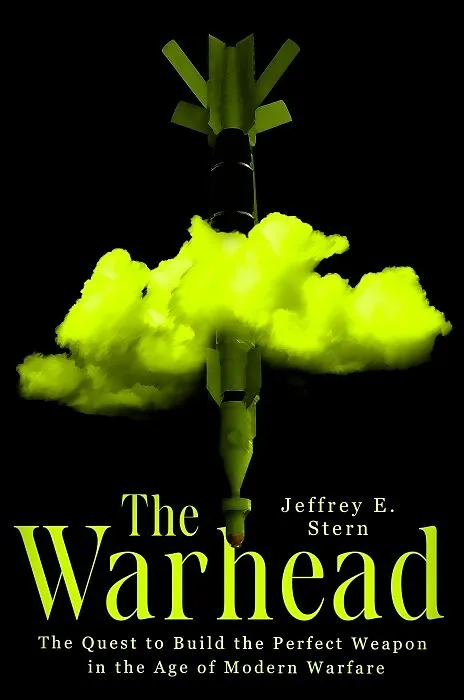
The Warhead
Beschreibung
From award-winning journalist and coauthor of Paveway, the first "smart" bomb, was created to be a more precise and ostensibly humane weapon, reducing civilian casualties. The true impact of the bomb, however, is ever more complex and unpredictable. In At once...Format auswählen
- Fester EinbandCHF 38.80

Wird oft zusammen gekauft
Andere Kunden kauften auch
Beschreibung
From award-winning journalist and coauthor of Paveway, the first "smart" bomb, was created to be a more precise and ostensibly humane weapon, reducing civilian casualties. The true impact of the bomb, however, is ever more complex and unpredictable. In At once revelatory and deeply human, <The Warhead< unearths the complicated truth behind one of the most significant weapons of our time.
Autorentext
Jeffrey E. Stern is an award-winning journalist and the author of five books, including The 15:17 to Paris, which was adapted as a major motion picture by Clint Eastwood and Warner Brothers, and The Last Thousand: One School’s Promise in a Nation at War, an honorable mention for Best Book of the Year by Library Journal. He has been named a graduate fellow at the Stanford Center on International Conflict and Negotiation and a grantee of the Pulitzer Center on Crisis Reporting. Stern’s reporting has appeared in magazines such as The New York Times Magazine, Vanity Fair, and The Atlantic.
Klappentext
**An Apple Best Book of the Month
From award-winning journalist and coauthor of The 15:17 to Paris, an affecting human history of the first self-steering bomb**
Paveway, the first "smart" bomb, was created to be a more precise and ostensibly humane weapon, reducing civilian casualties. The true impact of the bomb, however, is ever more complex and unpredictable.
In The Warhead, Jeffrey Stern tells the story of Paveway through the lives of seven interconnected stories. They're stories of Nazis, Kennedys, Operation Paperclip, and Walt Disney; of the Apollo mission and the space shuttle Challenger disaster. Paveway inadvertently sparked the personal computing revolution and the adoption of GPS, it ushered in the era of modern warfare, and it shows up at critical historical moments throughout the last half century.
At once revelatory and deeply human, The Warhead unearths the complicated truth behind one of the most significant weapons of our time.
Leseprobe
CAUTION: This email originated from outside of Penguin Random House. Please be extra cautious when opening file attachments or clicking on links.
Twenty-three years later
Somewhere over North Vietnam
Lieutenant Colonel Richard Hilton rockets through the sky at close to the speed of sound, five miles above enemy territory. His plane bobs in its formation. A small ship at sea, vortices of wind across the skin nudging the airframe up a little, down a little, a little over. He's at .88 Mach, a good speed, a good, smart speed, he thinks, not cooking through fuel but fast enough to fight if the enemy jets engage.
Which they almost certainly will.
Rick Hilton is a savant in the cockpit. Fused to the machine and sealed off from emotion, capable of rapid calculation at speed. He processes extraordinary amounts of information almost instantaneously. Pull up, bank, engage afterburners, he turns data to decisions and decisions to action in the time it takes for a ripple of electricity to flash across his brain.
He's at home up here. All he ever wanted to do was be in the sky, ever since he was a mouthy kid in Oklahoma on a Sunday drive and caught the sun glinting off a dinky old crop duster flying alongside the family sedan. A four-year-old Rick Hilton blurting out to scandalized parents, look at that sum' bitch go! Then, after his parents' marriage blew up, a stint being passed from home to home and idle time spent at the local airstrip waxing single-engine props for the chance to ride in them, then teenage years getting into the air however he could, even when it just meant finding a ramp to ride a heavy old Harley off of and get away from terra firma for a breath or two.
Now he's up in the thin air, in a real live war. Up above the matted clouds because a supply line snakes through the countryside right below and the enemy's protecting it with everything they have. Destroy that supply line and save Americans. Leave it intact and the enemy keeps feeding a beast chewing through the kids not lucky enough to do Vietnam the way he's doing it-the kids without 20/15 eyesight and the sealed-off kind of mind for math at altitude Hilton has.
The supply line is the problem, but as far as Hilton's concerned, the whole war might as well be about one especially brutal section of it, a 540-foot span of steel and rebar known as the Dragon's Jaw. The only railroad in the panhandle crosses that bridge. It's the only way the enemy can get supplies across the Sông Mã River, so the enemy has it defended better than any target in the country, which right now means it's defended better than just about any target in the world. Hilton's seen just about every kind of mission launched against that bridge, and they've barely dented it.
If Hilton survives this mission, it'll be the Dragon's Jaw that all the officers and pilots and even the Thai laborers back at base who wander across the tarmac to find work will talk about. They've lost friends over it. Enough failed missions, enough planes shot through and lost in the area around the Dragon's Jaw, that whole mythologies have risen up around it: that the bridge is the stitch that holds the universe together; that it's a link between two dimensions; that it doesn't exist on the terrestrial plane at all. A trick of the light-some kind of hologram drawing pilots in like mosquitoes to porch lamps.
For Hilton, it's only by dumb luck that, for all the deadly flying he's done over the supply line, he hasn't yet been tapped for a mission against the Dragon. But he knows. That luck won't last forever. If he survives today, tomorrow it'll be the Dragon, and without an effective weapon against small targets in dangerous airspace he's no more likely than all the pilots who've gone before to make it out alive.
Okaloosa County, Florida
Air Proving Ground Center
Eglin Air Force Base
"Detachment 5"
To Weldon Word, a blue-eyed thirty-four-year-old engineer, the problem was obvious. And almost instantly, he began to see how he might solve it.
Just called up by his employer, Texas Instruments, from a dead-end post off the coast of Rhode Island-a year and a half sitting on ships scraping up miles of sensor data for a sonar program theoretically useful to someone but so monotonous and incremental it was hard to feel any kind of impact-Weldon had been waiting for an escape, primed to dive into a problem with real stakes, when he got the call from TI dispatching him down to Florida for an important new project just now coming into focus.
Across from him an overenergized colonel paused a monologue about the dangers facing American pilots, pulled a file from a desk drawer, and slid it across the table to Weldon: an aerial reconnaissance shot in black-and-white. An important bridge, the colonel explained, over in Vietnam.
To Weldon, it looked like a bridge on the moon. From bombs, the colonel said-all bombs that missed the target, and this didn't even account for all the bombs that missed into the water. Weldon counted: ten, twenty, one hundred, two hundred . . . there had to be eight hundred craters near the bridge and, from the looks of it, almost no damage at all to the bridge itself.
Weldon looked up from the photo and trained his blue eyes on the colonel, already back at top speed, holding forth on his desire to provide the boys flying in Vietnam with a new kind of weapon, one that would at least give them a chance to land a few blows against this damned bridge before they got themselves shot out of the sky.
The colonel shifted to his wish list and began rattling off specifications.
The new weapon would have to be effective enough that pilots wouldn't need to linger in dangerous airspace for long or return to it again and again-a weapon that could help do away with massive "alpha" strikes …