Beschreibung
This book provides a comprehensive exploration of permutation flowshop group scheduling, focusing on sequence-dependent setup times (SDST) to minimize makespan and total completion time. Grounded in Group Technology philosophy, it bridges the gap between theo...
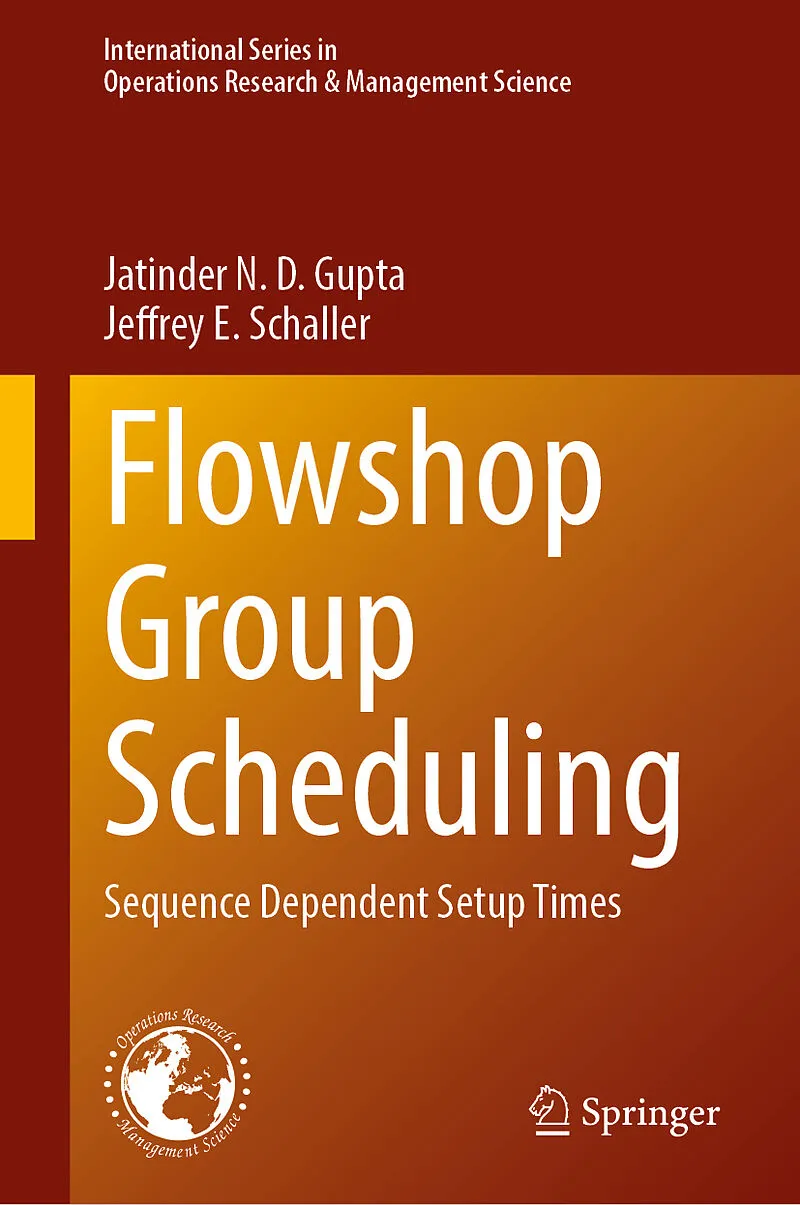
This book provides a comprehensive exploration of permutation flowshop group scheduling, focusing on sequence-dependent setup times (SDST) to minimize makespan and total completion time. Grounded in Group Technology philosophy, it bridges the gap between theoretical rigor and industrial practice, synthesizing over fifty years of research.
The text covers foundational scheduling concepts, computational complexity, and the formal classification of the Flowshop Group Scheduling Problem. It details exact and heuristic solution methodologies, including Mixed-Integer Linear Programming, sophisticated lower-bounding techniques, constructive heuristics, and metaheuristics like Tabu Search and Genetic Algorithms. Innovations include using inserted machine idle times to minimize makespan under SDST constraints.
Unique features include consideration of carryover setups, which are critical in electronics manufacturing, such as Printed Circuit Board assembly. Applications extend beyond manufacturing to service sectors like healthcare and cloud processing. Concluding with the "AI Revolution," the book recommends Deep Reinforcement Learning for real-time decision-making.
This book is designed as a definitive reference for students, researchers, and software developers, as well as professionals and consultants seeking a higher-level understanding of shop floor control and intelligent systems innovation.
Provides a single source to learn about the state-of-the-art solution procedures and algorithms Introduces practical methods to solve real-life problems in different industries Includes ideas and fruitful directions for future research
Autorentext
Jatinder N. D. Gupta is an Emeritus Professor and Eminent Scholar in Management of Technology, Information Systems, Industrial and Systems Engineering, and Engineering Management, and the former Director of Integrated Enterprise Lab at the University of Alabama in Huntsville, Alabama, USA. He has published extensively in international journals, including Production and Operations Management, Journal of Management Information Systems, International Journal of Information Management, AIIE Transactions, Operations Research, Annals of Operations Research, and Mathematics of Operations Research . Recipient of the outstanding teaching, faculty, researcher, service, and lifetime distinguished educator awards, he is the author and editor of several books. In addition to his academic career, Dr. Gupta has served in industry and government and has acted as a consultant to several of these organizations, bridging the gap between academic research and practical applications. Dr. Gupta has held elected and appointed positions in several professional societies, including serving as the President of the Production and Operations Management Society (POMS) and the President of the Decision Sciences Institute (DSI). He is a Fellow of POMS and DSI.
Jeffrey E. Schaller is an Emeritus Professor of Operations Management at Eastern Connecticut State University, USA. He held various Operations Management positions with the Singer Company, Becton Dickinson Company, and Cooper Industries. He has published articles in the Annals of Operations Research, International Journal of Production Research, European Journal of Operational Research, Computers and Industrial Engineering, Target Magazine, and The Journal of Enterprise Resource Management . Dr. Schaller is a member of the Decision Science Institute, INFORMS, ASCM, and AME.
Inhalt
Introduction and Scope.- Fundamentals of Scheduling Theory.- The Flowshop Group Scheduling Problem.- Models and Lower Bounds.- Constructive Heuristics to Minimize Makespan.- Local Search and Metaheuristics for Minimizing Makespan.- Total Completion Time Minimization.- Total Completion Time Minimization with Carryover Sequence Dependent Setups.- Summary, Related Problems, and Future Research Directions.