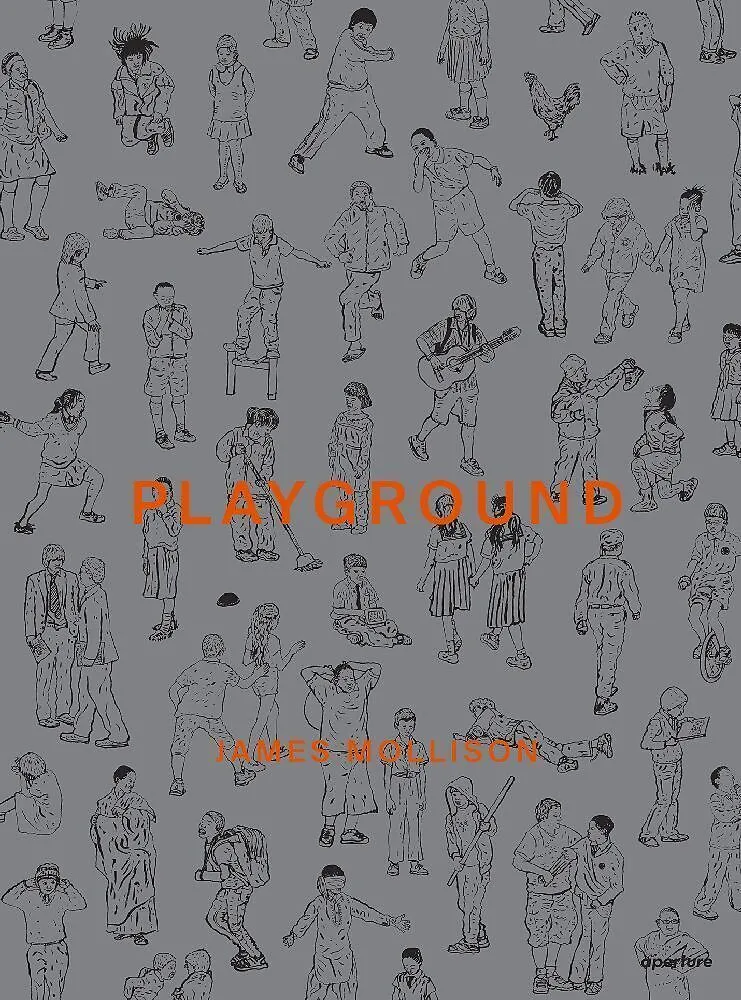
Playground
Beschreibung
James Mollison's photo projects are defined by smart, original concepts applied to serious social and environmental themes. For his latest book, Playground, Mollison photographs children at play in their school playgrounds, inspired by memories of his own...Format auswählen
- Fester EinbandCHF 42.85

Wird oft zusammen gekauft
Andere Kunden kauften auch
Beschreibung
James Mollison's photo projects are defined by smart, original concepts applied to serious social and environmental themes. For his latest book, Playground, Mollison photographs children at play in their school playgrounds, inspired by memories of his own childhood and interested in how we all learn to negotiate relationships and our place in the world through play. For each picture, Mollison sets up his camera during school break time, making multiple frames and then composing each final photograph from several scenes, in which he finds revealing "play" narratives. With photographs from rich and poor schools, in countries including Argentina, Bhutan, Bolivia, India, Israel, Italy, Japan, Kenya, Nepal, Norway, Sierra Leone, the United Kingdom, and the U.S., Mollison also provides access for readers of all ages to issues of global diversity and inequality.
The photos recall the scenes of fun, embarrassment, relaxation, disappointment and anxiety that plague the playground for a growing brain. Although, in retrospect, the notion of playtime tends to acquire a rose-colored glow, Mollison reminds us of the intensity and calamity that often occurred between classes. The photographer set up his camera during school breaks, capturing multiple frames and then collapsing them into a single composite image, in which a constructed play narrative is created. –Huffington Post
The images are stunning in their color and size, and use socio-economic, cultural and political elements as backdrops. – Wired
His images capture the similarities of youthful play across social boundaries and national borders, but also the deep divides of class and privilege that are often put in place long before we're old enough to understand their implications. – Hyperallergic
While on assignment, Mollison expanded the project to include schools in Kenya and eventually trekked around the world, photographing playgrounds in more than a dozen countries. He found an incredible diversity in the schools but, also, a universality in the children's play—particularly with boys. –Metropolis Magazine
Autorentext
James Mollison was born in Kenya. His photographs have been featured widely in such publications as Colors, the New York Times Magazine, and Paris Review. He has also published several books, among them James and Other Apes (2004), The Disciples (2008), and Where Children Sleep (2010).
Jon Ronson is an award-winning writer and documentary maker. He is the author of many bestselling books, including The Men Who Stare at Goats (2005). He also cowrote the screenplay for the film Frank (2014).
Klappentext
From Jane Goodall's Introduction:
'In 1859 Darwin shocked much of the world with his theory of evolution. Most people now accept the idea that we have evolved not from the modern great apes - chimpanzees, bonobos, gorillas and orangutans - but a common ancestor: a chimp-like human-like creature who lived some six to seven million years ago. Recent research has revealed startling similarities in the structure of DNA in apes and humans. We differ from chimpanzees by only about one per cent. Chimpanzees and bonobos are closer to humans than they are to gorillas. All three African great apes show more similarities to us than to orangutans.
'In most of the places where they range, the great apes face extinction within the next ten to fifteen years if we do not act to save them. There were probably close to two million chimpanzees across Africa 100 years ago. Today there are no more than 150,000. They are declining in numbers as a result of ever-growing human populations, constantly encroaching the remaining forests, fragmenting remaining habitats, setting snares and hunting. The situation is even worse for mountain gorillas and orangutans. As wild ape numbers decrease, so the population of orphans in sanctuaries is increasing. Chimpanzees, gorillas and bonobos are being hunted, along with elephants, antelopes and myriad other species, for food - and not to feed starving people, but to satisfy a taste for 'bushmeat' among the urban elite. There is not much meat on an infant ape, so often it will be sold alive, illegally, in the market beside the cut-up body of its mother.
'James Mollison's portraits are of the orphans, confiscated from illegal traders, that make up thepopulation of at least nine seven sanctuaries in Africa and Asia. Many of them have seen their mothers killed, and sometimes butchered, in front of them. Each individual ape has his or her own tragic story of pain and trauma. Each one is different. Look into the eyes of each one of them and you will sense their unique personality.
'I hope that James and Other Apes will stimulate thinking, and help people to understand better our place in nature. For many it will be a humbling experience. We are different from other animals (as they are different from each other) but not as different as we thought.'
((c) Jane Goodall)
Zusammenfassung
Presents photographs of children at play in their school playgrounds. In this book, the author, inspired by memories of his own childhood, looks at how we all learn to negotiate relationships and our place in the world through play.