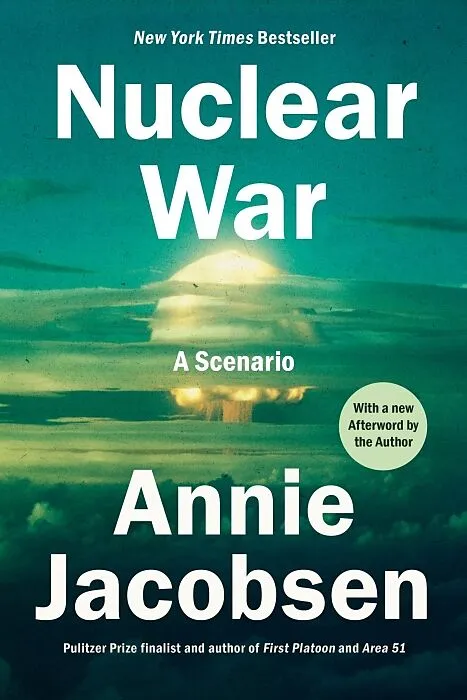
Nuclear War
Beschreibung
WITH A NEW AFTERWORD The INSTANT Instant Los Angeles Times bestseller Finalist, Dayton Literary Peace Prize One of NPR''s Books We Love One of Shortlisted for the Baillie Gifford Prize “In There is only one scenario other than an asteroid strike that cou...Format auswählen
- Kartonierter EinbandCHF 22.70
- Fester EinbandCHF 40.70
- Kartonierter EinbandCHF 15.40

Wird oft zusammen gekauft
Andere Kunden kauften auch
Beschreibung
WITH A NEW AFTERWORD The INSTANT Instant Los Angeles Times bestseller Finalist, Dayton Literary Peace Prize One of NPR''s Books We Love One of Shortlisted for the Baillie Gifford Prize “In There is only one scenario other than an asteroid strike that could end the world as we know it in a matter of hours: nuclear war. And one of the triggers for that war would be a nuclear missile inbound toward the United States. Every generation, a journalist has looked deep into the heart of the nuclear military establishment: the technologies, the safeguards, the plans, and the risks. These investigations are vital to how we understand the world we really live in--where one nuclear missile will beget one in return, and where the choreography of the world’s end requires massive decisions made on seconds’ notice with information that is only as good as the intelligence we have. Pulitzer Prize finalist Annie Jacobsen’s <Nuclear War: A Scenario< explores this ticking-clock scenario, based on dozens of exclusive new interviews with military and civilian experts who have built the weapons, have been privy to the response plans, and have been responsible for those decisions should they have needed to be made. <Nuclear War: A Scenario< examines the handful of minutes after a nuclear missile launch. It is essential reading, and unlike any other book in its depth and urgency.
Autorentext
Annie Jacobsen
Klappentext
**WITH A NEW AFTERWORD
The INSTANT New York Times bestseller**
Instant Los Angeles Times **bestseller
Finalist, Dayton Literary Peace Prize
One of NPR's Books We Love
One of Newsweek Staffers' Favorite Books of the Year
Shortlisted for the Baillie Gifford Prize
“In Nuclear War: A Scenario, Annie Jacobsen gives us a vivid picture of what could happen if our nuclear guardians fail….Terrifying.”—The Wall Street Journal
There is only one scenario other than an asteroid strike that could end the world as we know it in a matter of hours: nuclear war. And one of the triggers for that war would be a nuclear missile inbound toward the United States.
Every generation, a journalist has looked deep into the heart of the nuclear military establishment: the technologies, the safeguards, the plans, and the risks. These investigations are vital to how we understand the world we really live in—where one nuclear missile will beget one in return, and where the choreography of the world’s end requires massive decisions made on seconds’ notice with information that is only as good as the intelligence we have.
Pulitzer Prize finalist Annie Jacobsen’s Nuclear War: A Scenario explores this ticking-clock scenario, based on dozens of exclusive new interviews with military and civilian experts who have built the weapons, have been privy to the response plans, and have been responsible for those decisions should they have needed to be made. Nuclear War: A Scenario examines the handful of minutes after a nuclear missile launch. It is essential reading, and unlike any other book in its depth and urgency.
Inhalt
INTERVIEWS
(U.S. Nuclear Command and Control positions are formerly held)
Dr. Richard L. Garwin: nuclear weapons designer, Ivy Mike thermonuclear bomb
Dr. William J. Perry: United States secretary of defense
Leon E. Panetta: United States secretary of defense, director of the Central Intelligence Agency, White House chief of staff
General C. Robert Kehler: commander, United States Strategic Command
Vice Admiral Michael J. Connor: commander, United States [nuclear] submarine forces
Brigadier General Gregory J. Touhill: first U.S. federal chief information security officer (CISO); director, Command, Control, Communications, and Cyber (C4) Systems, U.S. Transportation Command
William Craig Fugate: administrator, Federal Emergency Management Agency (FEMA)
Honorable Andrew C. Weber: assistant secretary of defense for nuclear, chemical, and biological defense programs
Jon B. Wolfsthal: special assistant to the president for national security affairs, National Security Council
Dr. Peter Vincent Pry: CIA intelligence officer, weapons of mass destruction, Russia; executive director, Electromagnetic Pulse Task Force of National and Homeland Security
Judge Robert C. Bonner: commissioner, Customs and Border Protection, Department of Homeland Security
Lewis C. Merletti: director, United States Secret Service
Colonel Julian Chesnutt, PhD: Defense Clandestine Service, Defense Intelligence Agency;
U.S. defense attaché; U.S. air attaché; F-16 squadron commander
Dr. Charles F. McMillan: director, Los Alamos National Laboratory
Dr. Glen McDuff: nuclear weapons engineer, Los Alamos National Laboratory; laboratory historian
Dr. Theodore Postol: assistant to chief of naval operations; professor emeritus, MIT
Dr. J. Douglas Beason: chief scientist, United States Air Force Space Command
Dr. Frank N. von Hippel: physicist and professor emeritus, Princeton University (co-founder, Program on Science and Global Security)
Dr. Brian Toon: professor; nuclear winter theory (co-author with Carl Sagan)
Dr. Alan Robock: distinguished professor, climatologist, nuclear winter
Hans M. Kristensen: director, Nuclear Information Project, Federation of American
Scientists
Michael Madden: director, North Korea Leadership Watch, Stimson Center
Don D. Mann: team manager, SEAL Team Six, Nuclear, Biological, and Chemical Program
Jeffrey R. Yago: engineer; advisor to Electromagnetic Pulse Task Force of National and Homeland Security
H. I. Sutton: analyst and writer, U.S. Naval Institute
Reid Kirby: military historian of chemical, biological, radiological, and nuclear defense
David Cenciotti: aviation journalist; 2nd Lt. (ret.), Aeronautica Militare (Italian Air Force, ITAF)
Michael Morsch: Neolithic archeologist, University of Heidelberg; co-locator Göbekli Tepe
Dr. Albert D. Wheelon: CIA director, Directorate of Science and Technology
Dr. Charles H. Townes: inventor of the laser; Nobel Prize in Physics, 1964
Dr. Marvin L. Goldberger: former Manhattan Project physicist, founder and chairman of the Jason scientists, science advisor to President Johnson
Paul S. Kozemchak: special assistant to director, DARPA (and its longest-serving member)
Dr. Jay W. Forrester: computer pioneer, founder of system dynamics
General Paul F. Gorman: former commander in chief, U.S. Southern Command (U.S. SOUTHCOM); special assistant to the Joint Chiefs of Staff
Alfred O’Donnell: Manhattan Project member, EG&G nuclear weapons engineer, Atomic Energy Commission
Ralph James Freedman: EG&G nuclear weapons engineer, Atomic Energy Commission
Edward Lovick Jr.: physicist, former Lockheed Skunk Works stealth technologist
Dr. Walter Munk: oceanographer, former Jason scientist
Colonel Hervey S. Stockman: pilot, first man to fly over the Soviet Union in a U-2, atomic sampling pilot
Richard “Rip” Jacobs: engineer, VO-67 Navy squadron, in Vietnam
Dr. Pavel Podvig: research fellow, United Nations Institute for Disarmament Research; research fellow, Moscow Institute of Physics and Technology
Dr. Lynn Eden: research scholar emeritus, Stanford University, U.S. foreign and military
policy, nuclear policy, mass fire
Dr. Thomas Withington: researcher, electronic warfare, radar, and military communications, Royal United Services Institute, England
Joseph S. Bermudez Jr.: analyst, North Korean defense and intelligence affairs and ballistic missile development, Center for Strategic and International Studies
Dr. Patrick Biltgen: aerospace engineer, former BAE Systems Intelligence Integration Directorate
Dr. Alex We…