
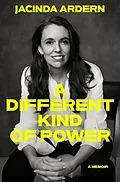
A Different Kind of Power
Beschreibung
An upcoming book to be published by Penguin Random House. Autorentext The Right Honourable Dame Jacinda Ardern was elected the 40th Prime Minister of New Zealand at the age of thirty-seven, becoming the country’s youngest Prime Minister in more than 150 ...Format auswählen
- Fester EinbandCHF 33.50
Wird oft zusammen gekauft
Andere Kunden kauften auch
Beschreibung
An upcoming book to be published by Penguin Random House.
Autorentext
The Right Honourable Dame Jacinda Ardern was elected the 40th Prime Minister of New Zealand at the age of thirty-seven, becoming the country’s youngest Prime Minister in more than 150 years. Since leaving office, Ardern has established the Field Fellowship on empathetic leadership. She is a Senior Fellow at Harvard University, continues to work on climate action, and is the Patron of the Christchurch Call to Action to eliminate terrorist and violent extremist content online. Ardern also works on a number of projects that support women and girls, but considers her greatest roles to be those she will hold for life, including that of mum and proud New Zealander.
Klappentext
**NEW YORK TIMES BESTSELLER • From the former prime minister of New Zealand, then the world’s youngest female head of government and just the second to give birth in office, comes a deeply personal memoir chronicling her extraordinary rise and offering inspiration to a new generation of leaders.
“A clear and compelling case for compassion . . . an implicit repudiation of the strongman style of leadership that has taken hold around the world.”—The Washington Post**
What if we could redefine leadership? What if kindness came first? Jacinda Ardern grew up the daughter of a police officer in small-town New Zealand, but as the 40th Prime Minister of her country, she commanded global respect for her empathetic leadership that put people first. This is the remarkable story of how a Mormon girl plagued by self-doubt made political history and changed our assumptions of what a global leader can be.
When Jacinda Ardern became Prime Minister at age thirty-seven, the world took notice. But it was her compassionate yet powerful response to the 2019 Christchurch mosque attacks, resulting in swift and sweeping gun control laws, that demonstrated her remarkable leadership. She guided her country through unprecedented challenges—a volcanic eruption, a major biosecurity breach, and a global pandemic—while advancing visionary new policies to address climate change, reduce child poverty, and secure historic international trade deals. She did all this while juggling first-time motherhood in the public eye.
Ardern exemplifies a new kind of leadership—proving that leaders can be caring, empathetic, and effective. She has become a global icon, and now she is ready to share her story, from the struggles to the surprises, including for the first time the full details of her decision to step down during her sixth year as Prime Minister.
Through her personal experiences and reflections, Jacinda is a model for anyone who has ever doubted themselves, or has aspired to lead with compassion, conviction, and courage. A Different Kind of Power is more than a political memoir; it’s an insight into how it feels to lead, ultimately asking: What if you, too, are capable of more than you ever imagined?
Leseprobe
One
You could drive for thirty miles in the Kāingaroa Forest and wonder if there’s anything left on earth besides trees. That’s the view: radiata pines, each standing one hundred feet tall, in tidy gridlines that extend as far as the eye can see. The forest is as vast as it is dense: tree upon tree, row upon row, mile upon mile. The sameness is broken by only two things. First, the road carving through the shadowy landscape, and then the radiata shoots, popping up sporadically and defiantly. These smaller, wilding pines look like the Christmas trees of my childhood—joyful but a bit pathetic, each with just a few sparse branches, enough only for a single string of tinsel that will never quite hide the exposed trunk.
Although Kāingaroa is man-made—it’s the second-largest timber plantation in the Southern Hemisphere—it is easy to feel isolated there. It’s a forest that has been known to swallow up hunters and hikers who get lost among the pines. Damp mists are common, and light struggles to break through, especially after the sun dips behind the green peaks of the distant Te Urewera mountain range. Needles and cones collect on the forest floor, and the air is thick with the scent of resin and pine.
But an hour into the journey, just as you become certain you’ve reached the middle of nowhere, there is a break in the trees, and signs of human life return: A run-down forestry building with a rusted sign. A timber motel with small, neat rooms. Then, around the corner, a service station with three petrol pumps that marks the entry to a town called Murupara.
As a young girl, I made that trip through the forest countless times. Today, when I close my eyes, I can still take myself there: the long solitary stretch of tar seal, the gray mass of the ranges, rough trunks piercing the sky.
The first time I visited Murupara, I was four years old and unwell with the flu in the backseat of my family’s beige 1979 Toyota Corona. In those days, I was also prone to car sickness, which was almost certainly made worse by my corduroy booster seat, little more than a wedge of dense foam covered in fabric. It gave me height, but it also exaggerated every turn in the road. Next to me sat my sister Louise, just eighteen months older than me. She was also in a booster, and queasy, but not so much that she would stop asking questions of my parents: How much longer? Why can’t we stop? What if I need the toilet? We each held our stuffed bears, which, uncannily, we resembled. Mine, with a round friendly face, a squat body, and short limbs, was simply called Teddy. My sister’s bear, Cookie, was almost twice the length of mine with a lean body and long legs.
The windows were rolled down just enough that I could hang my fingers over the top and wiggle them in the open air. Beneath my dangling feet were the items that my mum made sure accompanied us on every long car trip: an old towel and an empty, half-gallon plastic ice cream container, in case we needed to throw up. She never threw anything away, and even this container would likely later be repurposed to store home-baked blueberry muffins. Between me and Louise, trapped inside a cardboard box with small holes at the top, sat the most uncomfortable passenger of all: our gray rescue cat, Norm. The sedative from the vet was wearing off as he pressed his face up against the top of the box, whiskers protruding through the holes.
It was moving day. We had left behind friends and family in the city of Hamilton, more than two hours to the northwest, because my dad had a new job, as the police sergeant in Murupara, a place I’d never seen.
Dad had grown up in a large family in Te Aroha, a farming community in the shadow of mountains along the Waihou River. Like every region in New Zealand, Te Aroha was settled first by Māori, who’d navigated their way from Polynesia in waka (canoes) using stars, ocean swells, and sea life as their guide. Māori tribes had lived on this land for hundreds of years. Legend had it that the great chief Kahu climbed to the peak of a mountain to orient himself and was so moved to see his home from this vantage point that he named it Te Muri-aroha-o-Kahu, te aroha-tai, te aroha-uta, meaning “the love of Kahu for those on the coasts and those on the land.” Now it’s known simply as Mount Te Aroha, the mountain of love.
My dad’s family ran a drain-laying business in Te Aroha, and Ardern and Sons had dug most of the drains in the area. As a boy, my dad had helped out, but when his family converted to the Church of Jesus Christ of Latter-day Saints, or what many know as Mormonism, Dad left home to attend the Mormon boarding school in Temple View. After a short stint working at a lead and zinc mine, he joined the New Ze…