
IHR WARENKORB IST AKTUELL LEER.
Haben Sie noch nichts passendes gefunden? Stöbern Sie durch unser komplettes Sortiment.
Oder melden Sie sich an bzw. registrieren Sie sich.
- Kostenlose Lieferung
- Kauf auf Rechnung
- Ex Libris Tiefpreis
- Filiallieferung und 650+ Abholorte
- Rabatt-Bons als Club-Mitglied
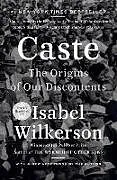
Caste
Beschreibung
#1 The Pulitzer Prize–winning, bestselling author of #1 NONFICTION BOOK OF THE YEAR: Winner of the Carl Sandberg Literary Award • Winner of the Los Angeles Times Book Prize • National Book Award Longlist • National Book Critics Circle Awar...Format auswählen
- Kartonierter EinbandCHF 22.70
- Fester EinbandCHF 33.10
Wird oft zusammen gekauft
Andere Kunden kauften auch
Beschreibung
#1 The Pulitzer Prize–winning, bestselling author of #1 NONFICTION BOOK OF THE YEAR: Winner of the Carl Sandberg Literary Award • Winner of the Los Angeles Times Book Prize • National Book Award Longlist • National Book Critics Circle Award Finalist • Dayton Literary Peace Prize Finalist • PEN/John Kenneth Galbraith Award for Nonfiction Finalist • PEN/Jean Stein Book Award Longlist • Kirkus Prize Finalist In this brilliant book, Isabel Wilkerson gives us a masterful portrait of an unseen phenomenon in America as she explores, through an immersive, deeply researched, and beautifully written narrative and stories about real people, how America today and throughout its history has been shaped by a hidden caste system, a rigid hierarchy of human rankings. Beyond race, class, or other factors, there is a powerful caste system that influences people’s lives and behavior and the nation’s fate. Linking the caste systems of America, India, and Nazi Germany, Wilkerson explores eight pillars that underlie caste systems across civilizations, including divine will, bloodlines, stigma, and more. Using riveting stories about people--including Martin Luther King, Jr., baseball’s Satchel Paige, a single father and his toddler son, Wilkerson herself, and many others--she shows the ways that the insidious undertow of caste is experienced every day. She documents how the Nazis studied the racial systems in America to plan their outcasting of the Jews; she discusses why the cruel logic of caste requires that there be a bottom rung for those in the middle to measure themselves against; she writes about the surprising health costs of caste, in depression and life expectancy, and the effects of this hierarchy on our culture and politics. Finally, she points forward to ways America can move beyond the artificial and destructive separations of human divisions, toward hope in our common humanity. Original and revealing, <Caste: The Origins of Our Discontents< is an eye-opening story of people and history, and a reexamination of what lies under the surface of ordinary lives and of American life today....
Autorentext
Isabel Wilkerson
Klappentext
**#1 NEW YORK TIMES BESTSELLER • NEW YORK TIMES READERS PICK: 100 BEST BOOKS OF THE 21st CENTURY • OPRAH’S BOOK CLUB PICK • ONE OF BARACK OBAMA’S FAVORITE BOOKS OF THE YEAR • TIME’S #1 NONFICTION BOOK OF THE YEAR
Referenced in the historic 2026 Supreme Court decision in the concurrence by Justice Ketanji Brown Jackson, who, in affirming birthright citizenship, called the Reconstruction Amendments “an anticaste, antisubordination reset for the nation.”
“An instant American classic and almost certainly the keynote nonfiction book of the American century thus far.”—Dwight Garner, The New York Times**
“[Caste] changes the lens through which we see the world.”—Oprah Winfrey for Time, “25 Books That Capture This American Moment”
The Pulitzer Prize-winning author of The Warmth of Other Suns examines the unspoken caste system that has shaped America and shows how our lives today are still defined by a hierarchy of human divisions—now with a new afterword by the author.
“As we go about our daily lives, caste is the wordless usher in a darkened theater, flashlight cast down in the aisles, guiding us to our assigned seats for a performance. The hierarchy of caste is not about feelings or morality. It is about power—which groups have it and which do not.”
Beyond race, class, or other factors, there is a powerful caste system that influences people’s lives and behavior and the nation’s fate. Linking the caste systems of America, India, and Nazi Germany, Isabel Wilkerson explores eight pillars that underlie caste systems across civilizations, including divine will, bloodlines, stigma, and more. Using riveting stories about people—including Martin Luther King, Jr., baseball’s Satchel Paige, a single father and his toddler son, Wilkerson herself, and many others—she shows the ways that the insidious undertow of caste is experienced every day. Finally, she points forward to ways America can move beyond the artificial and destructive separations of human divisions, toward hope in our common humanity.
ONE OF THE BEST BOOKS OF THE YEAR: The Washington Post, The New York Times, Los Angeles Times, Boston Globe, O: The Oprah Magazine, NPR, Bloomberg, The Christian Science Monitor, New York Post, The New York Public Library, Fortune, Smithsonian Magazine, Marie Claire, Slate, Library Journal, Kirkus Reviews
Winner of the Los Angeles Times Book Prize • National Book Critics Circle Award Finalist • Winner of the Carl Sandburg Literary Award • Dayton Literary Prize Finalist • PEN/John Kenneth Galbraith Award for Nonfiction Finalist • PEN/Jean Stein Book Award Finalist • Kirkus Prize Finalist
Leseprobe
Chapter 2
An Old House and an Infrared Light
The inspector trained his infrared lens onto a misshapen bow in the ceiling, an invisible beam of light searching the layers of lath to test what the eye could not see. This house had been built generations ago, and I had noticed the slightest welt in a corner of plaster in a spare bedroom and had chalked it up to idiosyncrasy. Over time, the welt in the ceiling became a wave that widened and bulged despite the new roof. It had been building beyond perception for years. An old house is its own kind of devotional, a dowager aunt with a story to be coaxed out of her, a mystery, a series of interlocking puzzles awaiting solution. Why is this soffit tucked into the southeast corner of an eave? What is behind this discolored patch of brick? With an old house, the work is never done, and you don’t expect it to be.
America is an old house. We can never declare the work over. Wind, flood, drought, and human upheavals batter a structure that is already fighting whatever flaws were left unattended in the original foundation. When you live in an old house, you may not want to go into the basement after a storm to see what the rains have wrought. Choose not to look, however, at your own peril. The owner of an old house knows that whatever you are ignoring will never go away. Whatever is lurking will fester whether you choose to look or not. Ignorance is no protection from the consequences of inaction. Whatever you are wishing away will gnaw at you until you gather the courage to face what you would rather not see.
We in the developed world are like homeowners who inherited a house on a piece of land that is beautiful on the outside, but whose soil is unstable loam and rock, heaving and contracting over generations, cracks patched but the deeper ruptures waved away for decades, centuries even. Many people may rightly say, “I had nothing to do with how this all started. I have nothing to do with the sins of the past. My ancestors never attacked indigenous people, never owned slaves.” And, yes. Not one of us was here when this house was built. Our immediate ancestors may have had nothing to do with it, but here we are, the current occupants of a property with stress cracks and bowed walls and fissures built into the foundation. We are the heirs to whatever is right or wrong with it. We did not erect the uneven pillars or joists, but they are ours to deal with now.
And any further deterioration is, in fact, on our hands.
Unaddressed, the ruptures and diagonal cracks will not fix themselves. The toxins will not go away but, rather, will spread, leach, and mutate, as they already have. When people live in an old house, they come to adjust to the idiosyncrasies and outright dangers skulking in an o…