Beschreibung
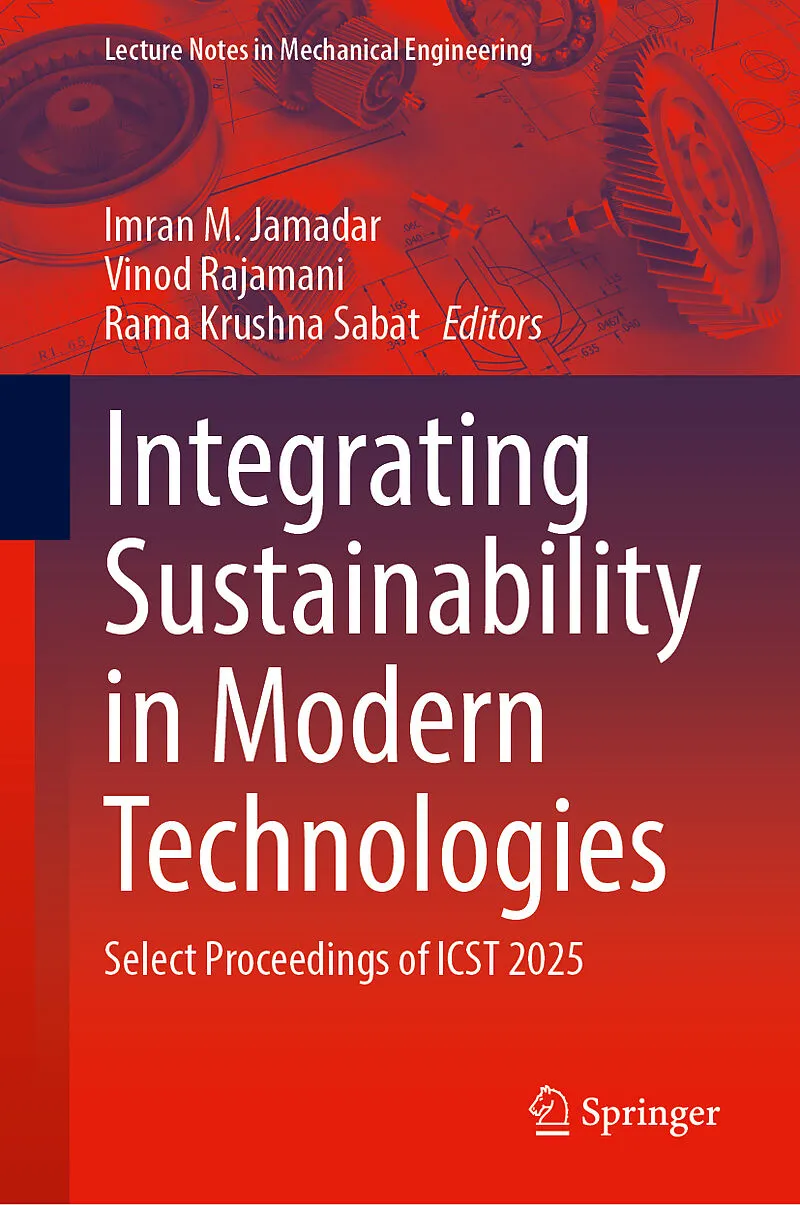
The book presents select proceedings of the International Conference on Sustainable Technology (ICST 2025). It provides comprehensive exploration of the latest advancements in sustainable technologies aimed at addressing global environmental challenges and su...
The book presents select proceedings of the International Conference on Sustainable Technology (ICST 2025). It provides comprehensive exploration of the latest advancements in sustainable technologies aimed at addressing global environmental challenges and sustainable development goals. The book covers key areas of sustainable development, including sustainable energy, focusing on renewable energy sources and energy efficiency; robotics & e-mobility for sustainable development, highlighting innovations in electric mobility and automation; sustainable materials, exploring environmentally friendly materials and waste reduction strategies; design for sustainability, emphasizing eco-conscious design in architecture and industrial development; green computing for sustainability, addressing energy-efficient computing practices and digital sustainability; and environment & green buildings, which covers sustainable architecture and energy-efficient construction. The proceedings conclude with a summary of key insights and future research directions, providing a roadmap for continued innovation in sustainability. This book is an essential resource for researchers, policymakers, and industry leaders committed to advancing sustainable development through technology and innovation.
Presents select peer-reviewed proceedings of ICST 2025 Presents comprehensive exploration in sustainable technologies, addressing global environmental challenges Covers key areas of sustainable development, including sustainable energy, renewable energy sources, efficiency, etc
Autorentext
Dr. Imran M. Jamadar is an accomplished academician and researcher, currently serving as Professor of Mechanical Engineering and Dean of Research & Development at The National Institute of Engineering, Mysuru, Karnataka. He earned B.E. from Shivaji University, Kolhapur, M.Tech. in Machine Design from VJTI, Mumbai University, and Ph.D. in mechanical engineering from SVNIT, Surat. His research expertise spans over vibration control in flexible robotic manipulators, predictive maintenance for rotating machinery, energy harvesting devices, and the enhancement of fatigue, tribology and wear properties in polymer composites. Dr. Jamadar actively reviews for numerous prestigious international journals. He has led several significant funded research projects that highlight his expertise in mechanical engineering , robotic vibration control and predictive maintenance.
Prof. Vinod Rajamani is a distinguished academician and industry expert with a robust background in mechanical and automotive engineering. He holds a bachelor's degree in mechanical engineering from RV College of Engineering, a master s in automotive systems engineering, and a Ph.D. in internal combustion engines from RWTH Aachen University. His academic journey is marked by notable achievements, including founding technical societies, participating in international Formula Student teams, and producing impactful theses on combustion analysis and hybrid vehicle technologies. With over a decade of professional experience, he has held key roles such as Design Engineer, Project Manager, and Department Manager at esteemed organizations like FEV GmbH and DEUTZ AG, where he led projects on advanced combustion systems and emission norms compliance. Currently, as a Professor at the University of Applied Sciences and Arts in Dortmund, he combines his extensive industry expertise with academic rigor, mentoring students and contributing to cutting-edge research.
Dr. Rama Krushna Sabat is an Associate Professor at the Indian Institute of Technology, Bhubaneswar (IIT Bhubaneswar), specializing in materials engineering. His research interests include virtual characterization, microstructural modeling, severe plastic deformation processes, microstructure-property relationships in light metals, and corrosion of metals. He holds a PhD in materials engineering from IISc Bangalore and a B.Tech in metallurgical and materials engineering from NIT Rourkela. Dr. Sabat has significant academic experience, having worked as a Postdoctoral Fellow at the University of Waterloo and IISc. Bangalore before joining IIT Bhubaneswar as a faculty member. Notable areas of his research include crystal plasticity-based FEM modelling, prediction of forming limit diagrams, and nano-void theory for failure modelling. His work is widely cited, with contributions to understanding the mechanical properties of various alloys, microstructure evolution, and thermoelectric materials. Dr. Sabat has led several significant funded research projects that highlight his expertise in mechanical engineering & is offering contributions to international journals and conferences in the field of materials & mechanical engineering.