
IHR WARENKORB IST AKTUELL LEER.
Haben Sie noch nichts passendes gefunden? Stöbern Sie durch unser komplettes Sortiment.
Oder melden Sie sich an bzw. registrieren Sie sich.
- Kostenlose Lieferung
- Kauf auf Rechnung
- Ex Libris Tiefpreis
- Filiallieferung und 650+ Abholorte
- Rabatt-Bons als Club-Mitglied
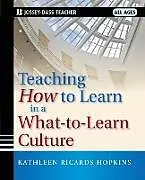
Teaching How to Learn in a What-to-Learn Culture
Beschreibung
Informationen zum Autor THE AUTHOR Kathleen Ricards Hopkins, Ed.D., is executive director of the National Institute for Learning Development (NILD), an international organization dedicated to meeting the needs of students who have difficulty learning, includin...Format auswählen
- Kartonierter EinbandCHF 37.50

Wird oft zusammen gekauft
Andere Kunden kauften auch
Beschreibung
Informationen zum Autor THE AUTHOR Kathleen Ricards Hopkins, Ed.D., is executive director of the National Institute for Learning Development (NILD), an international organization dedicated to meeting the needs of students who have difficulty learning, including those with and without specific learning disabilities. Klappentext Can intelligence be developed? Do teacher expectations shape student learning? How can I make learning 'stick' for my students? In this thought-provoking, informative book, noted education expert Kathleen Ricards Hopkins provides teachers with a hands-on resource based on the latest research on how we learn. Hopkins offers clear, actionable guidelines for teachers to enable all students to gain both the cognitive competence and confidence needed to succeed academically. Using the metaphor of a skylight?a window leading to infinite possibilities?Hopkins provides down-to-earth techniques teachers can use to help students develop their skills as readers, writers, and mathematicians. Hopkins translates the theoretical ideas of Piaget, Vygotsky, and Feuerstein into practical suggestions for teachers to use with their students. Students will benefit from these principles, and teachers may find their cognitive abilities transformed as well. As inspirational as it is practical, the book offers creative suggestions that help students build perseverance and diligent work habits. Teaching How to Learn in a What-to-Learn Culture is designed to apply to any and all learners, including students with special needs, and is richly illustrated with stories, activities, and useful examples from across the content areas. PRAISE FOR TEACHING HOW TO LEARN IN A WHAT-TO-LEARN CULTURE "Kathy Hopkins has a gift for bringing research to life with practical strategies for parents and teachers. Pay attention, folks, because our children desperately need to have you understand and apply the information in this book!" ?JANE M. HEALY, Ph.D., educational psychologist and author, Different Learners and Endangered Minds "An important book for any educator who seeks both a theoretical understanding of mediated learning and the application of these principles in modern classrooms. Hopkins shares the development of her career as a teacher of teachers and how she goes about teaching students of all ages to think beyond basic memorization?and much, much more." ?ROSA A. HAGIN, Ph.D., research professor of psychology, Department of Psychiatry, New York University School of MedicineAnswers such questions as - Can intelligence be developed? Do teacher expectations shape student learning? How can I make learning 'stick' for my students? This book offers practical guidance along with ideas to show how teachers can enable students to gain both the cognitive competence and confidence needed to succeed academically. Inhaltsverzeichnis About the Author vii About the National Institute for Learning Development ix Foreword xi Introduction xv 1 The Intelligence Dilemma 1 Opening the Skylight 3 A Conceptual Understanding of Intelligence 4 Defining Intelligence 5 Theory One: Cast Building 5 Theory Two: Brick Building 5 Theory Three: Mosaic Model 6 Classroom Activity 8 The Root of Intelligence 10 Intellectual Potential? 10 Mediated Learning 11 Practical Application 15 The First Fable 15 Prepare the Lesson 16 Project the Text of the Fable 16 Build Intelligence 17 Develop Cognitive Competence 17 Reflection 19 2 A Way Out of the Pressure Cooker 21 The Pressures are Real 24 A Survey 25 Identify the Pressures 26 Find the Way Out 27 The Need for Meaningfulness 28 Surface Versus Meaningful Knowledge 29 The Case for Co...
Autorentext
THE AUTHOR Kathleen Ricards Hopkins, Ed.D., is executive director of the National Institute for Learning Development (NILD), an international organization dedicated to meeting the needs of students who have difficulty learning, including those with and without specific learning disabilities.
Klappentext
Can intelligence be developed? Do teacher expectations shape student learning? How can I make learning 'stick' for my students? In this thought-provoking, informative book, noted education expert Kathleen Ricards Hopkins provides teachers with a hands-on resource based on the latest research on how we learn. Hopkins offers clear, actionable guidelines for teachers to enable all students to gain both the cognitive competence and confidence needed to succeed academically. Using the metaphor of a skylight?a window leading to infinite possibilities?Hopkins provides down-to-earth techniques teachers can use to help students develop their skills as readers, writers, and mathematicians. Hopkins translates the theoretical ideas of Piaget, Vygotsky, and Feuerstein into practical suggestions for teachers to use with their students. Students will benefit from these principles, and teachers may find their cognitive abilities transformed as well. As inspirational as it is practical, the book offers creative suggestions that help students build perseverance and diligent work habits. Teaching How to Learn in a What-to-Learn Culture is designed to apply to any and all learners, including students with special needs, and is richly illustrated with stories, activities, and useful examples from across the content areas. PRAISE FOR TEACHING HOW TO LEARN IN A WHAT-TO-LEARN CULTURE "Kathy Hopkins has a gift for bringing research to life with practical strategies for parents and teachers. Pay attention, folks, because our children desperately need to have you understand and apply the information in this book!" ?JANE M. HEALY, Ph.D., educational psychologist and author, Different Learners and Endangered Minds "An important book for any educator who seeks both a theoretical understanding of mediated learning and the application of these principles in modern classrooms. Hopkins shares the development of her career as a teacher of teachers and how she goes about teaching students of all ages to think beyond basic memorization?and much, much more." ?ROSA A. HAGIN, Ph.D., research professor of psychology, Department of Psychiatry, New York University School of Medicine
Zusammenfassung
Answers such questions as - Can intelligence be developed? Do teacher expectations shape student learning? How can I make learning 'stick' for my students? This book offers practical guidance along with ideas to show how teachers can enable students to gain both the cognitive competence and confidence needed to succeed academically.
Inhalt
About the Author vii
About the National Institute for Learning Development ix
Foreword xi
Introduction xv
1 The Intelligence Dilemma 1
Opening the Skylight 3
A Conceptual Understanding of Intelligence 4
Defining Intelligence 5
Theory One: Cast Building 5
Theory Two: Brick Building 5
Theory Three: Mosaic Model 6
Classroom Activity 8
The Root of Intelligence 10
Intellectual Potential? 10
Mediated Learning 11
Practical Application 15
The First Fable 15
Prepare the Lesson 16
Project the Text of the Fable 16
Build Intelligence 17
Develop Cognitive Competence 17
Reflection 19
2 A Way Out of the Pressure Cooker 21
The Pressures are Real 24
A Survey 25
Identify the Pressures 26
Find the Way Out 27
The Need for Meaningfulness 28
Surface Versus Meaningful Knowledge 29
The Case for Cognitive Modifiability 29
Practical Applications 31
Reflection 34
3 What Every Teacher Needs 37
A Survey 42
Love of Reading 42
Intellectual Curiosity 43
Cultural Literacy 45
Love of Learning 46
Competence and Confidence 47
Reflection 47
4 The Big Picture 51
Analysis or Synthesis? 54
Back to the Classroom 57
The Power of the Lie 58
Rethinking Those Rows 58
Real-Life Challenges 59
The Case for Handwriting 60
An Exercise 61
Practical Application 62
Reflection 64
5 Setting Students Free 67
…