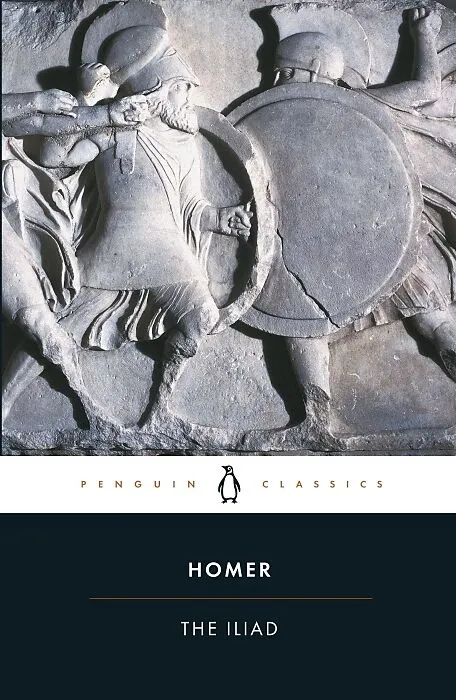
The Iliad
Beschreibung
Zusatztext Fitzgerald has solved virtually every problem that has plagued translators of Homer. The narrative runs! the dialogue speaks! the military action is clear! and the repetitive epithets become useful text rather than exotic relics. Atlantic Monthly Fi...Format auswählen
- Kartonierter EinbandCHF 17.30

Wird oft zusammen gekauft
Andere Kunden kauften auch
Beschreibung
Zusatztext Fitzgerald has solved virtually every problem that has plagued translators of Homer. The narrative runs! the dialogue speaks! the military action is clear! and the repetitive epithets become useful text rather than exotic relics. Atlantic Monthly Fitzgerald's swift rhythms! bright images! and superb English make Homer live as never beforeThis is for every reader in our time and possibly for all time. Library Journal [Fitzgerald's Odyssey and Iliad ] open up once more the unique greatness of Homer's art at the level above the formula; yet at the same time they do not neglect the brilliant texture of Homeric verse at the level of the line and the phrase. The Yale Review What an age can read in Homer! what its translators can manage to say in his presence! is one gauge of its morale! one index to its system of exultations and reticences. The supple! the iridescent! the ironic! these modes are among our strengths! and among Mr. Fitzgerald's. National Review With an Introduction by Gregory Nagy Informationen zum Autor Homer is thought to have lived c.750-700 BC in Ionia and is believed to be the author of the earliest works of Western Literature: The Odyssey and The Iliad. E V Rieu was a celebrated translator from Latin and Greek, and editor of Penguin Classics from 1944-64. His son, D C H Rieu, has revised his work. Peter Jones is former lecturer in Classics at Newcastle. He co-founded the 'Friends of Classics' society and is the editor of their journal and a columnist for The Spectator. Klappentext 'The first great book, and the first great book about the suffering and loss of war' Guardian One of the foremost achievements in Western literature, Homer's Iliad tells the story of the darkest episode in the Trojan War. At its centre is Achilles, the greatest warrior-champion of the Greeks, who refuses to fight after being humiliated by his leader Agamemnon. But when the Trojan Hector kills Achilles' close friend Patroclus, he storms back into battle to take revenge - knowing this will ensure his own early death. E. V. Rieu's acclaimed translation of The Iliad was one of the first titles published in Penguin Classics, and now has classic status itself. Originally translated by E. V. RIEU Revised and updated by PETER JONES with D. C. H. RIEU Edited with an Introduction and notes by PETER JONES Zusammenfassung Tells the story of darkest episode in "Trojan War". At its centre is Achilles, greatest warrior-champion of Greeks, and his refusal to fight after being humiliated by his leader Agamemnon. But when Trojan Hector kills Achilles' close friend Patroclus, he storms back into battle to take revenge - even though he knows this may ensure his own death. Inhaltsverzeichnis The IliadForeword Introduction Introduction to the 1950 Edition Notes on this Revision The Main Characters Further Reading Maps: 1. A reconstruction of Homer's imagined battlefields 2. The Troad 3. Trojan places and contingents 4. Homeric Greece 5. Greek contingents at Troy Preliminaries The Iliad 1. Plague and Wrath 2. A Dream, a Testing and the Catalogue of Ships 3. A Duel and a Trojan View of the Greeks 4. The Oath is Broken and Battle Joined 5. Diomedes' Heroics 6. Hector and Andromache 7. Ajax Fights Hector 8. Hector Triumphant 9. The Embassy to Achilles 10. Diomedes and Odysseus: The Night Attack 11. Achilles Takes Notice 12. Hector Storms the Wall 13. The Battle at the Ships 14. Zeus Outmanoeuvred 15. The Greeks at Bay 16. The Death of Patroclus 17. The Struggle Over Patroclus 18. Achilles' Decision 19. The Feud Ends 20. Achilles on the Rampage 21. Achilles Fights the River 22. The Death of Hector 23. The Funeral and the Games...
Autorentext
Homer was probably born around 725BC on the Coast of Asia Minor, now the coast of Turkey, but then really a part of Greece. Homer was the first Greek writer whose work survives.
He was one of a long line of bards, or poets, who worked in the oral tradition. Homer and other bards of the time could recite, or chant, long epic poems. Both works attributed to Homer – the Iliad and the Odyssey – are over ten thousand lines long in the original. Homer must have had an amazing memory but was helped by the formulaic poetry style of the time.
In the Iliad Homer sang of death and glory, of a few days in the struggle between the Greeks and the Trojans. Mortal men played out their fate under the gaze of the gods. The Odyssey is the original collection of tall traveller’s tales. Odysseus, on his way home from the Trojan War, encounters all kinds of marvels from one-eyed giants to witches and beautiful temptresses. His adventures are many and memorable before he gets back to Ithaca and his faithful wife Penelope.
We can never be certain that both these stories belonged to Homer. In fact ‘Homer’ may not be a real name but a kind of nickname meaning perhaps ‘the hostage’ or ‘the blind one’. Whatever the truth of their origin, the two stories, developed around three thousand years ago, may well still be read in three thousand years’ time.
E. V. Rieu was a celebrated translator from Latin and Greek, and editor of Penguin Classics from 1944-1964. His son, D. C. H. Rieu has revised his work.
Peter Jones is former lecturer in classics at the University of Newcastle upon Tyne.
D. C. H. Rieu is the son of E. V. Rieu, celebrated translator from Latin and Greek and Editor of Penguin Classics from 1944-1964.
Peter Jones is former lecturer in classics at the University of Newcastle upon Tyne.
Klappentext
E.V. Rieu's beloved translation of the great war epic of Western literature, revised and updated by D. C. H. Rieu
One of the foremost achievements in Western literature, Homer's Iliad tells the story of the darkest episode of the Trojan War. At its center is Achilles, the greatest warrior-champion of the Greeks, and his conflict with his leader Agamemnon. Interwoven in the tragic sequence of events are powerfully moving descriptions of the ebb and flow of battle, the besieged city of Ilium, the feud between the gods, and the fate of mortals.
For this Penguin Classics edition, classicist D. C. H. Rieu has revised the work of his father, E. V. Rieu, celebrated translator and founding editor of the Penguin Classics imprint. The book also includes an introduction and notes by Peter V. Jones.
For more than seventy years, Penguin has been the leading publisher of classic literature in the English-speaking world. With more than 1,700 titles, Penguin Classics represents a global bookshelf of the best works throughout history and across genres and disciplines. Readers trust the series to provide authoritative texts enhanced by introductions and notes by distinguished scholars and contemporary authors, as well as up-to-date translations by award-winning translators.
Zusammenfassung
Tells the story of darkest episode in "Trojan War". At its centre is Achilles, greatest warrior-champion of Greeks, and his refusal to fight after being humiliated by his leader Agamemnon. But when Trojan Hector kills Achilles' close friend Patroclus, he storms back into battle to take revenge - even though he knows this may ensure his own death.
Inhalt
The IliadForeword
Introduction
Introduction to the 1950 Edition
Notes on this Revision
The Main Characters
Further Reading
Maps:
1. A reconstruction of Homer's imagined battlefields
2. The Troad
3. Trojan places and contingents
4. Homeric Greece
5. Greek contingents at Troy
Preliminaries
The Iliad
- Plague and Wrath
- A Dream, a Testing and the Catalogue of Ships
- A Duel and a Trojan View of the Greeks
- The Oath is Broken and Battle Joined
- Diomedes' Heroics
- Hector and Andromache
- Ajax Fights Hector
- Hector Triumphant
- The Embassy to Achilles
- Diomedes and Odysseus: The Night Attack
- …