Moby-Dick
Beschreibung
Herman Meville's profound and timeless inquiry into one man's obsession, in a gorgeous new clothbound edition Informationen zum Autor Herman Melville was born on August 1, 1819, in New York City, the son of a merchant. Only twelve when his father die...Format auswählen
- Fester EinbandCHF 33.20
- Kartonierter EinbandCHF 17.00
- E-Book (epub)CHF 11.90
Wird oft zusammen gekauft
Andere Kunden kauften auch
Beschreibung
Herman Meville's profound and timeless inquiry into one man's obsession, in a gorgeous new clothbound edition
Informationen zum Autor Herman Melville was born on August 1, 1819, in New York City, the son of a merchant. Only twelve when his father died bankrupt, young Herman tried work as a bank clerk, as a cabin boy on a trip to Liverpool, and as an elementary schoolteacher, before shipping in January 1841 on the whaler Acushnet, bound for the Pacific. Deserting ship the following year in the Marquesas, he made his way to Tahiti and Honolulu, returning as an ordinary seaman on the frigate United States to Boston, where he was discharged in October 1844. Books based on these adventures won him immediate success. By 1850 he was married, had acquired a farm near Pittsfield, Massachussetts (where he was the impetuous friend and neighbor of Nathaniel Hawthorne), and was hard at work on his masterpiece Moby-Dick. Literary success soon faded; his complexity increasingly alienated readers. After a visit to the Holy Land in January 1857, he turned from writing prose fiction to poetry. In 1863, during the Civil War, he moved back to New York City, where from 1866 to1885 he was a deputy inspector in the Custom House, and where, on September 28, 1891, he died. A draft of a final prose work, Billy Budd, Sailor, was left unfinished and uncollated; packed tidily away by his widow, it was not rediscovered and published until 1924. Andrew Delbanco was born in 1952. Educated at Harvard, he has lectured extensively throughout the United States and abroad. In 2001, Time named him America's Best Social Critic and in 2011 he was awarded a National Humanities Medal. Two of his previous works, The Puritan Ordeal and Melville: His World and Work received the Lionel Trilling Book Award at Columbia University, where he is Director of American Studies and Julian Clarence Levi Professor in the Humanities. He lives in New York City with his wife and two children. Tom Quirk is Catherine Paine Middlebush Professor of English at the University of Missouri-Columbia. He is the editor of the Penguin Classics editions of Mark Twain's Tales, Speeches, Essays, and Sketches (1994) and Ambrose Bierce's Tales of Soldiers and Civilians and Other Stories (2000) and co-editor of The Portable American Realism Reader (1997). His recent books include Nothing Abstract: Investigations in the American Literary Imagination (2001) and Mark Twain and Human Nature (2007). Coralie Bickford-Smith is an award-winning designer at Penguin Books (U.K.), where she has created several highly acclaimed series designs. She studied typography at Reading University and lives in London. Klappentext Part of Penguin's beautiful hardcover Clothbound Classics series, designed by the award-winning Coralie Bickford-Smith, these delectable and collectible editions are bound in high-quality, tactile cloth with foil stamped into the design. In part, Moby-Dick is the story of an eerily compelling madman pursuing an unholy war against a creature as vast and dangerous and unknowable as the sea itself. But more than just a novel of adventure, more than an encyclopedia of whaling lore and legend, Moby-Dick is a haunting, mesmerizing, and important social commentary populated with several of the most unforgettable and enduring characters in literature. Written with wonderfully redemptive humor, Moby-Dick is a profound and timeless inquiry into character, faith, and the nature of perception. This edition contains the definitive text of Moby-Dick based on the Northwestern-Newberry edition. It also features an introduction by Andrew Delbanco and explanatory commentary by Tom Quirk. For more than seventy years, Penguin has been the leading publisher of classic literature in the English-speaking world. With more than 1,700 titles, Penguin Classics represents a global bookshelf of the best works throughout history and across genres and disciplines. Readers trust the series to provide a...
Autorentext
Herman Melville (1819-91) became in his late twenties a highly successful author of exotic novels based on his experiences as a sailor - writing in quick succession Typee, Omoo, Redburn and White-Jacket. However, his masterpiece Moby-Dick was met with incomprehension and the other later works which are now the basis of his reputation, such as Bartleby, the Scrivener and The Confidence-Man, were failures. Melville stopped writing fiction and the rest of his long life was spent first as a lecturer and then, for nineteen years, as a customs official in New York City. He was also the author of the immensely long poem Clarel, which was similarly dismissed. At the end of his life he wrote Billy Budd, Sailor which was published posthumously in 1924.
Klappentext
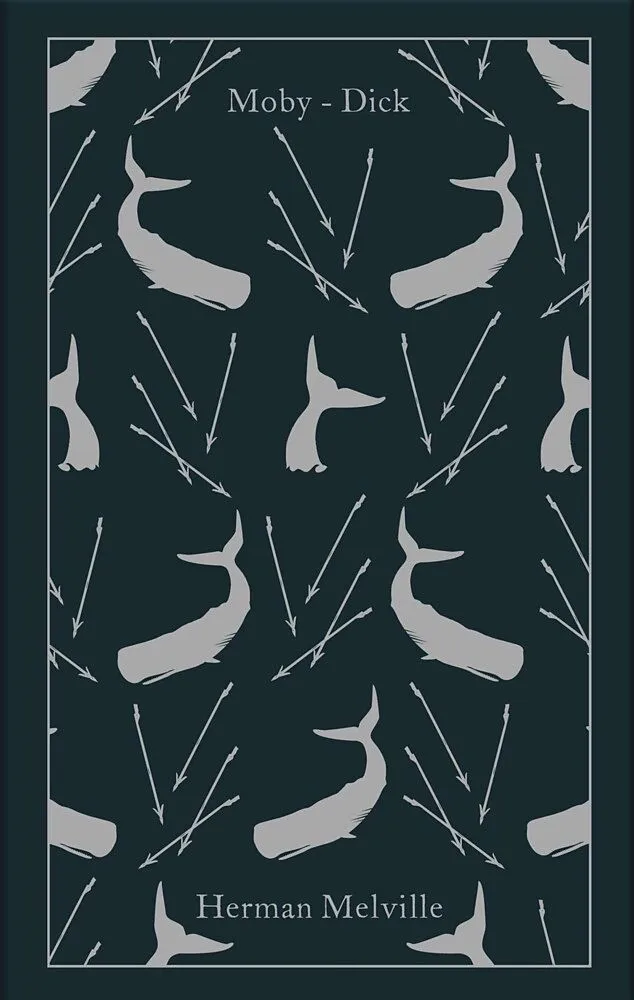
Part of Penguin’s beautiful hardcover Clothbound Classics series, designed by the award-winning Coralie Bickford-Smith, these delectable and collectible editions are bound in high-quality, tactile cloth with foil stamped into the design.
In part, Moby-Dick is the story of an eerily compelling madman pursuing an unholy war against a creature as vast and dangerous and unknowable as the sea itself. But more than just a novel of adventure, more than an encyclopedia of whaling lore and legend, *Moby-Dick *is a haunting, mesmerizing, and important social commentary populated with several of the most unforgettable and enduring characters in literature. Written with wonderfully redemptive humor, Moby-Dick is a profound and timeless inquiry into character, faith, and the nature of perception.
This edition contains the definitive text of *Moby-Dick *based on the Northwestern-Newberry edition. It also features an introduction by Andrew Delbanco and explanatory commentary by Tom Quirk.
For more than seventy years, Penguin has been the leading publisher of classic literature in the English-speaking world. With more than 1,700 titles, Penguin Classics represents a global bookshelf of the best works throughout history and across genres and disciplines. Readers trust the series to provide authoritative texts enhanced by introductions and notes by distinguished scholars and contemporary authors, as well as up-to-date translations by award-winning translators.
Leseprobe
Call me Ishmael. This resonant opening of Moby-Dick, the greatest novel in American literature, announces the narrator, Herman Melville, as he with a measure of slyness thought of himself. In the Scriptures Ishmael, a wild man sired by the overwhelming patriarch Abraham, was nevertheless the bastard son of a serving girl Hagar. The author himself was the offspring of two distinguished American families, the Melvilles of Boston and the Gansevoorts of Albany.
Melville's father cast something of a blight on the family escutcheon by his tendency to bankruptcy which passed down to his son. Dollars damn me, the son was to say over and over. When he sat down in the green landscape of Pittsfield, Massachusetts, to compose Moby-Dick he was in debt, the father of one son, and another to be born a few days after the publication of the novel in England.
Melville had published five novels previous to Moby-Dick; the first two did well, and then with the capriciousness of the public the subsequent novels failed to please. He was a known literary figure with a fading reputation. How he came upon the courage to undertake the challenging creation of the epical battle between a sea creature, a white whale called Moby Dick, and an old captain from Nantucket by the name of Ahab is one of literature's triumphant mysteries. Add to that, as one reads, that he was only thirty-two years old.
Ten years before, in 1841, he had signed up as a common seaman on the whaling vessel Acushnet bound for the South Seas. Young Ishmael was drawn by the lure of the sea and by the wonder of the whale itself, the Le…