1Q84
Beschreibung
Zusatztext 41132611 Informationen zum Autor HARUKI MURAKAMI was born in Kyoto in 1949 and now lives near Tokyo. His work has been translated into more than fifty languages, and one of the most recent of his many international honors is the Cino Del Duca World ...Format auswählen
- Kartonierter EinbandCHF 45.50
- Kartonierter EinbandCHF 28.80

Wird oft zusammen gekauft
Andere Kunden kauften auch
Beschreibung
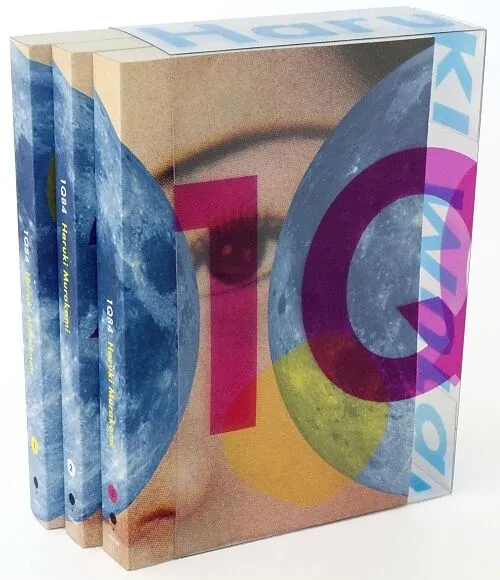
Zusatztext 41132611 Informationen zum Autor HARUKI MURAKAMI was born in Kyoto in 1949 and now lives near Tokyo. His work has been translated into more than fifty languages, and one of the most recent of his many international honors is the Cino Del Duca World Prize, whose previous recipients include Jorge Luis Borges, Ismail Kadare, Mario Vargas Llosa, and Joyce Carol Oates. Klappentext This deluxe three-volume paperback boxed set-gorgeously designed editions in a see-through case, with a removeable sticker on the shrink wrap packaging-is a collector's item in the making. It beautifully showcases Haruki Murakami's most ambitious novel yet, 1Q84-a love story, a mystery, a fantasy, a dystopia to rival George Orwell's. The year is 1984 and the city is Tokyo. A young woman named Aomame follows a taxi driver's enigmatic suggestion and begins to notice puzzling discrepancies in the world around her. She has entered, she realizes, a parallel existence, which she calls 1Q84-"Q is for 'question mark.' A world that bears a question." Meanwhile, an aspiring writer named Tengo takes on a suspect ghostwriting project. He becomes so wrapped up with the work and its unusual author that, soon, his previously placid life begins to come unraveled. As Aomame's and Tengo's narratives converge over the course of this single year, we learn of the profound and tangled connections that bind them ever closer: a beautiful, dyslexic teenage girl with a unique vision; a mysterious religious cult that instigated a shoot-out with the metropolitan police; a reclusive, wealthy dowager who runs a shelter for abused women; a hideously ugly private investigator; a mild-mannered yet ruthlessly efficient bodyguard; and a peculiarly insistent television-fee collector. An instant bestseller around the world, 1Q84 is a tremendous feat of imagination from one of our most revered contemporary writers. Leseprobe Chapter 1 Aomame DON'T LET APPEARANCES FOOL YOU The taxi's radio was tuned to a classical FM broadcast. Janaìcek's Sinfonietta probably not the ideal music to hear in a taxi caught in traffic. The middle-aged driver didn't seem to be listening very closely, either. With his mouth clamped shut, he stared straight ahead at the endless line of cars stretching out on the elevated expressway, like a veteran fisherman standing in the bow of his boat, reading the ominous confluence of two currents. Aomame settled into the broad back seat, closed her eyes, and listened to the music. How many people could recognize Janaìcek's Sinfonietta after hearing just the first few bars? Probably somewhere between "very few" and "almost none." But for some reason, Aomame was one of the few who could. Janaìcek composed his little symphony in 1926. He originally wrote the opening as a fanfare for a gymnastics festival. Aomame imagined 1926 Czechoslovakia: The First World War had ended, and the country was freed from the long rule of the Hapsburg Dynasty. As they enjoyed the peaceful respite visiting central Europe, people drank Pilsner beer in cafeìs and manufactured handsome light machine guns. Two years earlier, in utter obscurity, Franz Kafka had left the world behind. Soon Hitler would come out of nowhere and gobble up this beautiful little country in the blink of an eye, but at the time no one knew what hardships lay in store for them. This may be the most important proposition revealed by history: "At the time, no one knew what was coming." Listening to Janaìcek's music, Aomame imagined the carefree winds sweeping across the plains of Bohemia and thought about the vicissitudes of history. In 1926 Japan's Taisho Emperor died, and the era name was changed to Showa. It was the beginning of a terrible, dark time in this country, too. The short interlude of modernism and democracy was ending, giving way to fascism. Aomame loved history as much as she loved sport...
A New York Times Notable Book
A Washington Post Best Book of the Year
“Brilliant. . . . An irresistibly engaging literary fantasy. . . . Murakami possesses many gifts, but chief among them is an almost preternatural gift for suspenseful storytelling.”
—The Washington Post
“A grand, third-person, all encompassing meganovel. It is a book full of anger and violence and disaster and weird sex and strange new realities, a book that seems to want to hold all of Japan inside of it.”
—The New York Times Magazine
“Bewitching. . . . Part noir crime drama, part love story, and part hallucinatory riff on 1984. . . . You don’t know where things are going while you read it, and you can’t say exactly where you’ve been when you’re finished, but everything around you looks different somehow. If this is fiction as funhouse, it is very serious fun, and you enter at the risk of your own complacency.”
—Newsweek
“A magical journey to a parallel world . . . 1Q84 is a love story and a detective story. It’s a philosophical novel about the power of storytelling, the nature of reality, and the shifting balance of good and evil. . . . Once the narrative begins to pick up, you have no desire to put the book down.”
—The Philadelphia Inquirer
“A weirdly gripping page-turner. . . . Its tonal register—as if serving as an antidote to the unsettling world it presents—is consistently warmhearted, secretly romantic, and really quite genial.”
—Charles Baxter, The New York Review of Books
“Fascinating. . . . More than any author since Kafka, Murakami appreciates the genuine strangeness of our real world, and he’s not afraid to incorporate elements of surrealism or magical realism as tools to help us see ourselves for who we really are. . . . A tremendous accomplishment. It does every last blessed thing a masterpiece is supposed to—and a few things we never even knew to expect.”
—The San Francisco Chronicle
“Magnificent in many ways, a work of the imagination that defies description. . . . An immersive experience, one that will leave readers wondering what is real and what is imagined.”
—Pittsburgh Tribune-Review
“[A] Japanese novel set in Tokyo in which the words ‘sushi’ and ‘sake’ never appear but there are mentions of linguine and French wine, as well as Proust, Faye Dunaway, The Golden Bough, Duke Ellington, Macbeth, Churchill, Janáèek, Sonny and Cher, and, given the teasing title, George Orwell? . . . This is Murakami’s unflagging and masterful take on the desire and pursuit of the Whole.”
—Paul Theroux, Vanity Fair
“Profound. . . . A multilayered narrative of loyalty and loss. . . . A big sprawling novel [that] achieves what is perhaps the primary function of literature: to reimagine, to reframe, the world. . . . A vision, and an act of the imagination.”
—Los Angeles Times
“The international literary giant at his uncanny, mesmerizing best. . . . Translation is at the center of what Murakami does; not a translation from one tongue to another, but the translation of an inner world into this, the outer one. Very few writers speak the truths of that secret, inner universe more fluently.”
—Salon
“1Q84 is one of those books that disappear in your hands, pulling you into its mysteries with such speed and skill that you don’t even notice as the hours tick by. . . . Magical. . . . Its enigmatic glow makes the world seem a little strange long after you turn the last page. Grade: A.”
—Entertainment Weekly
“Two moons—two worlds—a girl with—900 pages—1Q84 is a gorgeous festival of words arranged for maximum comprehension and delicious satisfact…