Beschreibung
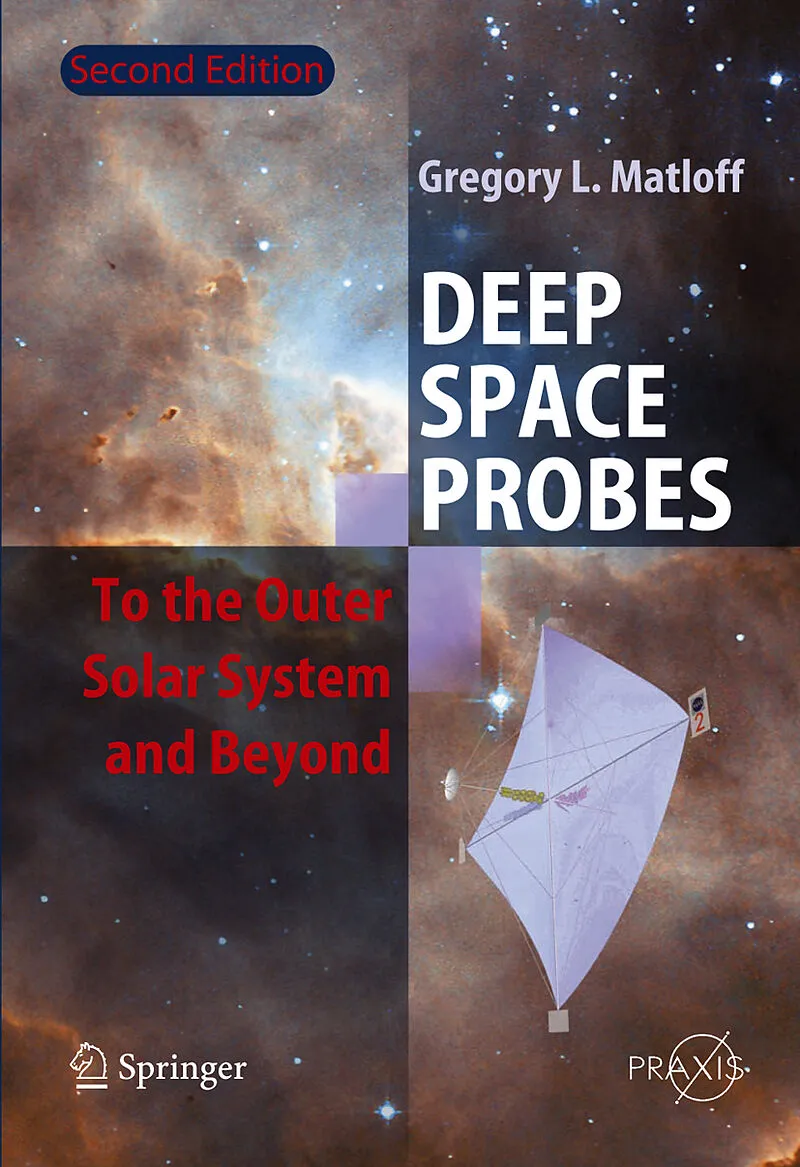
There is currently tremendous interest in the search for extrasolar life and extraterrestrial intelligence, and this is expressed by financial backing from NASA for extrasolar exploration by space probes. This book will be an authoritative and comprehensive su...There is currently tremendous interest in the search for extrasolar life and extraterrestrial intelligence, and this is expressed by financial backing from NASA for extrasolar exploration by space probes. This book will be an authoritative and comprehensive survey of the present-day state of the art in the field of extrasolar and interstellar space exploration, focusing on the most promising techniques. "Deep-Space Probes" will appeal to a wide audience, including non-technical readers as well as engineering/physics graduates. Drawing upon his experience as a Faculty Fellow at the NASA Marshall Spaceflight Center, the author has attempted to make the book as up to date as possible.
The Space Age is nearly 50 years old but exploration of the outer planets and beyond has only just begun. Deep-Space Probes Second Edition draws on the latest research to explain why we should explore beyond the edge of the Solar System and how we can build highly sophisticated robot spacecraft to make the journey. Many technical problems remain to be solved, among them propulsion systems to permit far higher velocities, and technologies to build vehicles a fraction of the size of today's spacecraft.
Beyond the range of effective radio control, robot vehicles for exploring deep space will need to be intelligent, 'thinking' craft able to make vital decisions entirely on their own. Gregory Matloff also looks at the possibility for human travel into interstellar space, and some of the immense problems that such journeys would entail.
This second edition includes an entirely new chapter on holographic message plaques for future interstellar probes a NASA-funded project.
Deep-Space Probes will appeal to a wide audience, including non-technical readers as well as engineering/physics graduates Drawing upon his experience as a Faculty Fellow at the NASA Marshall Spaceflight Center, the author has attempted to make the book as up to date as possible
Autorentext
Giovanni Vulpetti received his Ph.D. in plasma physics in 1973. Subsequently, he specialized in astrodynamics. He wrote many tens of scientific papers about astrodynamics, advanced propulsion concepts, and interstellar flight, with particular regard to matter-antimatter annihilation propulsion. In 1979, he joined Telespazio SpA (Rome, Italy). From 1995 to 2011, he has attended the committee for Lunar Base & Mars exploration of the International Academy of Astronautics (IAA). He has been involving in solar-photon sailing since 1992. In the 1990s, he found out new types of sailcraft trajectories and published his theory mainly on Acta Astronautica, JPL workshops, and IAA symposia. In 1994, he was elected a Full Member of IAA. In spring 1997, he was a consultant at ESA/ESTEC about the solar-sail mission concept Daedalus. In 1979-2004, he contributed to 11 Italian and European space programs. In 2001, he was a consultant at NASA/MSFC for the NASA Interstellar Probe. In the course of two decades, he accomplished some large computer codes devoted to mission analysis & trajectory optimization via rockets and/or solar-sails. In the 90s, he was a member of the IAA committee for small satellites and, consequently, he participated in the design of Telespazio TemiSat (launched in August 1993). During 2006-2007, he joined Galilean Plus (Rome, Italy) as chief scientist, and participated in the program of the Italian Space Agency for lunar explorations. To date, he has published about 120 research papers and reports. He was a COSPAR-Associate in 2002-2007. In 2009 and 2014, he served as managing guest editor of Acta Astronautica special issues. He wrote the book Fast Solar Sailing, Astrodynamics of Special Sailcraft Trajectories, Space Technology Library 30, Springer 2012. Since spring 2013, he has been a guest lecturer on the physics of in-space propulsion at the Dept. of Astronautical Engineering of University of Rome 'La Sapienza'. Les Johnson is a physicist at NASA's Marshall Space Flight Center in Huntsville, Alabama, where he serves as the Senior Technical Advisor for the Advanced Concepts Office. He was a Co-Investigator on the Japanese T-Rex space tether experiment, the Principal Investigator of the NASA ProSEDS mission, and the first manager of NASA's In-Space Propulsion Technology Project. He holds three patents and was thrice awarded NASA's Exceptional Achievement Medal. He is a TEDx speaker, was the featured "interstellar explorer" in National Geographic's January 2013 issue, and a member of the Advisory Board for The Journal of the British Interplanetary Society. Les and his wife, Carol, have two children and live in Madison, Alabama (a satellite community of Huntsville - the original "Rocket City, USA!"). Greg Matloff is a leading expert in possibilities for interstellar propulsion , especially near-Sun solar-sail trajectories that might ultimately enable interstellar travel, and is an astronomy professor with the physics department of New York City College of Technology, CUNY, a consultant with NASA Marshall Space Flight Center, a Hayden Associate of the American Museum of Natural History and a Member of the International Academy of Astronautics. He co-authored with Les Johnson of NASA and C Bangs Paradise Regained (2009), Living Off the Land in Space (2007) and has authored Deep-Space Probes (edition 1: 2000 and edition 2: 2005). As well as authoring More Telescope Power (2002), Telescope Power (1993), The Urban Astronomer (1991), he co-authored with Eugene Mallove The Starflight Handbook. (1989). His papers on interstellar travel, the search for extraterrestrial artifacts, and methods of protecting Earth from asteroid impacts have been published in JBIS, Acta Astronautica, Spaceflight, ,Space Technology, Journal of Astronautical Sciences, and Mercury. His popular articleshave appeared in many publications, including Analog and IEEE Spectrum. In 1998, he won a $5000 prize in the international essay contest o
Inhalt
Motivations for deep-space travel.- The realms of space.- Tomorrow's targets.- Space propulsion today.- The incredible shrinking spaceprobe.- The nuclear option.- 21st century starflight.- On the technological horizon.- Exotic possibilities.- Of stars, planets and life.- Life between the stars.- Conscious spacecraft.- Meeting ET.- Interstellar message plaques.- Appendix: Photon sail history, engineering and mission analysis.
Tief- preis