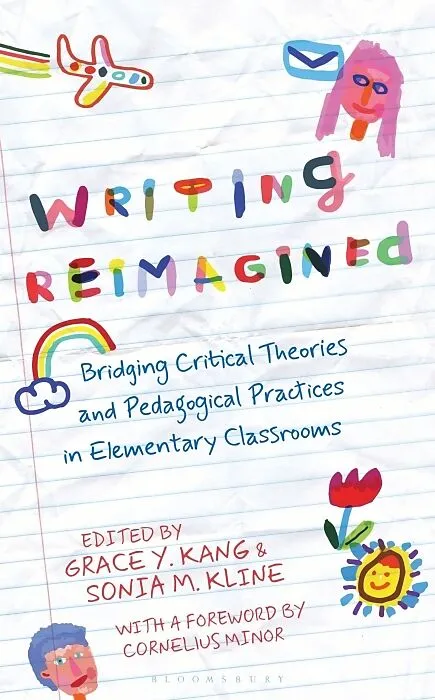
Writing Reimagined
Beschreibung
Writing Reimagined responds to an urgent need to challenge prevailing norms that offer limited perspectives on what it means to write and teach writing. By providing a broad understanding of writing and foregrounding issues of diversity, equity, inclusion, and...Format auswählen
- Fester EinbandCHF 101.20

Wird oft zusammen gekauft
Andere Kunden kauften auch
Beschreibung
Writing Reimagined responds to an urgent need to challenge prevailing norms that offer limited perspectives on what it means to write and teach writing. By providing a broad understanding of writing and foregrounding issues of diversity, equity, inclusion, and intersectionality, this book empowers educators to make meaningful shifts in their instructional approaches that disrupt oppressive systems of power and elevate the voices of young writers. Written for pre-service teachers, classroom educators, and teacher educators, the book provides a powerful synthesis of critical pedagogy and a framework for bridging critical theories and classroom practice in elementary classrooms. The book presents the central tenets of critical humanizing pedagogy and illuminates approaches to writing instruction that include: - Creating a collaborative classroom community that honors and values students'' multiple identities, grammars, and languages, ensuring this is reflected in their selection of books, curriculum materials, and teaching practices. - Supporting students to compose texts in a wide range of forms for a wide range of social purposes, including those not typically privileged in schools. - Positioning students as competent researchers and writers with the agency to investigate their queries and passions and negotiate writing projects and assessments. - Providing various technologies and digital tools to enable students to compose in multiple modalities and share beyond classroom walls. - Guiding students to cultivate critical consciousness and establish classroom communities where brave and rich conversations occur, and equity, anti-racism, and inclusion are centered. Through the contributions of multiple equity-centered writing scholars and educators, readers are introduced to a series of essential critical concepts, including identity, community, pop culture, play, resistance, multilingualism, multimodality, and trauma. Each chapter contains powerful examples designed to inspire and equip educators to bring critical humanizing pedagogies to life in their own classrooms. Ultimately, the book empowers teachers to create learning communities where young writers act with agency to compose for justice and joy. ...
Autorentext
Grace Kang is Professor of Elementary Education and Literacy at Illinois State University. Both her teaching and research focus on critical and humanizing perspectives and culturally sustaining pedagogies and practices around literacy. Specifically, her research centers on and elevates critical orientations in teaching writing in the elementary grades, as well as in teacher education. Dr. Kang is the co-founder of the Diversity and Equity cohort, where she has developed a partnership with Champaign Unit 4 schools and Illinois State University. She serves on the Language and Litearcies for All Board. Additionally, she has written over 20 peer- reviewed articles and book chapters, and has over 20 presentations at professional conferences and professional development sessions. Currently, she is one of the co-editors of the Literacy Research Association Journal, Literacy Methods Research Teaching and Practice. * Dr.
Sonia Kline is Professor of Elementary Education and Literacy at Illinois State University. She advocates for approaches to teaching that involve valuing students' social, cultural, and linguistic resources and highlighting issues of power, equity, and social justice. She engages learners in critical inquiry, deep reflection, and collaborative learning, making visible the complex processes of literacy teaching and learning. The overarching purpose of Dr. Kline's research is to illuminate broad and disrupt narrow understanding of literacy. Her scholarship centers on literacy in teacher education and writing as a sociocultural and sociopolitical activity. Dr. Kline has published articles and book chapters in many venues, including Language Arts, the Reading Teacher, and the Teacher Education Quarterly. She is currently a co-editor of the Literacy Research Association Journal, Literacy Methods Research Teaching and Practice*.
Klappentext
This book invites educators to rethink writing instruction in ways that are joyful, purposeful, and justice-driven. Grounded in humanizing pedagogy, critical literacy, and culturally sustaining pedagogy, this book affirms the brilliance of elementary children and their teachers, positioning them as powerful storytellers, thinkers, and changemakers.
Focusing on elementary education-a space often underrepresented in social justice education-this volume features contributions from both emerging and established equity-centered educators and scholars. Each chapter explores one of ten interrelated concepts: identity, translanguaging, raciolinguistics, trauma, multimodality, pop culture, play, activism, resistance, and love.
This book is more than a collection of strategies-it's a flexible framework, a set of generative pathways, and a call to action. Together, these elements honor teachers' autonomy and local knowledge while inviting educators to examine assumptions, deepen understanding, and reimagine writing pedagogy in ways that are both critical and humanizing.
Written for pre-service teachers, classroom educators, and teacher educators, this book weaves together insights from critical theory-ideas that illuminate power, identity, and justice-with concrete classroom practices.
Ultimately, this book invites educators and students to co-create writing communities rooted in agency, justice, and joy.
Inhalt
Foreword by Cornelius Minor
Preface by Grace Kang and Sonia Kline
Introduction: What is Critical Humanizing Writing Pedagogy? by Grace Kang and Sonia Kline
Chapter 1: Identity
At the Core: Student Identities and Writing Instruction in the Elementary Classroom by Katie Peachy and Crystal Chen-Lee
Chapter 2: Translanguaging
Translanguaging Writing Pedagogy to Leverage Multilingual Writers' Funds of Knowledge and Identity by Margarita Gómez and Joanna Wong
Chapter 3: Raciolinguistics
Critical Cultural Language and Revolutionary Love in Writing Instruction: Centering Cultural Language as Resistance, Belonging, and Affirmation by Roberta Gardner and Sanjuana Rodriguez
Chapter 4: Trauma
"We go through a story together": Considering Trauma in Critical, Humanizing Writing Classrooms by Elizabeth Dutro
Chapter 5: Multimodality
The Power and Promise of Multimodal Composition for Enacting Critical Humanizing Writing Pedagogies by Shawna Coppola
Chapter 6: Pop Culture
Powerful "X-people" and Rhythmic "Teen-age-ers": Popular Culture in Childhood Composing by Anne Haas Dyson
Chapter 7: Play
Storying Identity as Curricular Practice: The Multimodal Resonances of Play and Writing by Haeny Yoon
Chapter 8: Activism
Environmental Artivism as a Critical Multimodal Writing Pedagogy by Rebecca Woodard and Kristine Schutz
Chapter 9: Resistance
Writing as Resistance: Poetic Inquiry as a Liberatory Practice in the Classroom by Darius Phelps
Chapter 10: Love
Revolutionary Love: A Critical Approach for Teaching Young Writers by Michele Myers
Closing Thoughts by Grace Kang and Sonia Kline