Haben Sie noch nichts passendes gefunden? Stöbern Sie durch unser komplettes Sortiment.
Oder melden Sie sich an bzw. registrieren Sie sich.


Beschreibung
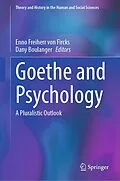
Goethe and Psychology: A Pluralistic Outlook explores the deep and often overlooked connections between Johann Wolfgang von Goethe's philosophical worldview and contemporary psychology. It argues that Goethe's holistic natural philosophyparticularly his rejec...Goethe and Psychology: A Pluralistic Outlook explores the deep and often overlooked connections between Johann Wolfgang von Goethe's philosophical worldview and contemporary psychology. It argues that Goethe's holistic natural philosophyparticularly his rejection of a strict subject-object dichotomyoffers valuable insights for modern psychological research, particularly in fields such as phenomenology, cultural psychology, and psychography. The book is divided into multiple sections, addressing both applied and theoretical advancements in what could be termed "Goethian Psychology." It examines Goethe's contributions to fields beyond literature, including his work in color theory, natural sciences, and philosophical anthropology. Various authors discuss how Goethe's ideas can inform contemporary psychological research, whether through the development of alternative research protocols, analyses of his literary works through a psychological lens, or critiques of mainstream psychology's overreliance on quantification. This perspective is complemented by translated chapters from major psychologists and philosophers analyzing the work of Goethe the majority of chapters having been unpublished in English (Jonas Cohn, Georg Simmel, Wilhelm Dilthey). The book ultimately advocates for a more pluralistic and interdisciplinary approach to psychology that integrates Goethe's legacy.
Offers a groundbreaking synthesis of Goethe's natural philosophy and modern psychology Argues for a holistic, interconnected view of perception and conduct that challenges mainstream psychological paradigms Challenges reductionist methodologies and advocates for a richer, more integrated understanding of human experience
Autorentext
Enno von Fircks, PhD is a psychologist and scholar whose work is situated at the intersection of cultural psychology, personology, and leadership studies. His research focuses on the role of culture in shaping personality, action, and social organization, with particular attention to historical context, lived experience, and the microgenetic development of meaning. Drawing on intellectual traditions associated with William Stern and Ernest E. Boesch, von Fircks has contributed to the renewal of person-centered and culturally grounded approaches within modern psychology.
Von Fircks’s scholarship is characterized by its interdisciplinary orientation, combining psychological theory with historical, sociocultural, and biographical analysis. His work frequently explores how individuals and groups construct meaning within specific cultural lifeworlds and how these processes inform identity, leadership, and social cohesion.
His recent publications reflect a sustained engagement with cultural psychology and its applications to leadership, action, and historical communities. These include:
Inhalt
Chapter 1. Goethe's Legacy: Bridging Natural Philosophy and Psychology.- Chapter 2. Towards the Development of a Goethian Scientific Research Protocol: Making Sense of Folk Psychology.- Chapter 3. Reading Places: Transformative Methods in Applied Phenomenology and Goethean Science.- Chapter 4. Navigating Tensions: A Vygotskian Interpretation of Goethe's Faust as Psychoeducative Literature.- Chapter 5. Goethe flees. A cultural psychological examination of the stay in Rome from the perspectives of yearning and change.- Chapter 6. Goethe's Natural Philosophy: A Psychological Interpretation of the Prologue in Heaven in Faust I.- Chapter 7. Culture has no borders: Tranquil Reflections on Faust I.- Chapter 8. Why Goethe Should not be Considered an Early Psychoanalyst.- Chapter 9. Goethe's Delicate Empiricism and the Sharing of Emotional Meaning through Music: parallels and thoughts .- Chapter 10. Development of the Psyche: Carl Gustav Carus and Johann Wolfgang Goethe.- Chapter 11. Goethe; or, the Writer by Emerson, R.W..- Chapter 12. Goethe by W. Dilthey .- Chapter 13. Goethe Development by G. Simmel .- Chapter 14. Goethe's Philosopy by P. Carus.- Chapter 15. The Kantian Element in Goethe's Worldview. Schiller's Philosophical Influence on Goethe by Jonas Cohn .- Chapter 16. Goethe and Psychology: Pathways to a Future Research Agenda.
Tief- preis