Composite Sampling
Beschreibung
This monograph provides a comprehensive statistical account of composite sampling as an ingenious environmental sampling method to help accomplish observational economy in a variety of environmental and ecological studies. Sampling consists of selection, acqui...Format auswählen
- Kartonierter EinbandCHF 126.35
- Fester EinbandCHF 156.95

Wird oft zusammen gekauft
Andere Kunden kauften auch
Beschreibung
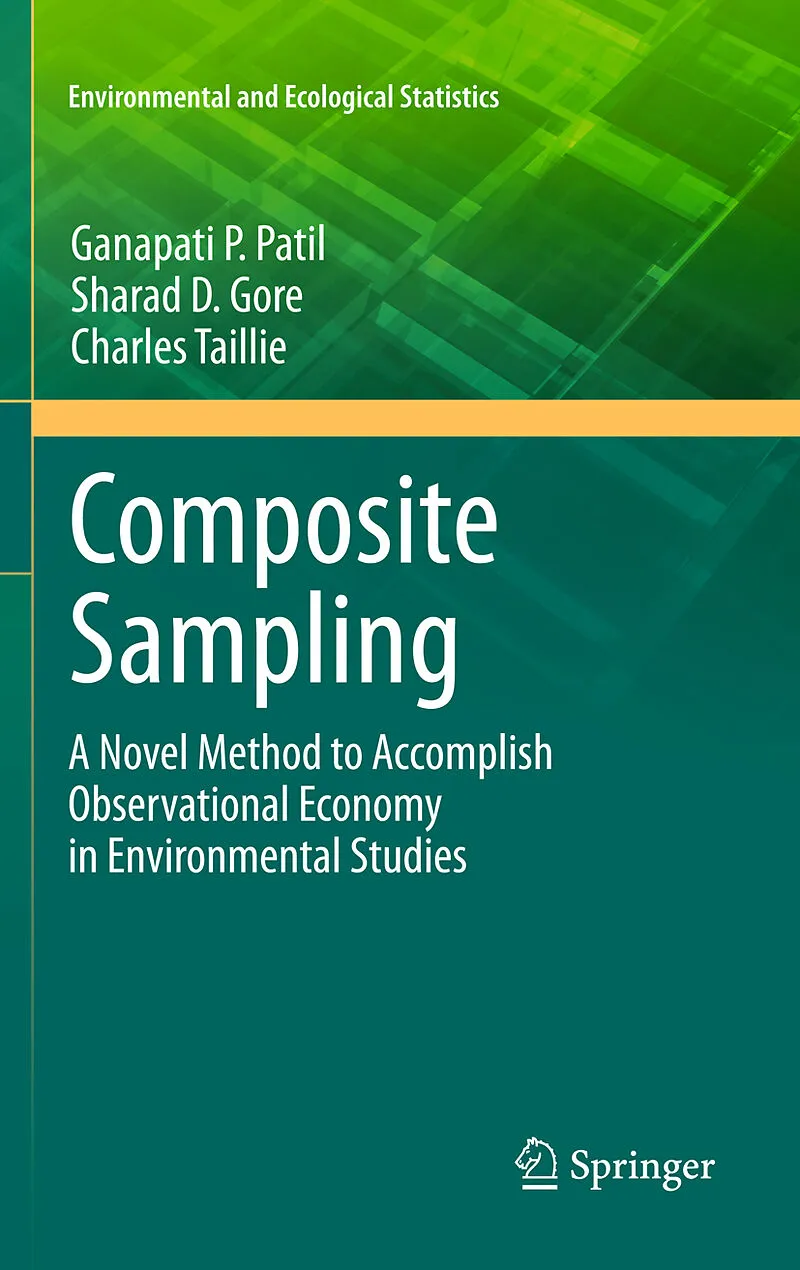
This monograph provides a comprehensive statistical account of composite sampling as an ingenious environmental sampling method to help accomplish observational economy in a variety of environmental and ecological studies.
Sampling consists of selection, acquisition, and quantification of a part of the population. While selection and acquisition apply to physical sampling units of the population, quantification pertains only to the variable of interest, which is a particular characteristic of the sampling units. A sampling procedure is expected to provide a sample that is representative with respect to some specified criteria. Composite sampling, under idealized conditions, incurs no loss of information for estimating the population means. But an important limitation to the method has been the loss of information on individual sample values, such as, the extremely large value. In many of the situations where individual sample values are of interest or concern, composite sampling methods can be suitably modified to retrieve the information on individual sample values that may be lost due to compositing. This book presents statistical solutions to issues that arise in the context of applications of composite sampling.
Presents statistical solutions to issues that arise in the context of applications of composite sampling Gives emphasis to the most recent results that are not covered in review papers and other monographs Examines cost analysis of composite sampling, and why it is so difficult to determine expected measurements Includes supplementary material: sn.pub/extras
Autorentext
Dr. Wayne L. Myers earned M.F. and Ph.D. degrees in forest ecology and forest entomology at the University of Michigan. He began his professional career in Canada as a research forest entomologist and biometrician. He then joined the faculty of forestry at Michigan State University specializing in biometrics and remote sensing. The position at Michigan State also encompassed consultancies with the U.S. Forest Service and a work in Brazil. He moved to Penn State University in 1978 in the School of Forest Resources. He is professor of forest biometrics and Director of the Office for Remote Sensing and Spatial Information Resources (ORSSIR) in the Penn State Institutes of Environment. He has thirty-five years of experience in research on development of remote sensing, geographic information systems, and related spatial technologies with applications focusing on natural resources and environment. This extends back to participation as a co-investigator in early investigations of ERTS/LANDSAT as the first spaceborne civilian multispectral sensor. His recent research has focused on dual level progressive segmentation of multispectral images for purposes of compression, integration with geographic information systems and pattern-based change detection. He has developed concepts and computation of echelons of spatial structure in digital surfaces that facilitate extracting major change features from change indicator images. Echelons offer alternatives to thresholding in surface or pseudo-surface rasters. Dome domains provide a further generalization of topological structure in signal surfaces. He has extensive international experience including long-term advisory for the U.S. Agency for International Development in India and research fellowships in Malaysia. He has placed special emphasis on interdisciplinary research and team approach. G.P. Patil: is Distinguished Professor of Mathematical and Environmental Statistics in the Department of Statistics at the Pennsylvania State University, and is a former Visiting Professor of Biostatistics at Harvard University in the Harvard School of Public Health. He has a Ph.D. in Mathematics, D.Sc. in Statistics, one Honorary Degree in Biological Sciences, and another in Letters. GP is a Fellow of American Statistical Association, Fellow of American Association of Advancement of Science, Fellow of Institute of Mathematical Statistics, Elected Member of the International Statistical Institute, Founder Fellow of the National Institute of Ecology and the Society for Medical Statistics in India. GP has been a founder of Statistical Ecology Section of International Association for Ecology and Ecological Society of America, a founder of Statistics and Environment Section of American Statistical Association, and a founder of the International Society for Risk Analysis. He is founding editor-in-chief of the international journal, Environmental and Ecological Statistics and founding director of the Penn State Center for Statistical Ecology and Environmental Statistics. He has published thirty volumes and three hundred research papers. GP has received several distinguished awards which include: Distinguished Statistical Ecologist Award of the International Association for Ecology, Distinguished Achievement Medal for Statistics and the Environment of the American Statistical Association, Distinguished Twentieth Century Service Award for Statistical Ecology and Environmental Statistics of the Ninth Lukacs Symposium, Best Paper Award of the American Fisheries Society, and lately, the Best Paper Award of the American Water Resources Association, among others. Currently, GP is principal investigator of a multi-year NSF grant for surveillance geoinformatics for hotspot detection and prioritization across geographic regions and networks for digital government in the 21st Century.
Klappentext
This monograph provides, for the first time, a most comprehensive statistical account of composite sampling as an ingenious environmental sampling method to help accomplish observational economy in a variety of environmental and ecological studies. Sampling consists of selection, acquisition, and quantification of a part of the population. But often what is desirable is not affordable, and what is affordable is not adequate. How do we deal with this dilemma? Operationally, composite sampling recognizes the distinction between selection, acquisition, and quantification. In certain applications, it is a common experience that the costs of selection and acquisition are not very high, but the cost of quantification, or measurement, is substantially high. In such situations, one may select a sample sufficiently large to satisfy the requirement of representativeness and precision and then, by combining several sampling units into composites, reduce the cost of measurement to an affordable level. Thus composite sampling offers an approach to deal with the classical dilemma of desirable versus affordable sample sizes, when conventional statistical methods fail to resolve the problem. Composite sampling, at least under idealized conditions, incurs no loss of information for estimating the population means. But an important limitation to the method has been the loss of information on individual sample values, such as the extremely large value. In many of the situations where individual sample values are of interest or concern, composite sampling methods can be suitably modified to retrieve the information on individual sample values that may be lost due to compositing. In this monograph, we present statistical solutions to these and other issues that arise in the context of applications of composite sampling.
Inhalt
Introduction.- Classification.- Extreme Values.- Estimating Prevalence.- Bayesian Approach.- Inference on Mean and Variance.- Random Weights.- A Linear Model.- Site Characterization and Cleanup.- Spatial Structures.- Sampling of Soils and Sediments.- Sampling of Liquids and Fluids.- Indoor Air Pollution.- Bioaccumulation.- References.
Produktinformationen
Weitere Produkte aus der Reihe "Environmental and Ecological Statistics"


10%
- Composite Sampling
- Ganapati P. Patil, Sharad D. Gore, Charles Taillie

