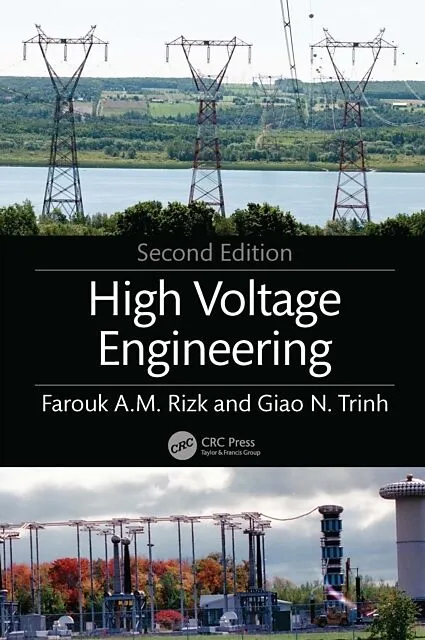
High Voltage Engineering
Beschreibung
Autorentext Farouk A.M. Rizk holds a BSc Eng and an MSc from Cairo University; a PhD from the Royal Institute of Technology, Stockholm, Sweden; and a DTech from Chalmers University of Technology, Gothenburg, Sweden. He worked as a research engineer with ASEA (...Format auswählen
- Fester EinbandCHF 328.00

Wird oft zusammen gekauft
Andere Kunden kauften auch
Beschreibung
Autorentext
Farouk A.M. Rizk holds a BSc Eng and an MSc from Cairo University; a PhD from the Royal Institute of Technology, Stockholm, Sweden; and a DTech from Chalmers University of Technology, Gothenburg, Sweden.
He worked as a research engineer with ASEA (ABB), Sweden, in the High Power Laboratory, Ludvika, from 1960 to 1963, and in the Computer Department, Vasteras, in 1963. He worked for the Egyptian Electricity Authority (1964-1971), becoming manager, High Voltage, in 1968. He joined the Hydro-Quec Institute of Research (IREQ) as a senior research scientist in 1972, subsequently passing from scientific director (1976) to vice president of laboratories (1986). He also held the title of fellow research scientist from 1986 to 1996.
His research work covers a wide range of topics in high voltage and high power engineering: arc dynamics in circuit breakers, polluted insulators, singleole switching, electromagnetic shielding, compressed gas and liquid breakdown, long air gaps, and lightning attachment.
He was elected IEEE fellow in 1982 "for contributions to the science of high voltage technology and for technical leadership in the advancement of the electric power industry." He has served as chairman of the 10th International Symposium on High Voltage Engineering (ISH) in 1997 and as chairman of the ISH Steering Committee. He received prize paper awards from the IEEE Transmission and Distribution Committee in 1989, 1991, and 1995 and from the Power Engineering Society of IEEE in 1996. He was awarded the IEEE Herman Halperin Electric Transmission Award in 1996 for outstanding contributions to electric power transmission and distribution. He is a distinguished member of the International Council on Large High Voltage Electrical Systems (CIGRE) and a recipient of the CIGRE Technical Committee Award, 1997.
He made major contributions to standardization work, particularly during his tenure as international chairman of IEC Technical Committee 28: Insulation Cordination, 1983-1996. Under his leadership, the whole area of insulation cordination was revised, which led to the new standards IEC 71and IEC 71 His efforts to promote insulation cordination of higholtage DC transmission led to standardization work now undertaken by IEC TC 28.
He currently serves as president of Lightning Electrotechnologies Inc., a lightning protection equipment manufacturer, and Expodev Inc., a consulting engineering firm, both of which are in Montrl, Quec, Canada.
Giao N. Trinh received his BSc in electrical engineering in 1963 and his PhD in high voltage engineering from Laval University, Quec City, Quec, Canada, in 1969. His study of corona discharges in atmospheric air helped establish the various corona discharge modes developed at high-voltage line conductors.
He joined the Hydrouebec Institute of Research (IREQ), Varennes, Quec, Canada, in 1968. Until 1977, he participated in various research activities, studying the corona performance of higholtage transmission lines up to the ultrigholtage level of 1,200 kV AC and 600 kV DC. His main contribution has been to the development of a method for evaluating the corona performance of higholtage line conductors, based on cageest results obtained under artificial rain conditions.
In 1978, his research activities shifted to the field of insulation of high-voltage equipment, and until 1997, he carried out studies on practical insulation systems, including the following:
- Gas insulation: He studied the influence of epoxy spacers on dielectric performance and the risk of burn-through of gas-insulated cables. He participated in the commissioning tests of the first few GIS introduced at Hydro-Quec in the Montrl region in the late 1970s.
- Power transformers: He studied the breakdown of large oil volumes, which clearly established the important role of particle contamination with regard to the withstand capability of transformer insulation.
- High-voltage cables: He participated in a study group on the feasibility of a river crossing for Hydro-Quec's 500 kV dc line at Grondines and participated in the testing of the type cable selected for the project. He holds two patents and is the author or coauthor of over 80 technical papers in the areas of corona and partialischarge phenomena; liquid, solid, and gaseous insulation; higholtage testing; and power equipment insulation. His main contribution has been in the field of gasnsulated cables, where his work on the assessment of the risk of burnhrough of gasnsulated cables earned him the 1993 prize paper award from the Substation Committee.
He was elected fellow of the IEEE in 1997 for his "contribution to understanding of dielectric and arc phenomena in gas insulated cables." He is a member of the Power Engineers Society (PES), where he participates in the activities of PESsulated Conductors and PES Substation Committees, and of the Dielectrics and Electrical Insulation Society (DEIS), where he has served as secretary of DEISCom from 1993 to 1994 and as chairman of the DEIS Statistics Committee from 1995 to 1997. From 1976 to 2002, he served as an invited professor at Ecole Polytechnique de Montrl, Montrl, Quebec, Canada, where he taught a graduate course on high voltage engineering. He currently serves as a consultant in high voltage engineering.
Klappentext
Inspired by a new revival of worldwide interest in exträhigh voltage (EHV) and ulträhigh voltage (UHV) transmission, High Voltage Engineering, Second Edition merges the latest research with the extensive experience of the best in the field to deliver a comprehensive treatment of electrical insulation systems for the next generation of utility engineers and electric power professionals. This book offers extensive coverage of the physical basis of high voltage engineering, from insulation stress and strength to lightning attachment and protection and beyond. Presenting information critical to the design, selection, testing, maintenance, and operation of a myriad of high voltage power equipment, this must have text:
- Discusses power system overvoltages, electric field calculation, and statistical analysis of ionization and breakdown phenomena essential for proper planning and interpretation of high voltage tests
- Considers the breakdown of gases (SF6), liquids (insulating oil), solids, and composite materials, as well as the breakdown characteristics of long air gaps
- Describes insulation systems currently used in high voltage engineering, including air insulation and insulators in overhead power transmission lines, gas insulated substation (GIS) and cables, oil paper insulation in power transformers, paper oil insulation in high voltage cables, and polymer insulation in cables
- Examines contemporary practices in insulation coordination in association with the International Electrotechnical Commission (IEC) definition and the latest standards
- Explores high voltage testing and measuring techniques, from the generation of test voltages to digital measuring methods With an emphasis on handling practical situations encountered in the operation of high voltage power equipment, High Voltage Engineering, Second Edition provides readers with a detailed, real world understanding of electrical insulation systems, including the various factors affecting-and the actual means of evaluating-insulation performance and their application in the establishment of technical specifications.
Inhalt
- Power System Overvoltages. 2. Electric Field Calculation. 3. Application of Statistical Analysis in High Voltage Engineering 4. Electric Breakdown in Gases. 5. Breakdown Characteristics of Long Air Gaps. 6. Electric Breakdown in Liquids. 7. Electric Breakdown in Solids and Composite Materials. 8. Selection of Overhead Transmission Line Conductors. 9. Lightning Incidence and Lightning Protection. 10. High-Voltage Insulators. 11. High-Voltage (Underground) Cables. 12.…