
IHR WARENKORB IST AKTUELL LEER.
Haben Sie noch nichts passendes gefunden? Stöbern Sie durch unser komplettes Sortiment.
Oder melden Sie sich an bzw. registrieren Sie sich.
- Kostenlose Lieferung
- Kauf auf Rechnung
- Ex Libris Tiefpreis
- Filiallieferung und 650+ Abholorte
- Rabatt-Bons als Club-Mitglied
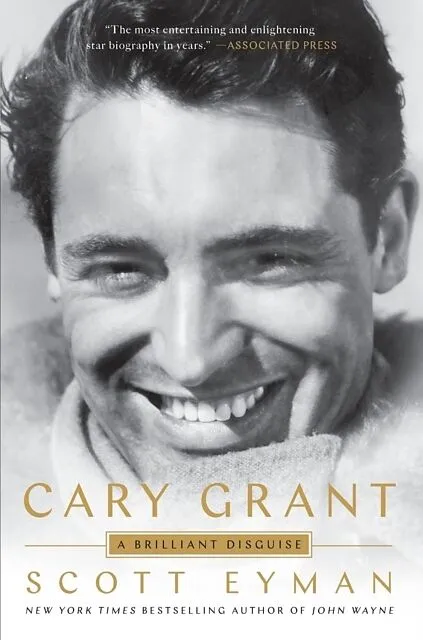
Cary Grant
Beschreibung
Autorentext Scott Eyman is the author or coauthor of eighteen books, including the bestseller John Wayne and Pieces of My Heart and You Must Remember This with actor Robert Wagner. Eyman, formerly the literary critic at&...Format auswählen
- Kartonierter EinbandCHF 21.90

Wird oft zusammen gekauft
Andere Kunden kauften auch
Beschreibung
Autorentext
Scott Eyman is the author or coauthor of eighteen books, including the bestseller John Wayne and Pieces of My Heart and You Must Remember This with actor Robert Wagner. Eyman, formerly the literary critic at The Palm Beach Post, also writes book reviews for The Wall Street Journal, and has written for The New York Times, The Washington Post, and the Chicago Tribune. He and his wife, Lynn, live in West Palm Beach.
Klappentext
Film historian and acclaimed New York Times bestselling biographer Scott Eyman has written the definitive, “captivating” (Associated Press) biography of Hollywood legend Cary Grant, one of the most accomplished—and beloved—actors of his generation, who remains as popular as ever today.
Born Archibald Leach in 1904, he came to America as a teenaged acrobat to find fame and fortune, but he was always haunted by his past. His father was a feckless alcoholic, and his mother was committed to an asylum when Archie was eleven years old. He believed her to be dead until he was informed she was alive when he was thirty-one years old. Because of this experience, Grant would have difficulty forming close attachments throughout his life. He married five times and had numerous affairs.
Despite a remarkable degree of success, Grant remained deeply conflicted about his past, his present, his basic identity, and even the public that worshipped him in movies such as Gunga Din, Notorious, and North by Northwest.
This “estimable and empathetic biography” (The Washington Post) draws on Grant’s own papers, extensive archival research, and interviews with family and friends making it a definitive and “complex portrait of Hollywood’s original leading man” (Entertainment Weekly).
Zusammenfassung
Film historian and acclaimed bestselling biographer Scott Eyman has written the definitive, biography of Hollywood legend Cary Grant, one of the most accomplished actors of his generation, who remains as popular as ever today.
Leseprobe
Prologue PROLOGUE
Fate rarely writes the perfect ending.
Eleanora Duse died in Pittsburgh, Pennsylvania.
John Huston died in Middletown, Rhode Island.
And Cary Grant died in Davenport, Iowa.
He had been doing “A Conversation with Cary Grant” for several years, playing second- and third-tier towns, avoiding New York, Chicago, or Los Angeles in favor of Fort Lauderdale, Joliet, and Schenectady. As Grant explained to Douglas Fairbanks Jr., a good friend since they costarred in Gunga Din, he did the show for “jam money.” Fairbanks found this amusing since, as he would confide, “Cary’s still got the first dollar he ever earned.”
“A Conversation with Cary Grant” began with eight minutes of film clips, ending with a shot of Grant walking out to accept his honorary Academy Award in 1970. As the screen showed Grant in 1970, a spotlight would hit him striding onto the stage, invariably meeting with thunderous applause. He had maintained the trim figure of his movie star prime; his only apparent concessions to age were a full head of white hair and glasses with heavy black rims. They were identical to the glasses worn by Lew Wasserman, the head of MCA-Universal, who had made Grant extremely wealthy. Grant told Doug Fairbanks that he chose the large rims because he didn’t want to go to the trouble of plastic surgery, and the rims covered the bags under his eyes.
Grant would take his place on a stool, and after a brief introduction, take questions, generally from women in various stages of emotional distress at being in the same geographic space as Cary Grant.
“You look gorgeous—what’s your secret?”
“Who was your favorite leading lady?”
“What was it like to kiss Grace Kelly?”
The answers were, in order, think thin, Grace Kelly, and divine. His least favorite leading lady was Mae West, whose choice of a youthful Grant as her leading man in She Done Him Wrong and I’m No Angel gave him a large career boost. Nevertheless, he was not grateful. “She was all contrivance, all artifice,” he said. “I don’t like artifice in a woman.”
Occasionally, there were uncomfortable moments. In Stamford, he was asked about both Sophia Loren and Randolph Scott. And in February 1984, while speaking at Johns Hopkins University in Baltimore, things teetered uncomfortably. Before Grant was introduced, the audience was told there would be no photographs and no autographs, the latter a pet peeve since he became a star a half-century before.
That night in Baltimore, the first question came from a man in the rear of the audience. In a put-upon voice, the man begged for an autograph. “I don’t give autographs,” said Grant, who attempted to be light and casual about it. But the man would not let go, claiming the autograph was for a crippled child who was counting the hours until he had Cary Grant’s autograph.
“Yes, yes,” said Grant, whose patience was obviously wearing thin. “You’re obviously the same man who previously requested an autograph at the stage door. I’d sent word to you then that I’d sign one for you before leaving. But it’s the only one I’ll sign tonight, I’ll tell you that!”
A young man named Greg Mank was in the audience and thought it was possible that Grant might storm off and end the evening prematurely. Grant went on at some length, fretfully talking about how autograph hounds harass celebrities and make it impossible for them to go out in public. But he gradually sensed that the audience was on his side and began to relax. The show continued. He told the audience that, while he wouldn’t sign autographs after the show, they were welcome to come to the front of the stage and shake his hand.
That night in Baltimore, and in all the other cities, he was cumulatively charming, funny, and demonstrated excellent recall. He talked about a simple thing like mixing a drink in a scene. You had to mix the drink correctly or someone in the audience would be sure to notice and complain, but at the same time you also had to make sure to hit your marks and remember the dialogue. If you dropped ice cubes in the glass you had to do it gently, so the sound of the ice hitting the glass wouldn’t make a distracting sound. He made it sound like a six-ball juggle, a technical and creative burden that was accompanied by a load of tension no matter the level of feigned nonchalance camouflaging a very real professional expertise.
Grant was a marvelously skilled ringmaster at controlling his audience. As far as he was concerned, the shows were a chance to be seen and to be reassured that he was remembered. As if anybody could forget Cary Grant.
Grant’s ease in front of audiences confounded his friends, because for most of his life he had been a nervous wreck whenever he had to make any kind of speech in public, no matter how innocuous. Even a prepared speech would give him weeks of anxiety, but over the years he managed quite well with press conferences to promote his films. He would sit amongst the reporters and answer questions in a tone that never strayed far from the light touch people expected from Cary Grant. It was those apparently relaxed sessions with reporters that Grant sought to replicate with “A Conversation with Cary Grant.”
He expected the mixture as before when he arrived in Davenport by private plane on Friday evening, November 28, 1986. The Saturday performance would be the thirty-seventh time he did the show. It was the crowning event of a four-day event Davenpo…