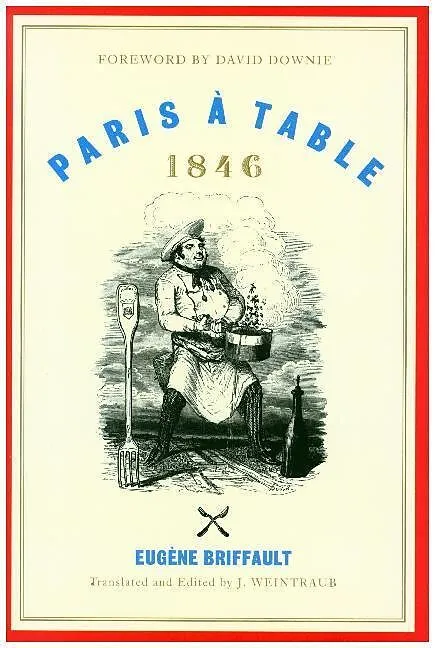
Paris À Table
Beschreibung
Paris à Table: 1846 is the first translation in English of a seminal book on gastronomy. Focusing on the Parisian dining scene, it takes the reader from the most elegant restaurant to a laborer's meals on the street, offering "the richest view of Bal...Format auswählen
- Fester EinbandCHF 35.60

Wird oft zusammen gekauft
Andere Kunden kauften auch
Beschreibung
Paris à Table: 1846 is the first translation in English of a seminal book on gastronomy. Focusing on the Parisian dining scene, it takes the reader from the most elegant restaurant to a laborer's meals on the street, offering "the richest view of Balzac's time seen from the table" (Le Monde).
Paris à Table: 1846 is the first English translation of a seminal book in the literature of nineteenth-century gastronomy, a work described by Le Monde as "the richest view of Balzac's time seen from the table." It was written by the journalist Eugène Briffault, well-known in his day as a theater critic and chronicler of contemporary Paris, but also as a bon-vivant, celebrated for his ability to quaff a magnum of champagne from a bell jar in a single draft and well-qualified to write authoritatively about the culinary culture of Paris. Focusing on the manners, customs, and "moeurs" of the dining scene, the author takes the reader from the opulence of a dinner at the Rothschilds through every social stratum down to the laborer eating on the streets. He surveys the restaurants of the previous generation and his own-from the most elegant to the lowest dive-along with the eating habits of the bourgeoisie, the importance and variety of banquets, the institutional meal, and even the plight of "people who do not dine." Briffault was also a fine storyteller, and the book is a compendium of culinary anecdotes, from the tantrums of a king deprived of his spinach to the tragedy of "the friendliest pig that was ever seen." The edition also includes the humorous drawings of the caricaturist Bertall, artwork that cleverly reinforces the witty and ironic tone that pervades the text. Along with an introduction -which provides the first modern biography of the author and analyses the place of Paris à Table in the literary culture of the time--the text is copiously annotated, acquainting readers with the events and characters that appear in the narrative and providing an entryway to the author's Paris, the city Walter Benjamin characterized as "the capital of the nineteenth century."
Historians, enthusiasts and anyone who teaches in English about nineteenth-century France will be glad to have this new translation of Briffault's famous book on the dinners and diners of mid-nineteenth-century Paris ... J. Weintraub's skillful translation maintains the breezy but serious tone of the original, and the footnotes throughout offer the kinds of explanations destined to make this a useful teaching tool as well as a good read ... Reading this book, one gains a colourful impression of the primacy of food in the life of the city, and of the multiple identities defined in relation to the types of food on offer and the places where people ate them.
Autorentext
Eugène Briffault (1799-1854) was an editor, journalist, theater critic, and man-of-letters, who, as a chronicler of contemporary Paris, contributed to many anthologies and periodicals of his day. J. Weintraub is a Chicago writer, dramatist, poet, and translator. His work has appeared in many literary journals, regional publications, and such journals as Gastronomica: The Journal of Critical Food Studies. David Downie is the author of fourteen books, most recently A Passion for Paris: Romanticism and Romance in the City of Light and A Taste of Paris: A History of the Parisian Love Affair with Food. His website is www.davidddownie.com.
Inhalt
Acknowledgments
Foreword TK
Introduction Dinner in the Current Age: A Translation from Paris à table
Chapter I Introduction: The Parisian Dinner
Chapter II The History of Dinner up to Our Time
Chapter III Dinner in the Current Age
Chapter IV Varieties of Dinner
Chapter V People Who Do Not Dine
Chapter VI Breakfast
Chapter VII Luncheon
Chapter VIII Supper
Chapter IX Clubs, Cercles, Tables d'Hôte, Pensions Bourgeoises, Rest Homes
Chapter X The Restaurants of Paris
Chapter XI Eccentricities