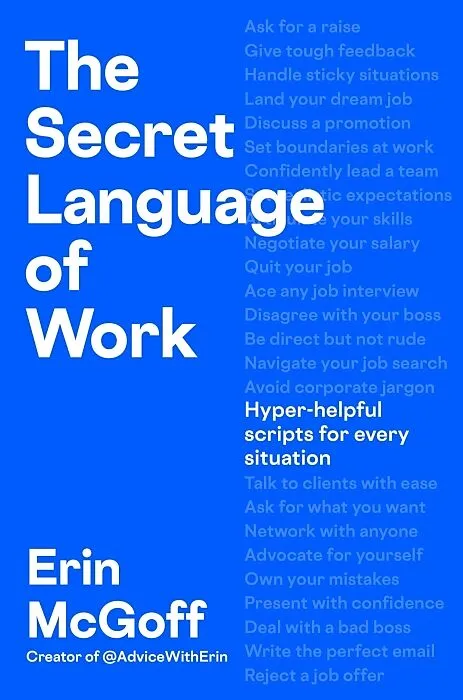
The Secret Language of Work
Beschreibung
From the creator of AdviceWithErin, the definitive book on how to use the right words at work--so you can build the career you deserve We’ve all been there: you’re sweating, sitting in front of your laptop, and the interviewer on the screen says, &...Format auswählen
- Fester EinbandCHF 31.60
Wird oft zusammen gekauft
Andere Kunden kauften auch
Beschreibung
From the creator of AdviceWithErin, the definitive book on how to use the right words at work--so you can build the career you deserve We’ve all been there: you’re sweating, sitting in front of your laptop, and the interviewer on the screen says, “Tell me about yourself.” You freeze. Is that even a question? What are they expecting from you? If that paragraph made your heart beat a little faster, TikTok star, career educator, and “the internet’s big sister” Erin McGoff is here to help. In Learning how to say the right words, in the right order, in the right way, at the right time, is an art that too few people are taught. Stellar communication is probably the most valuable skill you can possess--and once you know the secret language of work, you will be able to confidently tackle anything your sure-to-be outstanding career presents to you.
Autorentext
Erin McGoff
Klappentext
**NEW YORK TIMES BESTSELLER!
From the creator of AdviceWithErin, the definitive book on how to use the right words at work—so you can build the career you deserve**
We’ve all been there: you’re sweating, sitting in front of your laptop, and the interviewer on the screen says, “Tell me about yourself.” You freeze. Is that even a question? What are they expecting from you? What do you say?
If that paragraph made your heart beat a little faster, TikTok star, career educator, and “the internet’s big sister” Erin McGoff is here to help. In The Secret Language of Work, McGoff shares her best, customizable scripts for how to communicate in the professional world—word-for-word, exactly what to say during interviews, while negotiating salaries, when you need to set boundaries with co-workers, as you advocate for yourself, and in any sticky situation at the office. With McGoff’s advice, you will master the unwritten rules of work speak that are key to career advancement.
Learning how to say the right words, in the right order, in the right way, at the right time, is an art that too few people are taught. Stellar communication is probably the most valuable skill you can possess—and once you know the secret language of work, you will be able to confidently tackle anything your sure-to-be outstanding career presents to you.
Leseprobe
Chapter 1
Change Your Words, Change Your Life
Clear is kind. Unclear is unkind.
-Brené Brown
When I was a freshman in college, I landed an internship at a small commercial film production company. In my interview, I was eager to please. I said I could do anything! I'd stay late, work hard, and do whatever needed to be done-even "sweep the floors" if I had to. (Yes, I actually said that.) I pictured myself drafting call sheets, organizing the gear room, shaking hands with celebrities on set, reviewing scripts, and learning from directors. I was so excited!
But the truth is, I had no idea what I was doing. I was merely a guppy out in the big blue sea, faking it until I made it. This was my first time working in a corporate environment, and I didn't know what to expect or what would be expected of me. What should I wear? Should I get to work early? How could I impress everyone around me?
To my dismay, I showed up on my first day (overdressed and too early) and was introduced to my first task by an unenthusiastic post-production manager. "You need to organize these files. It's pretty self-explanatory," he said and left me alone in a dark, windowless room. It was just me, Excel, a hard drive, and a broken dream.
I looked at the screen and saw files-lots and lots of files. I had to cross-reference them with a spreadsheet. It was menial, tedious, boring, and unglamorous. (I mean, there were no celebrities!)
I quickly grew bitter. This was an unpaid internship. I was giving up three half days a week-days I could have spent working at a paid job-to do some random tasks alone in a room while learning nothing about filmmaking. I wondered if this was even legal.
But . . . I had told them I'd do anything, right? I couldn't blame them . . . right? In my interview, I had basically promised to do just this. I decided that as a rookie intern, I just had to bite my tongue.
Another producer who worked at the production company checked in on me every now and then (probably for proof of life). She was so nice, and I was hoping that one day she'd come to my rescue. But when she asked me how everything was going, I responded, "Great!" I didn't know how to say in a professional way, "I'm so bored I want to rip out my hair. Is there literally anything else I could do?"
Meanwhile, the aforementioned unenthusiastic post-production manager was often nowhere to be found. (I guess he was my boss? It was never clear.) When he did show his face, I'd remind him of my existence and ask him to check my work. I waited eagerly, daydreaming of him snapping out of it and saying, "You're still doing this? I have a commercial that needs editing. How about you take over as our lead editor?" But alas, he never did.
It continued on like this for an entire semester. I eventually realized that I could get my work done pretty efficiently and spend the rest of the time watching Vimeo Staff Picks, eating Chinese takeout, and doing homework. But overall, the internship was a bust. I learned very little and met almost no one.
It took me years to realize that to a great extent this was my fault. See, I never vocalized . . . well . . . anything. I wanted to be happy-go-lucky and help out wherever I could. I didn't want to offend anyone by complaining about the work I was being assigned. And I assumed that if I did a good job at my tasks, the people around me would notice and eventually give me more interesting things to work on. That, my friends, was my first crucial mistake: assuming anything about anyone, anytime, anywhere.
As my career progressed, I was able to observe and absorb the secret language of work-the language that highly successful people know how to speak to get what they want. I witnessed businesswomen smiling and even laughing as they negotiated deals. I saw colleagues smartly challenge each other on ideas and give blunt feedback that somehow wasn't offensive. I saw folks articulate their thoughts, share opinions, lead conversations, and make tough decisions, all without any emotional baggage attached.
These people knew how to communicate professionally and perfectly curate their words to communicate what they meant. They would never sit in a windowless room eating Chinese food for an entire semester. They would have looked at that room on day one and said, "Yeah, this isn't going to work for me." But, you know, in a professional way.
In fact, these folks probably wouldn't have been in that room in the first place because they would have asserted themselves in the interview. Maybe they would even have managed to negotiate for a stipend so that the internship wasn't completely unpaid. They knew how to professionally, effortlessly, and joyfully advocate for themselves. I had so much to learn.
After that internship, I became obsessed with mastering the art of professional communication. How could I take my honest thoughts and turn them into effective, strategic communication? How could I be direct without being rude, confident without being cocky, assertive without being arrogant, and successful while still being liked? How could I learn this secret language that magically made everyone listen to and like me, all while still getting my way?
It took me awhile, but through a lot of trial and error, I learned all this, and I went on to craft my dream career by using the secret language of work. After a few years of studying this hidden curriculum, I no longer had to blindly send résumés to apply for jobs or vent to my friends…