IHR WARENKORB IST AKTUELL LEER.
Haben Sie noch nichts passendes gefunden? Stöbern Sie durch unser komplettes Sortiment.
Oder melden Sie sich an bzw. registrieren Sie sich.
- Kostenlose Lieferung
- Kauf auf Rechnung
- Ex Libris Tiefpreis
- Filiallieferung und 650+ Abholorte
- Rabatt-Bons als Club-Mitglied
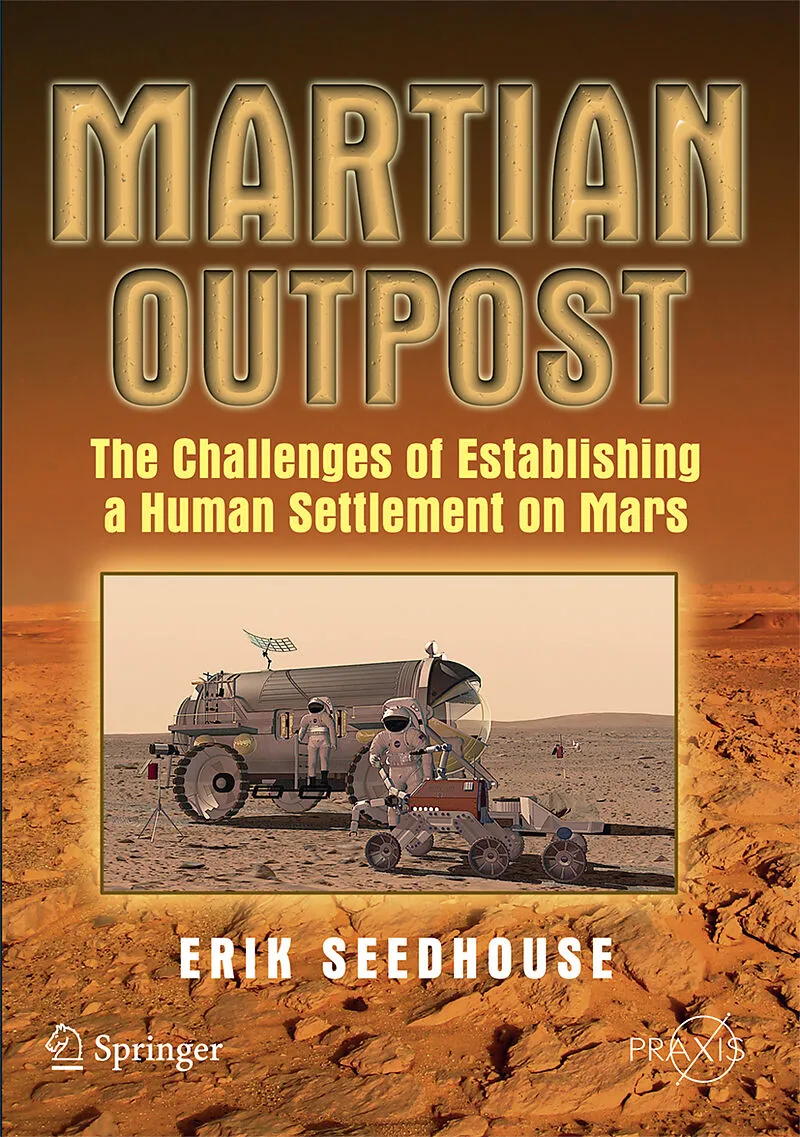
Martian Outpost
Beschreibung
This book thoroughly details how humans will get to Mars. It fully covers crew preparation and mission trajectories and explains an adaptable and mobile exploration architecture that will enable long-term human exploration of the planet. Mars Outpost provides ...Format auswählen
- Kartonierter EinbandCHF 40.70

Wird oft zusammen gekauft
Andere Kunden kauften auch
Beschreibung
This book thoroughly details how humans will get to Mars. It fully covers crew preparation and mission trajectories and explains an adaptable and mobile exploration architecture that will enable long-term human exploration of the planet.
Mars Outpost provides a detailed insight into the various technologies, mission architectures, medical requirements, and training needed to send humans to Mars. It focuses on mission objectives and benefits, and the risks and complexities that are compounded when linked to an overall planet exploration program involving several expeditions and setting up a permanent presence on the surface.
The first section provides the background to sending a human mission to Mars. Analogies are made with early polar exploration and the expeditions of Shackleton, Amundsen, and Mawson. The interplanetary plans of the European Space Agency, NASA, and Russia are examined, including the possibility of one or more nations joining forces to send humans to Mars. Current mission architectures, such as NASA's Constellation, ESA's Aurora, and Ross Tierney's DIRECT, are described and evaluated.
The next section looks at how humans will get to the Red Planet, beginning with the preparation of the crew. The author examines the various analogues to understand the problems Mars-bound astronauts will face. Additional chapters describe the transportation hardware necessary to launch 4-6 astronauts on an interplanetary trajectory to Mars, including the cutting edge engineering and design of life support systems required to protect crews for more than a year from the lethal radiation encountered in deep space. NASA's current plan is to use standard chemical propulsion technology, but eventually Mars crews will take advantage of advanced propulsion concepts, such as the Variable Specific Impulse Magnetoplasma Rocket, ion drives and nuclear propulsion.
The interplanetary options for reaching Mars, as well as the major propulsive maneuvers required and the trajectories and energy requirements for manned and unmanned payloads, are reviewed . Another chapter addresses the daunting medical problems andavailable countermeasures for humans embarking on a mission to Mars: the insidious effects of radiation on the human body and the deleterious consequences of bone and muscle deconditioning. Crew selection will be considered, bearing in mind the strong possibility that they may not be able to return to Earth. Still another chapter describes the guidance, navigation, and control system architecture, as well as the lander design requirements and crew tasks and responsibilities required to touch down on the Red Planet.
Section 3 looks at the surface mission architectures. Seedhouse describes such problems as radiation, extreme temperatures, and construction challenges that will be encountered by colonists. He examines proposed concepts for transporting cargo and astronauts long distances across the Martian surface using magnetic levitation systems, permanent rail systems, and flying vehicles. In the penultimate chapter of the book, the author explains an adaptable and mobile exploration architecture that will enable long-term human exploration of Mars, perhaps making it the next space-based tourist location.
Focuses on the human performance factors in manned Mars missions, such as radiation hazards, bone deconditioning, and the behavioral challenges of prolonged isolation Describes various tools and approaches used in selecting and training future Mars crew members Provides unique insight into revolutionary mission architectures that will enable long-term exploration of the Martian surface
Autorentext
Erik Seedhouse is a Norwegian-Canadian suborbital astronaut whose life-long ambition to work in space is one step closer to being realized thanks to the organization that provided the inspiration for this book. After completing his first degree in Sports Science at Northumbria University, the author joined the legendary 2nd Battalion the Parachute Regiment, the world's most elite airborne regiment. During his time in the "Para's," Erik spent six months in Belize, where he was trained in the art of jungle warfare and conducted several border patrols along the Belize-Guatemala border. Later, he spent several months learning the intricacies of desert warfare on the Akamas Range in Cyprus. He made more than 30 jumps from a Hercules C130 aircraft, performed more than 200 helicopter abseils, and fired more light anti-tank weapons than he cares to remember! Upon returning to the comparatively mundane world of academia, the author embarked upon a Master's degree in Medical Science at Sheffield University. He supported his studies by winning prize money in 100 km ultradistance running races. Shortly after placing third in the World 100 km Championships in 1992 and setting the North American 100 km record, the author turned to ultradistance triathlon, winning the World Endurance Triathlon Championships in 1995 and 1996. For good measure, he also won the inaugural World Double Ironman Championships in 1995 and the infamous Decatriathlon, the world's longest triathlon - an event requiring competitors to swim 38 km, cycle 1,800 km, and run 422 km. Non-stop! Returning the academia once again in 1996, Erik pursued his Ph.D. at the German Space Agency's Institute for Space Medicine. While conducting his Ph.D. studies, he still found time to win Ultraman Hawai'i and the European Ultraman Championships as well as completing the Race Across America (RAAM) bike race. Due to his success as the world's leading ultradistance triathlete, Erik was featured in dozens ofmagazines and television interviews. In 1997, GQ magazine nominated him as the "Fitted Man in the World." In 1999, Erik decided it was time to get a real job. He retired from being a professional triathlete and started his post-doctorial studies at Vancouver's Simon Fraser University's School of Kinesiology. In 2005, the author worked as an astronaut training consultant for Bigelow Aerospace in Las Vegas and wrote Tourists in Space, a training manual for spaceflight participants. He is a Fellow of the British Interplanetary Society and a member of the Space Medical Association. Recently, he was one of the final 30 candidates of the Canadian Space Agency's Astronaut Recruitment Campaign. Erik works as a manned spaceflight consultant, professional speaker, triathlon coach, and author. He is the Training Director for Astronauts for Hire (www.astronauts4hire.org) and completed his suborbital astronaut training in May 2011. He is eligible for spaceflight assignments and plans to travel into space as an A4H astronaut on board one ore more (hopefully several!) of the commercial spacecraft written about in this book. In addition to being a suborbital astronaut, triathlete, skydiver, pilot, and author, Erik is an avid mountaineer and is currently pursuing his goal of climbing the Seven Summits. Astronauts for Hire is his ninth book. When not writing, he spend as much time as possible in Kona on the Big Island of Hawai'i and at his real home in Sandefjord, Norway. Erik is owned by three rambunctious cats - Jasper, Mini-Mach, and Lava - none of whom has expressed any desire to travel into space but who nevertheless provided invaluable assistance in writing this book (!).
Inhalt
Why go?.- Interplanetary plans.- Mission architectures.- Abort modes and the challenges of entry, descent and landing.- Propulsion systems.- Mars hardware.- Crew selection and training.- Biomedical and behavioral issues.- Voyage to Mars.- Exploration activities and surface systems.- Extreme EXPeditionary Architecture.