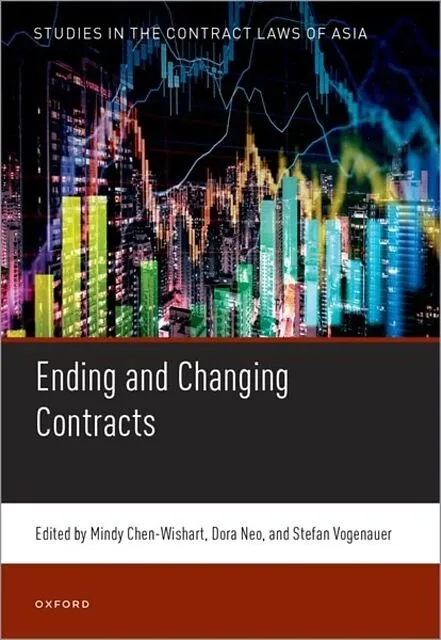
Ending and Changing Contracts
Beschreibung
Autorentext Mindy Chen-Wishart is Provost's Professor at National University of Singapore. Until 2023, she was Dean, and Professor at Faculty of Law, Oxford University and Fellow of Merton College. She has authored numerous articles on the theory, doctrines an...Format auswählen
- Fester EinbandCHF 235.20

Wird oft zusammen gekauft
Andere Kunden kauften auch
Beschreibung
Autorentext
Mindy Chen-Wishart is Provost's Professor at National University of Singapore. Until 2023, she was Dean, and Professor at Faculty of Law, Oxford University and Fellow of Merton College. She has authored numerous articles on the theory, doctrines and comparative law of contract, including an international prize-winning article. She is an Editor of Chitty on Contracts (36th ed) and Elgar Handbook in the Philosophy of Contract law. She authored Contract Law, 7th ed (OUP). In 2024, she received an Honorary Doctor of Laws from Otago University, and a Lifetime Achievement Award at the International Conference on Contracts (KCON XVII).
Dora Neo is an Associate Professor at the Faculty of Law, National University of Singapore. She was the founding Director of the Faculty's Centre for Banking & Finance Law which she led for ten years. She has authored and edited books, chapters and articles on trade finance law, secured transactions law, trade in services, and contract law. She is a graduate of Oxford University and Harvard Law School and is a non-practising member of the Bar in London (Gray's Inn) and in Singapore.
Stefan Vogenauer is Head of the Department 'European and Comparative Legal History' at the Max Planck Institute for Legal History and Legal Theory, Frankfurt. Prior to his current positions he held the Chair of Comparative Law at the University of Oxford (2003-15), where he also served as Director of the Oxford Institute of European and Comparative Law and Fellow of Brasenose College. He is a graduate of the University of Kiel (Germany) and the University of Oxford.
Klappentext
This fifth volume in the acclaimed Studies in the Contract Laws of Asia series offers a comprehensive comparative analysis of contract termination and change of circumstances across thirteen key Asian jurisdictions: China, India, Japan, Hong Kong, Taiwan, South Korea, Singapore, Malaysia, Myanmar, Vietnam, Thailand, the Philippines, and Indonesia.
Drawing on four major legal traditions-Napoleonic, German, common law, and the Indian Contracts Act-the volume explores how these Asian systems handle core issues such as withholding performance, termination for breach, impossibility, and adaptation of contracts under unforeseen hardship. While many jurisdictions converge on basic principles, striking differences emerge in how they allocate risk and define fairness, particularly in response to changing circumstances.
From Indonesia's requirement of judicial termination to China's unique approach to court-led contract adaptation, this volume reveals the deep influence of historical legal traditions and modern innovations on current commercial practice. It highlights both the complexity and richness of Asian contract laws, offering valuable insights for scholars, practitioners, and policymakers seeking to understand or harmonize legal approaches in a rapidly evolving economic region.
Inhalt
1: Mindy CHEN-WISHART, Dora NEO, and Stefan VOGENAUER: Introduction
2: Andrew PHANG: On Comparative Analysis as well as Ending and Changing Contracts
CHINA: CHANGING CIRCUMSTANCES
3: WANG Lei: Change of Circumstances in China's Civil Legislation and Judicial Practice
CHINA: ENDING CONTRACTS
4: Lei CHEN and Zhicheng WU: Termination of Contract in Chinese Law
HONG KONG: CHANGING CIRCUMSTANCES
5: Stephen HALL: Contract Terms in Hong Kong: Changed Circumstances and Variation
HONG KONG: ENDING CONTRACTS
6: Kelvin FK LOW: Termination of Contracts in Hong Kong
INDIA: CHANGING CIRCUMSTANCES
7: Chitra NARAYAN and R Yashod VARDHAN: Changes in Circumstances and their Impact on Contractual Obligations in India
INDIA: ENDING CONTRACTS
8: R Yashod VARDHAN and Chitra NARAYAN: Discharge of Performance and Termination of Contracts in India
INDONESIA: CHANGING CIRCUMSTANCES
9: Gary F BELL: Change of Circumstances in the Indonesian Law of Obligations
INDONESIA: ENDING CONTRACTS
10: HERLIANA: Termination of Contracts under Indonesian Law
JAPAN: CHANGING CIRCUMSTANCES
11: Eriko TAOKA: Ending and Changing Performance under Japanese Law
JAPAN: ENDING CONTRACTS
12: Akira KAMO: Termination of Contracts under Japanese Law
KOREA: CHANGING CIRCUMSTANCES
13: KWON Youngjoon: Change of Circumstances: Korea
KOREA: ENDING CONTRACTS
14: AHN Tae-Yong: Termination under Korean Law
MALAYSIA: CHANGING CIRCUMSTANCES
15: Yin Harn LEE and May Fong CHEONG: Change of Circumstances: The Position under Malaysian Contract Law
MALAYSIA: ENDING CONTRACTS
16: May Fong CHEONG and Yin Harn LEE: Termination of Contracts: The Position under Malaysian Contract Law
MYANMAR: CHANGING CIRCUMSTANCES AND ENDING CONTRACTS
17: Adrian BRIGGS: Myanmar: Change of Circumstances and Termination of Contract for Breach
PHILIPPINES: CHANGING CIRCUMSTANCES
18: Ma. Ngina Teresa CHAN-GONZAGA: Revision of Contracts in the Philippines: The Ramifications of a Change of Circumstances
PHILIPPINES: ENDING CONTRACTS
19: Michael Anthony C DIZON: Rescission of Contracts in the Philippines: Ending Performance and Extinguishing Obligations
SINGAPORE: CHANGING CIRCUMSTANCES
20: Dora NEO: Contractual Obligations and Change of Circumstances in Singapore
SINGAPORE: ENDING CONTRACTS
21: Chee Ho THAM: Termination under Singapore Law
TAIWAN: CHANGING CIRCUMSTANCES
22: Tsung-fu CHEN: The Doctrine of Change of Circumstances in Taiwanese Law
TAIWAN: ENDING CONTRACTS
23: Sheng-Lin JAN: Termination and Rescission under Taiwanese Contract Law
THAILAND: CHANGING CIRCUMSTANCES
24: Munin PONGSAPAN: A Change of Circumstances in Thai Law
THAILAND: ENDING CONTRACTS
25: Nadnaphas LEAKPECH: Termination of Contracts in Thai Law
VIETNAM: CHANGING CIRCUMSTANCES
26: DO Giang Nam: Change of Circumstances under Vietnamese Contract Law
VIETNAM: ENDING CONTRACTS
27: TRAN Kien: Termination of Contracts under Vietnamese Law
28: Hugh BEALE: Ending Contracts and Changing Circumstances in Asia: Comparative Conclusions