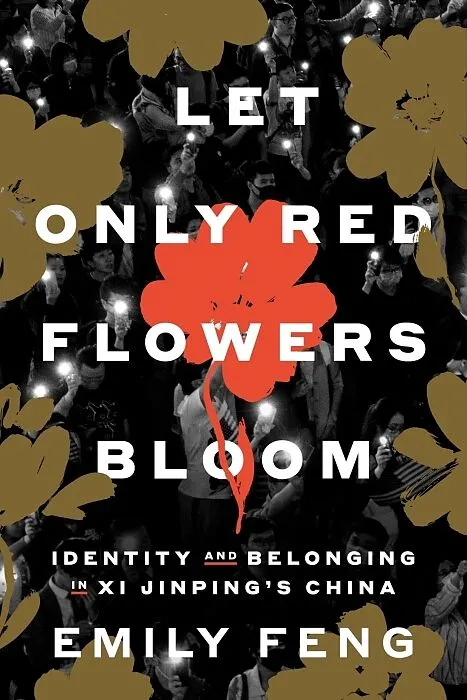
Let Only Red Flowers Bloom
Beschreibung
A deeply reported investigation into the battle over identity in China, chronicling the state oppression of those who fail to conform to Xi Jinping''s definition of who is "Chinese," from an award-winning NPR correspondent. In the hot summer months of 2021, Ch...Format auswählen
- Fester EinbandCHF 30.30

Wird oft zusammen gekauft
Andere Kunden kauften auch
Beschreibung
A deeply reported investigation into the battle over identity in China, chronicling the state oppression of those who fail to conform to Xi Jinping''s definition of who is "Chinese," from an award-winning NPR correspondent. In the hot summer months of 2021, China celebrated the 100th anniversary of the founding of the Communist Party. Authorities held propaganda and education campaigns across the country defining the ideal Chinese citizen: ethnically Han Chinese, Mandarin speaking, solidly atheist, and devoted to the socialist project of strengthening China against western powers.; No one can understand modern China--including its response to the pandemic--without understanding who actually lives there, and the ways that the Chinese State tries to control its people. Illuminating a country that has for too long been secretive of the real lives its citizens are living, Feng reveals what it’s really like to be anything other than party-supporting Han Chinese in China, and the myriad ways they’re trying to survive in the face of an oppressive regime.
Autorentext
Emily Feng is an award-winning international correspondent for NPR. She’s a regular contributor to NPR podcasts and member stations and she is also a frequent guest on U.S. and BBC radio and television programs. Previously based in Beijing, China for NPR, she now lives in Taipei, Taiwan.
Klappentext
A “gripping and scrupulously reported” (The Washington Post) investigation into the battle over identity in China, chronicling the state oppression of those who fail to conform to Xi Jinping’s definition of who is “Chinese,” from an award-winning NPR correspondent.
“Emily Feng’s focus on ordinary people—bravely determined to shape their own lives—captures the mood of the Xi Jinping era more essentially than reams of statistics ever can.”—Evan Osnos, National Book Award winner, author of Age of Ambition
A WASHINGTON POST BEST BOOK OF THE YEAR
The rise of China and its great power competition with the U.S. will be one of the defining issues of our generation. But to understand modern China, one has to understand the people who live there – and the way the Chinese state is trying to control them along lines of identity and free expression.
In vivid, cinematic detail, Let Only Red Flowers Bloom tells the stories of nearly two dozen people who are pushing back. They include a Uyghur family, separated as China detains hundreds of thousands of their fellow Uyghurs in camps; human rights lawyers fighting to defend civil liberties in the face of mammoth odds; a teacher from Inner Mongolia, forced to make hard choices because of his support of his mother tongue; and a Hong Kong fugitive trying to find a new home and live in freedom.
Reporting despite the personal risks, journalist Emily Feng reveals dramatic human stories of resistance and survival in a country that is increasingly closing itself off to the world. Feng illustrates what it is like to run against the grain in China, and the myriad ways people are trying to survive, with dignity.
Leseprobe
Chapter 1
The Lawyer
Yang Bin was born wanting more. Her parents had wanted her to be like them: factory workers with a stable income, a guaranteed pension, and state-assigned housing. They both worked at a state-run auto parts factory that never closed even though it almost never turned a profit. But Yang was consumed by a gnawing sense that the purpose of her life could be bigger.
In person, she exudes energy: gregarious, with bright eyes and deep dimples that appear whenever she smiles or laughs (which is frequent), but her easy confidence was learned. As a young girl, she was shy and prone to blushing. She was born in the midst of the Cultural Revolution, a decade of political violence starting in the 1960s that killed at least an estimated half-million people, and she learned to value compliance. Growing up, her parents hinted darkly at previous purges under Chairman Mao Zedong, who ruled the Communist Party until his death in 1976. These tales taught her that standing out made one an easy target in the next political campaign that cropped up. At university, she chose what she thought would be the politically safest major: a now-nonexistent field of study called Building Chinese Socialism, an arcane discipline designed to study Deng Xiaoping’s famous phrase of creating a socialism “with Chinese characteristics.”
Yang had the good fortune to enter adulthood just after China was looking for a way to redefine itself post-Mao. Economic and political reforms begun in 1978 by Deng, a senior Party leader himself twice purged by Mao, meant people could choose their own jobs, if they dared, at the handful of new private businesses starting up. And so, after graduating in 1990, when Yang was offered a position to join her parents in the same factory danwei, or Communist work unit, she turned the offer down. Two decades ago, her actions would have been unimaginable, but she was of a new generation. “I did not want a life where I could already envision its ending,” she told me. While she didn’t exactly know what she wanted just yet, she did know with certainty that she was not going to find it in a Hunan provincial state company where “it is possible for a person to live and die in a ten-thousand-worker factory, from kindergarten to the mortuary home,” as she described it—the “iron rice bowl” of the socialist safety net.
Her search for adventure landed her in coastal Guangdong province, where her brother had already moved. It was a fortuitous choice. Yang quickly secured a job at a new, private pesticides factory. In the 1990s, in the heady days of China’s opening and reform policy, enormous financial opportunities were up for grabs after nearly four decades of strict ideological controls on the economy. Guangdong was in prime position to benefit given its proximity to the then-British colony of Hong Kong, where wealth and business acumen were plentiful. Guangdong’s massive port also made it an attractive location to place one of the country’s first economic pilot zones, where private businesses could set up and trade internationally, accelerating China’s economic opening.
When she was fired from the factory, which had sponsored her Guangdong residence papers, Yang couldn’t stomach the idea of returning home. One of the factory managers—a man she still calls her guardian angel—stepped in and arranged another job as a copy writer in a county-level prosecutor’s office. The job did not pay well, but it was a position in the civil service, coveted for its benefits and stability.
The job allowed her to reinvent herself. At the prosecutor’s office, it did not matter that she was the daughter of factory workers who had, just a few years earlier, been destined to be one herself; in Guangdong she could learn to be a servant of the law. She knew little then of the challenges ahead of her over the next four decades, and even if she did, she would not have changed her mind. Her career would put her on the front lines of a struggle to define a nascent Chinese system of law, to determine whose interests it fought for, and to decide what kind of country this system aspired to create. This was the purpose she had been looking for.
Yang started her career when much of China’s economic and Party system was up for reinvention, including the legal system. China wanted to build a more cosmopolitan legal system that governed by the rule of law. Controls on private businesses were lifting, and economic growth was booming after three decades of repressed demand. China would need fair courts and transparent laws to guide and con…