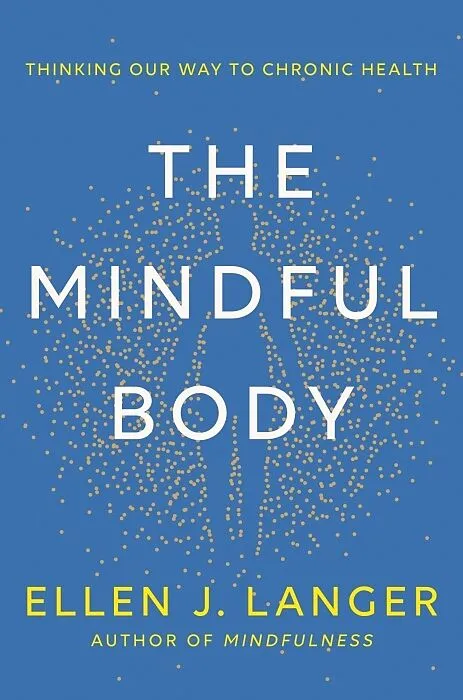
The Mindful Body
Beschreibung
Informationen zum Autor Ellen J. Langer, Ph.D., was the first woman to be tenured in psychology at Harvard, where she is still professor of psychology. The recipient of three Distinguished Scientist awards, the Arthur W. Staats Award for Unifying Psychology, a...Format auswählen
- Fester EinbandCHF 29.50

Wird oft zusammen gekauft
Andere Kunden kauften auch
Beschreibung
Informationen zum Autor Ellen J. Langer, Ph.D., was the first woman to be tenured in psychology at Harvard, where she is still professor of psychology. The recipient of three Distinguished Scientist awards, the Arthur W. Staats Award for Unifying Psychology, a Guggenheim Fellowship, and the Liberty Science Genius Award, Dr. Langer is the author of twelve books, including the international bestseller Mindfulness, as well as The Power of Mindful Learning, Counterclockwise, and On Becoming an Artist . Her trailblazing experiments in social psychology have earned her inclusion in The New York Times Magazine 's Year in Ideas issue. She is known worldwide as the mother of mindfulness and the mother of positive psychology. She lives in Cambridge, Massachusetts. Klappentext Learn how adjusting your thoughts can change your healthfrom the mother of mindfulness and first female tenured professor of psychology at Harvard. What matters more: mind or body? Filled with original research and thought-provoking insights, The Mindful Body shows that the two are not just connected but are actually one, opening us to vast potential for health and happiness.Dan Ariely, New York Times bestselling author of Predictably Irrational Can changing your thoughts improve your health? We tend to live our lives as though our ailmentsour stiff knees or frayed nerves or diminished eyesightcan change only in one direction: for the worse. Award-winning social psychologist Ellen J. Langer's life's work proves the fault in this negative outlook as well as the healing power of its alternative: mindfulnessthe process of active noticing where we are not bound by past experience or conventional wisdom. In The Mindful Body, Dr. Langer unpacks her assumption-busting findings and outlines her bold new theory of mind-body unity, along the way clearly demonstrating how our thoughts and perspectives have the potential to profoundly shape our well-being. Whether it is hotel chambermaids who lost weight when they simply came to see that their work constituted exercise, or patients whose wounds healed faster in rooms with accelerated clocks, she shows how influential our thoughts are to the state of our bodies. Her work has likewise proven that discouraging health news can have negative effects. Learning you are prediabetic, for exampleeven if your blood sugar reading is only a fraction away from normalmay actually play a part in the development of the disease. A paradigm-shifting book by one of the great psychologists of the twenty-first century, The Mindful Body returns the control over our bodies back to us and reveals that a true understanding of health begins with our minds. Leseprobe Chapter 1 Whose Rules? Any fool can make a rule. And any fool will mind it. Henry David Thoreau Rules are important but, in my view, they should guide not govern our behavior. We need to take a closer look at the creation and adherence to rules in general before we can more fully understand the problem mindless compliance to rules has on our health. Consider a simple, low-stakes example. I've been painting for decades, though I've never been formally trained. When I started to paint, I had no idea what the rules were. I didn't even know there were rules. Had I known, I think my own technique would have taken a different form. I am still amused when I go into an art supply store and see the labels indicating which brush to use for which effect, as if there were no other way to achieve itas if there were a right way and a wrong way. On occasion, I cut the hairs of my brushes to get a novel look. I'd like to think it is this originalitythe desire to create something different, a work of art that doesn't resemble anything elsethat makes my paintings interesting, at le...
Autorentext
Ellen J. Langer, Ph.D., was the first woman to be tenured in psychology at Harvard, where she is still professor of psychology. The recipient of three Distinguished Scientist awards, the Arthur W. Staats Award for Unifying Psychology, a Guggenheim Fellowship, and the Liberty Science Genius Award, Dr. Langer is the author of twelve books, including the international bestseller Mindfulness, as well as The Power of Mindful Learning, Counterclockwise, and On Becoming an Artist. Her trailblazing experiments in social psychology have earned her inclusion in The New York Times Magazine’s Year in Ideas issue. She is known worldwide as the “mother of mindfulness” and the “mother of positive psychology.” She lives in Cambridge, Massachusetts.
Klappentext
Learn how adjusting your thoughts can change your health—from the “mother of mindfulness” and first female tenured professor of psychology at Harvard.
“What matters more: mind or body? Filled with original research and thought-provoking insights, The Mindful Body shows that the two are not just connected but are actually one, opening us to vast potential for health and happiness.”—Dan Ariely, New York Times bestselling author of Predictably Irrational
Can changing your thoughts improve your health? We tend to live our lives as though our ailments—our stiff knees or frayed nerves or diminished eyesight—can change only in one direction: for the worse. Award-winning social psychologist Ellen J. Langer’s life’s work proves the fault in this negative outlook as well as the healing power of its alternative: mindfulness—the process of active noticing where we are not bound by past experience or conventional wisdom.
In The Mindful Body, Dr. Langer unpacks her assumption-busting findings and outlines her bold new theory of mind-body unity, along the way clearly demonstrating how our thoughts and perspectives have the potential to profoundly shape our well-being. Whether it is hotel chambermaids who lost weight when they simply came to see that their work constituted exercise, or patients whose wounds healed faster in rooms with accelerated clocks, she shows how influential our thoughts are to the state of our bodies. Her work has likewise proven that discouraging health news can have negative effects. Learning you are prediabetic, for example—even if your blood sugar reading is only a fraction away from “normal”—may actually play a part in the development of the disease.
A paradigm-shifting book by one of the great psychologists of the twenty-first century, The Mindful Body returns the control over our bodies back to us and reveals that a true understanding of health begins with our minds.
Leseprobe
**Chapter 1
Whose Rules?**
Any fool can make a rule. And any fool will mind it. —Henry David Thoreau
Rules are important but, in my view, they should guide not govern our behavior. We need to take a closer look at the creation and adherence to “rules” in general before we can more fully understand the problem mindless compliance to rules has on our health.
Consider a simple, low-stakes example. I’ve been painting for decades, though I’ve never been formally trained. When I started to paint, I had no idea what the rules were. I didn’t even know there were rules. Had I known, I think my own technique would have taken a different form. I am still amused when I go into an art supply store and see the labels indicating which brush to use for which effect, as if there were no other way to achieve it—as if there were a right way and a wrong way. On occasion, I cut the hairs of my brushes to get a novel look. I’d like to think it is this originality—the desire to create something different, a work of art that doesn’t resemble anything else—that makes my paintings interesting, at least to me. The novelty might not have been possible if I had rigidly followed the rules.
This attitude has def…