Beschreibung
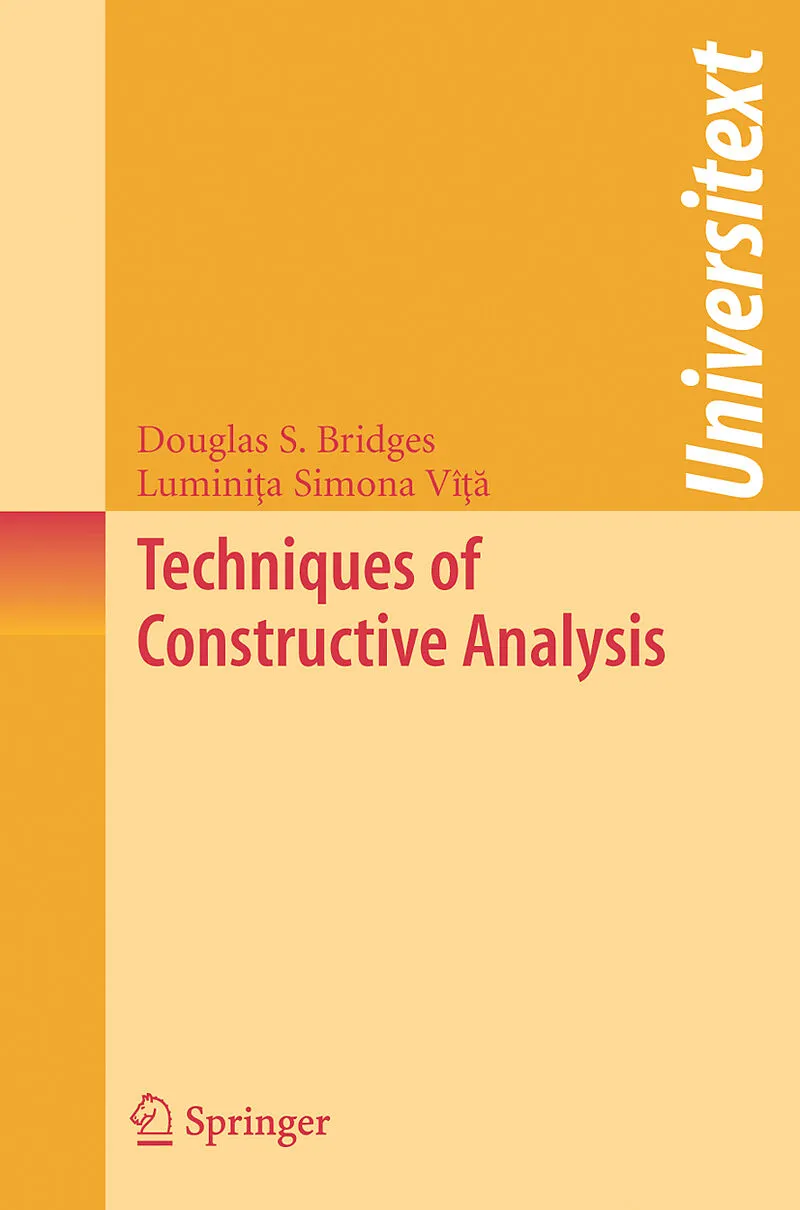
This book is an introduction to constructive mathematics with an emphasis on techniques and results that have been obtained in the last twenty years. There is specific focus on techniques and themes, and the book includes many simplified or improved proofs. On...This book is an introduction to constructive mathematics with an emphasis on techniques and results that have been obtained in the last twenty years. There is specific focus on techniques and themes, and the book includes many simplified or improved proofs.
Only book to deal with developments in Bishop-style constructive analysis over the past 20 years Specific focus on techniques and themes, and includes many simplified or improved proofs Instead of using classical logic, author uses intuitionistic logic Computer scientists interested in implementing mathematics will find it a good source of proofs from which to extract programs
Autorentext
Prof. Douglas S. Bridges is a professor of pure mathematics at the University of Canterbury. His research interests include the constructive foundations of analysis and topology; mathematical economics; computability and abstract complexity theory; and quantum logic. He has published many related articles and papers, among his 8 authored books are "Computability: A Mathematical Sketchbook", "Foundations of Real and Abstract Analysis", and "Techniques of Constructive Analysis". He is a Fellow of the Royal Society of New Zealand, and a Corresponding Fellow of the Royal Society of Edinburgh. Dr. Lumini a Simona Vî is an Adjunct Fellow of the Department of Mathematics and Statistics, University of Canterbury, and a Senior Business Analyst with the New Zealand Customs Service. Her research interests include constructive foundations of analysis and topology, and recursive function theory, computability and complexity. She has published many related articles and papers, and coauthored "Techniques of Constructive Analysis".
Klappentext
This text provides a rigorous, wide-ranging introduction to modern constructive analysis for anyone with a strong mathematical background who is interested in the challenge of developing mathematics algorithmically. The authors begin by outlining the history of constructive mathematics, and the logic and set theory that are used throughout the book. They then present a new construction of the real numbers, followed by the fundamentals of the constructive theory of metric and normed spaces; the lambda-technique (a special method that enables one to prove many results that appear, at first sight, to be nonconstructive); finite- dimensional and Hilbert spaces; and convexity, separation, and Hahn-Banach theorems. The book ends with a long chapter in which the work of the preceding ones is applied to operator theory and other aspects of functional analysis. Many results and proofs, especially in the later chapters, are of relatively recent origin.
The intended readership includes advanced undergraduates, postgraduates, and professional researchers in mathematics and theoretical computer science. With this book, the authors hope to spread the message that doing mathematics constructively is interesting and challenging, and produces new, deep computational information.
Inhalt
to Constructive Mathematics.- Techniques of Elementary Analysis.- The ?-Technique.- Finite-Dimensional and Hilbert Spaces.- Linearity and Convexity.- Operators and Locatedness.