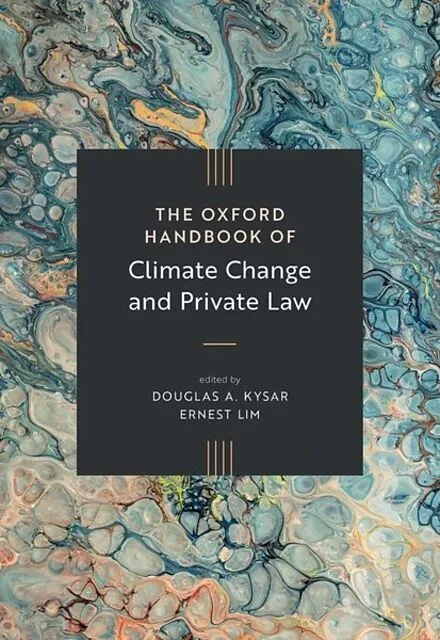
The Oxford Handbook of Climate Change and Private Law
Beschreibung
Autorentext Douglas Kysar is Joseph M. Field '55 Professor of Law at Yale University and faculty director of the Law, Environment and Animals Program. His teaching and research areas include torts, environmental law, climate change, animal law, products liabil...Format auswählen
- Fester EinbandCHF 213.20
Wird oft zusammen gekauft
Andere Kunden kauften auch
Beschreibung
Autorentext
Douglas Kysar is Joseph M. Field '55 Professor of Law at Yale University and faculty director of the Law, Environment and Animals Program. His teaching and research areas include torts, environmental law, climate change, animal law, products liability, and risk regulation. Kysar was previously on the faculty at Cornell Law School. He received his B.A. summa cum laude from Indiana University in 1995 and his J.D. magna cum laude from Harvard Law School in 1998. Following law school, he clerked for the Honorable William G. Young of the United States District Court for the District of Massachusetts.
Ernest Lim is the Chan Sek Keong Professor of Private Law and Vice Dean at the Faculty of Law, National University of Singapore. An internationally recognised scholar, his research expertise in comparative corporate governance and private law addresses critical global challenges: sustainability and artificial intelligence. He has delivered keynotes at leading universities across Asia, Europe, and the Middle East, and has acted as an expert witness on corporate law. He holds a doctorate from Oxford University and a master's from Harvard Law School. He previously practised law at Davis Polk & Wardwell LLP in New York and Hong Kong.
Klappentext
The Oxford Handbook of Climate Change and Private Law offers a comprehensive scholarly assessment of the impacts of climate change for private law. It brings together a team of world-leading experts to examine the interface between private law and climate change, including how existing private law can respond to climate change and whether private law itself might be impacted by climate change. This Handbook joins theory and practice through jurisdictional case studies from the EU, Africa, the U.S., China, and more. It also includes an analysis of emerging issues from artificial intelligence to the horizontal effect of human rights. This authoritative analysis charts the path toward a new private law, one capable of stewarding and sustaining human relationships within, and with, a world in transition.
Inhalt
Chapter 1: Douglas A. Kysar and Ernest Lim: Introduction
Part I. Theoretical Approaches to Private Law
Chapter 2: Michael Faure: Law and Economics
Chapter 3: K-Sue Park: Critical and Social Theory
Chapter 4: Avihay Dorfman: Relational Justice
Part II. Law of Obligations
Chapter 5: Eric W. Orts: Consumer Climate Contracts
Chapter 6: Irina Sakharova: Contract Law
Chapter 7: David Bullock: Common Law Torts
Chapter 8: Mark A. Geistfeld and Sandy Steel: Causation and Climate Change in Tort
Chapter 9: E. R. de Jong: Civil Law Torts
Chapter 10: Douglas A. Kysar: Products Liability
Chapter 11: Tiffanie Chan, Juliana Vélez Echeverri, Joana Setzer, and Catherine Higham: Consumer Protection
Chapter 12: Maytal Gilboa, Yotam Kaplan, and Roee Sarel: Unjust Enrichment and Climate Litigation
Chapter 13: Seth Davis and Gregory Shaffer: Fiduciary Law
Part III. Property
Chapter 14: J. B. Ruhl and Jim Rossi: Property Law
Chapter 15: Nicole Graham: Cultures of Land Use and Ownership
Chapter 16: Graham Reynolds: Intellectual Property
Chapter 17: Carla Spivack: Trusts
Part IV. Corporate and Commercial Law
Chapter 18: Ernest Lim: Corporate Law and Governance
Chapter 19: Maria Eduarda Lessa and Mariana Pargendler: Climate Disclosure in the Global South
Chapter 20: Arjuna Dibley: Finance
Chapter 21: Julian Nowag and Thomas Cheng: Competition Law
Chapter 22: Franziska Arnold-Dwyer: Insurance Law
Chapter 23: Virginia Harper Ho: Securities Regulation
Chapter 24: Joshua C. Macey: Bankruptcy Law
Chapter 25: Ying Zhu: International Commercial Arbitration
Chapter 26: Frances Flanagan: Labour Law
Chapter 27: Martin Davies: Maritime Law
Chapter 28: Kyla Tienhaara: Investor-State Disputes
Chapter 29: Barbara Pozzo: Corporate Sustainability and the European Union
Chapter 30: Cynthia A. Williams: Non-Governmental Organisations and Private Standard Setting
Chapter 31: Michael P. Vandenbergh and Paul C. Stern: Private Environmental Governance
Chapter 32: Ekaterina Aristova and Ugljea Grui : Private International Law
Part V. Area Perspectives
Chapter 33: Harro van Asselt and Jessica Crow: The European Union
Chapter 34: Kim Bouwer: The United Kingdom
Chapter 35: John C. Dernbach: The United States
Chapter 36: Umakanth Varottil: India
Chapter 37: Jacqueline Peel: Australasia
Chapter 38: Jolene Lin: East and Southeast Asia
Chapter 39: Uzuazo Etemire: Africa
Chapter 40: Yue Zhao and Yi Feng: China
Chapter 41: Danielle de Andrade Moreira: Brazil
Part VI. Emerging Issues
Chapter 42: Candida Leone: Legal Education
Chapter 43: Camila Bustos: Lawyers and Law Firms
Chapter 44: Jan-Erik Schirmer: Artificial Intelligence
Chapter 45: Olha O. Cherednychenko and Boudewijn de Bruin: The Horizontal Effect of Fundamental Rights
Chapter 46: Sam Bookman: Indigenous Peoples