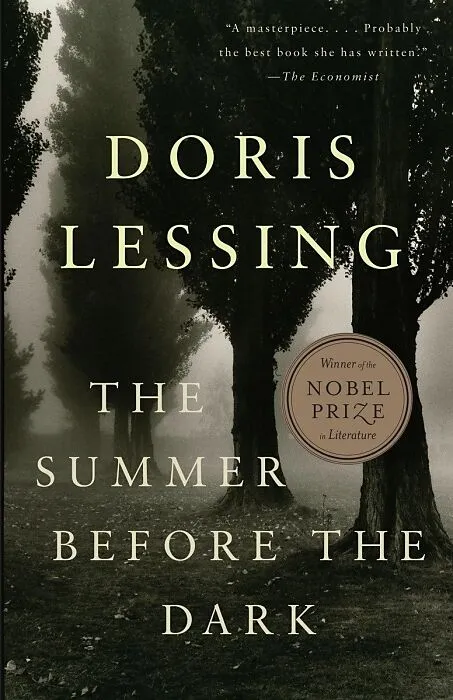
The Summer Before the Dark
Beschreibung
Zusatztext "A masterpiece. . . . Probably the best book she has written." The Economist "A splendid and serious novel that reminds one once again of just how much the fictive imagination can order and enrich experience." The National Observer "We are caught up...Format auswählen
- Kartonierter EinbandCHF 24.30

Wird oft zusammen gekauft
Andere Kunden kauften auch
Beschreibung
Zusatztext "A masterpiece. . . . Probably the best book she has written." The Economist "A splendid and serious novel that reminds one once again of just how much the fictive imagination can order and enrich experience." The National Observer "We are caught up in a rush of strong feeling. . . . Lessing's prose has the nervous intensity and quick! impressionistic lightness of some of D.H. Lawrence's later work." Newsweek Informationen zum Autor Doris Lessing Klappentext Nobel laureate Doris Lessing's classic novel of the pivotal summer in one woman's life is a brilliant excursion into the terrifying gulf between youth and old age. As the summer begins! Kate Brownattractive! intelligent! forty-five! happily married! with a house in the London suburbs and three grown childrenhas no reason to expect that anything will change. But by summer's end the woman she wasliving behind a protective camouflage of feminine charm and caringno longer exists. The Summer Before the Dark takes us along on Kate's journey: from London to Turkey to Spain! from husband to lover to madness! on the road to a frightening new independence and a confrontation with herself that lets her finally and truly come of age. Zusammenfassung Nobel laureate Doris Lessing's classic novel of the pivotal summer in one woman's life is a brilliant excursion into the terrifying gulf between youth and old age. As the summer begins! Kate Brownattractive! intelligent! forty-five! happily married! with a house in the London suburbs and three grown childrenhas no reason to expect that anything will change. But by summer's end the woman she wasliving behind a protective camouflage of feminine charm and caringno longer exists. The Summer Before the Dark takes us along on Kate's journey: from London to Turkey to Spain! from husband to lover to madness! on the road to a frightening new independence and a confrontation with herself that lets her finally and truly come of age. ...
"A masterpiece. . . . Probably the best book she has written." **
—The Economist
"A splendid and serious novel that reminds one once again of just how much the fictive imagination can order and enrich experience."
—The National Observer
"We are caught up in a rush of strong feeling. . . . Lessing's prose has the nervous intensity and quick, impressionistic lightness of some of D.H. Lawrence's later work."
—Newsweek
Autorentext
Doris Lessing
Klappentext
Nobel laureate Doris Lessing's classic novel of the pivotal summer in one woman's life is a brilliant excursion into the terrifying gulf between youth and old age.
As the summer begins, Kate Brown—attractive, intelligent, forty-five, happily married, with a house in the London suburbs and three grown children—has no reason to expect that anything will change. But by summer's end the woman she was—living behind a protective camouflage of feminine charm and caring—no longer exists. The Summer Before the Dark takes us along on Kate's journey: from London to Turkey to Spain, from husband to lover to madness, on the road to a frightening new independence and a confrontation with herself that lets her finally and truly come of age.
Leseprobe
At HomeA woman stood on her back step, arms folded, waiting. Thinking? She would not have said so. She was trying to catch hold of something, or to lay it bare so that she could look and define; for some time now she had been "trying on" ideas like so many dresses off a rack. She was letting words and phrases as worn as nursery rhymes slide around her tongue: for towards the crucial experiences custom allots certain attitudes, and they are pretty stereotyped. Ah yes, first love! . . . Growing up is bound to be painful! . . . My first child, you know. . . But I was in love! . . . Marriage is a compromise. . . . I am not as young as I once was. Of course, the choice of one rather than another of these time-honoured phrases has seldom to do with a personal feeling, but more likely your social setting, or the people you are with on an occasion. You have to deduce a person's real feelings about a thing by a smile she does not know is on her face, by the way bitterness tightens muscles at a mouth's corner, or the way air is allowed to flow from the lungs after: I wouldn't like to be a child again! Such power do these phrases have, all issued for use as it might be by a particularly efficient advertising campaign, that it is probable many people go on repeating Youth is the best time of your life or Love is a woman's whole existence until they actually catch sight of themselves in a mirror while they are saying something of the kind, or are quick enough to catch the reaction on a friend's face.A woman stood on her back doorstep, arms folded, waiting for a kettle to boil.There had been power cuts most of the day, because of a strike. Tim, her youngest, and Eileen, her daughter, had driven out into the country early, had gathered fallen wood in Epping Forest and--enjoying every minute of it--had built a fire on the gravel of the path, and fixed over it a tripod made of scrap iron found at the back of the garage. This fire, the cooking on it, the watching of it, the joking about it, had been the family's point of enjoyment all day. The woman, however, had found it all rather irritating. The kettle had taken twenty minutes to reach even the stage of singing: she could not remember having heard a singing kettle for years. Electricity brought water from stillness to turmoil in a moment, and singing was bypassed altogether. . . .Perhaps she had been insensitive? Perhaps both Tim and Eileen--who were after all grown up, were nineteen and twenty-two--had not enjoyed the day's small contrivings as much as it had seemed; they had been pretending out of social feeling? Their behaviour had been, in fact, the equivalent of one of the old phrases, a convention which people did not know how to lose in favour of the truth--whatever that was?Just like herself.The truth was, she was becoming more and more uncomfortably conscious not only that the things she said, and a good many of the things she thought, had been taken down off a rack and put on, but that what she really felt was something else again.The woman unfolded her arms, took a couple of steps towards the absurd contraption in the middle of her gravel path, pushed some more twigs under the kettle where it dangled from a bit of bent wire from the tripod, and listened: was the note of the kettle's singing changing at all? She thought it was. If there was going to be a power cut tomorrow, as was threatened, then it would be sensible to get a camper's stove, or something of the sort: this boyscouting was all very well, but if it rained . . . the strike was likely to go on for some time, they said. This series of power cuts did seem to have come very fast after the last? It did rather look as if crises over power--heat, light, fuel--were bound to become more frequent, and it would be wise to make provision? Perhaps Tim and Eileen were right; a load of wood might be a good idea.The woman returned to her back step, leaned against the wall, and folded her arms again.There were the public, or communal, events--wars, strikes, floods, earthquakes; what are felt as Acts of God. There was the feeling abroad, irrational or not, that these events, once high and rare (or had they ever been, was that just false memory?), were moving into the first place of everyone's experience, as if an air that had once been the climate of a distant and cataclysmic star had chosen to engulf our poor planet. The crucial experiences, when you came to think about it, were for more and more people: invasion, war, civil war, epidemic, famine, flood, quake, poisoning of soil, food, and air. For these, the allotted attitudes were even more stereotyped. None go much beyond: We ought to be doing something about it. or Oh woe, alas! There aren'…