
IHR WARENKORB IST AKTUELL LEER.
Haben Sie noch nichts passendes gefunden? Stöbern Sie durch unser komplettes Sortiment.
Oder melden Sie sich an bzw. registrieren Sie sich.
- Kostenlose Lieferung
- Kauf auf Rechnung
- Ex Libris Tiefpreis
- Filiallieferung und 650+ Abholorte
- Rabatt-Bons als Club-Mitglied
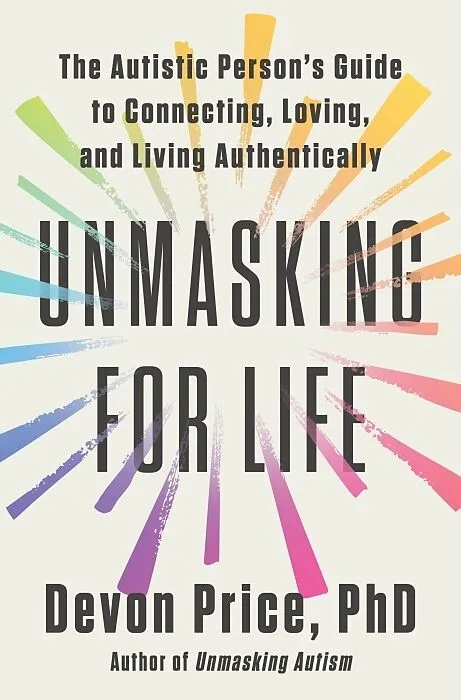
Unmasking for Life
Beschreibung
Live your best, unashamedly unmasked Autistic life with this invaluable resource featuring tools for navigating friendships, family, work, love, and life, from the author of <Unmasking Autism<. Most masked Autistics have spent a lifetime being told how to perf...Format auswählen
- Fester EinbandCHF 29.50

Wird oft zusammen gekauft
Andere Kunden kauften auch
Beschreibung
Live your best, unashamedly unmasked Autistic life with this invaluable resource featuring tools for navigating friendships, family, work, love, and life, from the author of <Unmasking Autism<.
Most masked Autistics have spent a lifetime being told how to perform neurotypically: how to behave, how to carry themselves, what to feel, and how to live. With his previous book, <Unmasking Autism<, Dr. Devon Price has given them the space and tools to unmask and embrace their neurodiversity. But no matter where you are in the unmasking process, there is still work to be done. Because Autistic people often fear change, struggle to process unfamiliar situations, and have trauma histories that have conditioned them to avoid conflict, they don’t always know how to transform their inner revelations into outer realities. They need more than internal healing—they need practical tools to translate acceptance into assertiveness and interpersonal effectiveness.
Enter< Unmasking for Life, <which provides the resources to help you advocate for your needs and invent new ways of living, loving, and being that work with your disability rather than against it. You''ll learn how to develop five key skills for building authentic relationships and living unmasked:
<lAcceptance of change, loss, and uncertainty</l<lEngagement in productive conflict, discussion, and disagreement</l<lTransgression of unfair rules, demands, and social expectations</l<lTolerance of distress, disagreement, or being disliked</l<lCreation of new accommodations, relationship structures, and new ways of living</l
<Unmasking for Life< will help validate and support you so you can move beyond unmasking your Autism and begin unmasking your world....
Autorentext
Devon Price, PhD, is a social psychologist, professor, author, and proud Autistic person. He is the author of Unmasking Autism, Laziness Does Not Exist, and Unlearning Shame. His research has appeared in journals such as the Journal of Experimental Social Psychology, Personality and Social Psychology Bulletin, and The Journal of Positive Psychology. Price’s writing has also appeared in outlets such as the Financial Times, HuffPost, Los Angeles Times, Slate, Jacobin, Business Insider, and LitHub, and his work has been featured on PBS, NPR, MSNBC, and the BBC. He lives in Chicago, where he serves as a clinical associate professor at Loyola University Chicago’s School of Continuing and Professional Studies.
Klappentext
"Most masked Autistics have spent a lifetime being told how to perform neurotypically: how to behave, how to carry themselves, what to feel, and how to live. With his previous book, Unmasking Autism, Dr. Devon Price has given them the space and tools to unmask and embrace their neurodiversity. But no matter where you are in the unmasking process, there is still work to be done. Because Autistic people often fear change, struggle to process unfamiliar situations, and have trauma histories that have conditioned them to avoid conflict, they don't always know how to transform their inner revelations into outer realities. They need more than internal healing--they need practical tools to translate acceptance into assertiveness and interpersonal effectiveness. Enter Unmasking for Life, which provides the resources to help you advocate for your needs and invent new ways of living, loving, and being that work with your disability rather than against it"--
Leseprobe
Introduction
From Unmasking Autism to Unmasking Life
I first found out that I was Autistic in 2014, when I was twenty-five years old. I’d known very little about Autism up to that point, despite having completed a PhD in psychology. I mostly viewed the disability the same way the average person did: a condition of three-year-old boys who were obsessed with baseball statistics or trains. Even in some graduate-level clinical classes, I’d heard ignorant, stereotypical myths about Autism: that Autistic people lacked any interest in forming friendships, for example, and that they were incapable of compassion. I’d heard that Autism was always a very obviously debilitating burden, and that there was essentially no hope of Autistics ever leading fulfilling lives. Though I’d struggled to form healthy relationships, live independently, and experience happiness of my own, I’d never considered that the Autism label had anything to do with me.
What I didn’t realize then was that Autism is actually a complex developmental disorder, one that shapes every aspect of how a person processes information and makes sense of the world around them. I didn’t understand, for example, that Autistic people take in sensory data in a bottom-up fashion, rather than the efficient top-down way many non-Autistics (also known as allistics) do. For example, laboratory studies have used eye-tracking technology to observe that Autistic people, when presented with a photo of a person’s face and asked to judge what emotion the person in the photo is feeling, look at all the individual components of the face equally, and carefully: their gaze darts from the mouth to the nose to the eyes, forehead, and chin, processing each feature and trying to piece together what the person might be feeling. Non-Autistic people, in contrast, look at the face as a whole, and recognize emotions on an intuitive level at a glance.1 Because Autistics typically can’t see this top-down “picture” of an emotion, we instead have to memorize what specific arrangements of face parts might mean (for example, that wide eyes could mean either fear or aggression).
This bottom-up processing style also explains why we Autistics find it so much more stressful to be in loud or visually busy spaces compared to most allistics, whose brains instinctively filter out unwanted distractions in ways ours cannot. It is also the reason Autistics need far more time to figure out how to behave in an unfamiliar situation. But sometimes our processing style works to our advantage: studies show that we make fewer errors than non-Autistics when faced with complicated logic problems. I didn’t know my brain processed things more effortfully, precisely, and slowly than many other people’s brains when I was growing up. All I knew was that other people seemed to move so quickly, driven by instincts I couldn’t follow. By my teenage years, I chalked up my confusion and detachment to my being a misanthrope.
I also didn’t understand that many Autistic people desperately crave close relationships but have trouble forming them, because many of us cannot read facial expressions, hear differences in tone of voice, or comprehend the indirectness of sarcasm and small talk. I’d just figured other people were worse communicators than me, and I had no time for their irrationality.
I had no clue that my childhood inability to ride a bike or write in cursive could be linked to Autistic fine motor deficits, or that the furious rage I felt when a meeting dragged on longer than expected was due to an Autistic need for predictability and structure. Finally, I didn’t understand that my inability to recognize my own emotions or bodily needs (such as hunger or tiredness) was because I’d been masquerading as neurotypical for my entire life, stuffing down all the voices inside me that were constantly clamoring for softer clothes, darker rooms, less cluttered spaces, more intense flavors, and an explanation for what the hell was going on around me at all times.
I spent many years of my life believing that I was an unfeeling robot who could never love or be loved by other people, and camouflaging every moment of discomfort and confusion I ever experienced. Then I finally received the gift …