
IHR WARENKORB IST AKTUELL LEER.
Haben Sie noch nichts passendes gefunden? Stöbern Sie durch unser komplettes Sortiment.
Oder melden Sie sich an bzw. registrieren Sie sich.
- Kostenlose Lieferung
- Kauf auf Rechnung
- Ex Libris Tiefpreis
- Filiallieferung und 650+ Abholorte
- Rabatt-Bons als Club-Mitglied
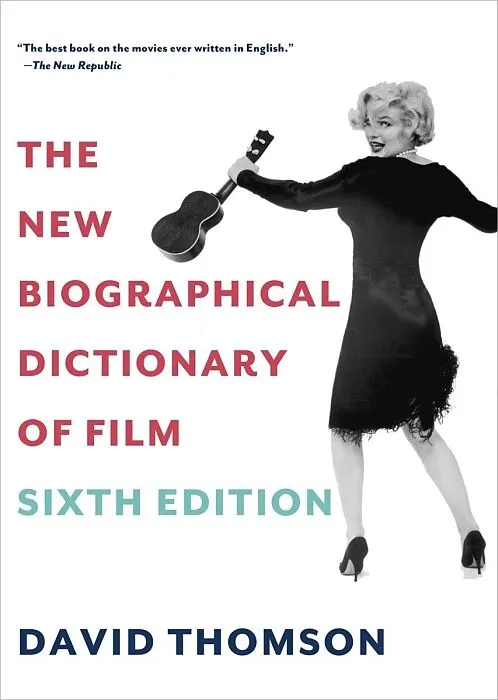
The New Biographical Dictionary of Film
Beschreibung
Zusatztext 77573710 Informationen zum Autor David Thomson Klappentext With more than 100 new entries, from Amy Adams, Benedict Cumberbatch, and Cary Joji Fukunaga to Joaquin Phoenix, Mia Wasikowska, and Robin Wright, and completely updated, here from David Tho...Format auswählen
- Kartonierter EinbandCHF 57.90

Wird oft zusammen gekauft
Andere Kunden kauften auch
Beschreibung
Zusatztext 77573710 Informationen zum Autor David Thomson Klappentext With more than 100 new entries, from Amy Adams, Benedict Cumberbatch, and Cary Joji Fukunaga to Joaquin Phoenix, Mia Wasikowska, and Robin Wright, and completely updated, here from David ThomsonThe greatest living writer on the movies (John Banville, New Statesman ); Our most argumentative and trustworthy historian of the screen (Michael Ondaatje)is the latest edition of The New Biographical Dictionary of Film , which topped Sight & Sound 's poll of international critics and writers as THE BEST FILM BOOK EVER WRITTEN. 3/7 Leseprobe CHAPTER ONE A Abbott and Costello: Bud (William A.) Abbott (1895-74), b. Asbury Park, New Jersey; and Lou Costello (Louis Francis Cristillo) (1906-59), b. Paterson, New Jersey The marital chemistry (or the weird mix of blunt instrument and black hole) in coupling is one of the most persistent themes in tragedy and comedy. At their best, you can't have one without the other. More than fifty years after they first tried it, Abbott and Costello's "Who's On First?" sketch is about the best remedy I know for raising laughter in a mixed bag of nuts-or for making the collection of forlorn individuals a merry mob. Many people know the routine (written, like most of their stuff, by John Grant) by heart. Amateurs can get a good laugh out of it. But Bud and Lou achieve something lyrical, hysterical, and mythic. Watch them do the sketch and you feel the energy and hope of not just every comedian there ever was. You feel Beckett, Freud, and Wittgenstein (try it!). You see every marriage there ever was. You rejoice and despair at the impossibility of language. You wonder whether God believed in harmony, or in meetings that eternally proved our loneliness. Lou is the one who has blood pressure, and Bud hasn't. So they are together in the world, yet together alone, doomed to explain things to each other. They are companions, halves of a whole, chums, lovers if you like. But they are a raw display of hatred, opposition, and implacable difference. They are also far better than all the amateurs. And if Lou is the performer, the valiant seeker of order, while Bud is the dumb square peg, the one who seems oblivious of audience, still, nobody did it better. If I were asked to assemble a collection of things to manifest America for the stranger, "Who's On First?" would be there-and it might be the first piece of film I'd use. At the same time, they are not very good, rather silly, not really that far above the ocean of comedians. It isn't even that one can separate their good work from the poor. Nor is it that "Who's On First?" is simply and mysteriously superior to all the rest of their stuff. No, it's only that that routine feels an inner circle of dismay within all the others, the suffocating mantle next to Lou's heart. It isn't good, or superior; it's divine. Which is why no amount of repetition dulls it at all. I think I could watch it every day and feel the thrills and the dread as if for the first time. They bumped into each other. Bud was a theatre cashier where Lou was playing (around 1930), and he grudgingly took the job when Lou's partner was sick. They were doing vaudeville and radio for ten years before they got their movie break at Universal: One Night in the Tropics (40, A. Edward Sutherland) was their first film, but Buck Privates (41, Arthur Lubin) was the picture that made them. There were twenty-three more films in the forties, a period for which they were steadily in the top five box-office attractions. Buck Privates, and their whole appeal, reflected the unexpected intimacies of army life. They broke up in 1957, long since outmoded by the likes of Martin and Lewis. But there again, Abbott and Costello are the all-talking model (as opposed to the semi-silence o...
"America has given the world Emily Dickinson, "Moby-Dick," jazz, Faulkner, Hollywood, rock 'n' roll, and this book." --Michael Robbins, Chicago Tribune
"The best book on the movies ever written in English." —The New Republic
“Thomson proves anew that he is irreplaceable . . . His monologue has blossomed into an unlikely, searching dialogue about what to value in the movies—how to love what’s come before without nostalgia, and how to find the courage to demand more from the stuff being made right now . . . Deservedly treasured . . . One of the most probing accounts ever written of a human being’s engagement with the movies.” —Sarah Kerr, The New York Times Book Review
“Delicious. One of the best and most useful books written about the movies.” —Edward Guthmann, San Francisco Chronicle
“The Dictionary is not only an indispensable book about cinema, but one of the most absurdly ambitious literary achievements of our time.” —Geoff Dyer, Sight & Sound
“A marvel . . . Eccentric, audacious, sparkling . . . Probably the greatest living film critic and historian, Thomson writes the most fun and enthralling prose about the movies since Pauline Kael.” —Benjamin Schwarz, The Atlantic
“From Abbott and Costello to *Crumb’s *Terry Zwigoff, David Thomson expertly caters the banquet of film history in the latest edition of this classic. One critics’ poll called it the best movie book ever; it also has some of the finest, orneriest writing in the English language.”
—Time
“Truly, maddeningly, gloriously subjective . . . Buy this book for a friend, and bask in the pleasure of knowing that you have incalculably enriched his life. Buy it for yourself, and book some quality time with one of the finest writers the story of film has ever had.”
—Saul Austerlitz, San Francisco Chronicle
“[A] mad and magnificent opus . . . Thomson is a great rhapsodist of how film acts on his, and therefore our, imagination. . . . Close viewing, and the insights that spring from rapt attention, are what Thomson’s criticism is all about. Despite its seemingly straitlaced A-to-Z format, the ‘Dictionary’ is oddball and Borgesian, finding imaginative ecstasy in its encyclopedic tendency. The book crackles with epigram while often reaching for meanings that endow familiar subjects with a new reality. . . . It’s an essential, loony, irresistible book, and scarcely a week passes when I don’t submerge myself for an hour or two in its labyrinthine marvels.”
—Richard Rayner, Los Angeles Times
“Essential . . . Razor-sharp reviews are often commentaries on both the filmmaker and the audience. . . . We’re always aware that we’re engaging with a passionate educated human being. Isn’t that more interesting and rewarding than marketing-driven Netflix summaries? Great critics are cinema’s most inspiring enthusiasts. Four stars.”
—Jeffrey Overstreet, Books & Culture
“Witty, expasive, convincing, honest, more than a little mischievous and, so often, absolutely on the money. Thomson’s voice is one of the most distinctive and enjoyable in film criticism. It leaps from the pages of this spruced up classic like flames from a bonfire. . . . Almost every page contains at least one unexpected nugget of information that you would struggle to come across by any other means. . . . However, the real value of this book lies not in facts, but in opinions. Thomson’s views are so shrewd, so exquisitely stated that, more often than not, they feel like thoughts you already held but were never quite sure how to put into words. . . In a world awash with amateur pundits, the value of a genuine expert who knows his own mind has never been higher. . . . Dip into any entry and you will fi…