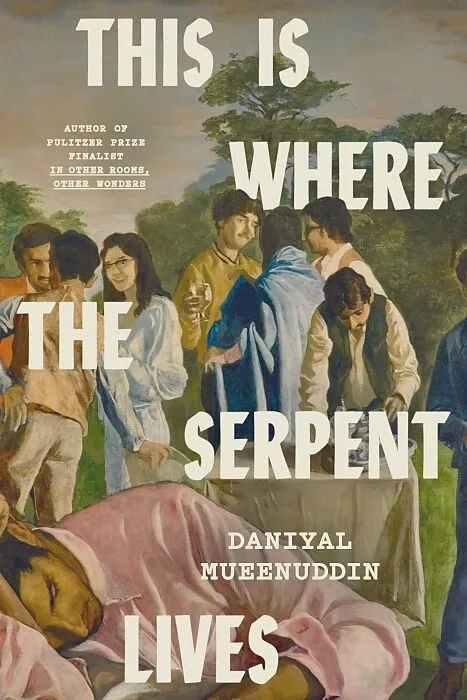
This Is Where the Serpent Lives
Beschreibung
A stunning first novel from universally acclaimed Daniyal Mueenuddin, whose debut short story collection won the Story Prize and was a finalist for the Los Angeles Book Prize, the National Book Award, and the Pulitzer Prize. Moving from Pakistan’s sophis...Format auswählen
- Fester EinbandCHF 30.30

Wird oft zusammen gekauft
Andere Kunden kauften auch
Beschreibung
A stunning first novel from universally acclaimed Daniyal Mueenuddin, whose debut short story collection won the Story Prize and was a finalist for the Los Angeles Book Prize, the National Book Award, and the Pulitzer Prize. Moving from Pakistan’s sophisticated cities to its most rural farmlands, Daniyal Mueenuddin’s ;In matters of both business and the heart, Mueenuddin’s characters struggle to choose between the paths that are moral and the paths that will allow them to survive the systems of caste, capital, and social power that so tightly grip their country. Intimate and epic, elegiac and profoundly moving, Mueenuddin’s <This Is Where the Serpent Lives< is a tour de force destined to become a classic of contemporary literature.
Autorentext
DANIYAL MUEENUDDIN was brought up in Lahore, Pakistan, and Elroy, Wisconsin. A graduate of Dartmouth College and Yale Law School, his stories have appeared in The New Yorker, Granta, Zoetrope, and The Best American Short Stories 2008, selected by Salman Rushdie. His collection In Other Rooms, Other Wonders was a finalist for the Pulitzer Prize and the National Book Award. For a number of years he practiced law in New York. He now divides his time between Oslo, Norway, and his farm in Pakistan’s South Punjab.
Klappentext
**A NEW YORK TIMES BEST BOOK OF THE YEAR SO FAR • A stunning new work from universally acclaimed Daniyal Mueenuddin, whose debut short story collection won the Story Prize and was a finalist for the Los Angeles Book Prize, the National Book Award, and the Pulitzer Prize.
“The pages turn themselves. . . . This Is Where the Serpent Lives is a serious book that you’ll be hearing about again when the shortlists for the big literary prizes are announced.” —The New York Times**
Moving from Pakistan’s dazzling chaotic cities to its lawless feudal countryside, This Is Where the Serpent Lives powerfully evokes contemporary feudal Pakistan, following the destinies of a dozen unforgettable characters whose lives are linked through violence and tragedy, triumph, and love. Orphaned as a little boy and fending for himself in the city streets, Yazid rises to a place of responsibility and respect in the Lahore household of Colonel Atar, a powerful industrialist and politician, only to find that position threatened by conflicting loyalties and misplaced trust. Born on Colonel Atar’s country estate to a poor gardener, Saqib is entrusted with the management of a pioneering business, but he overreaches and finds himself an outlaw, confronting the violence of the corrupt Punjab Police. The colonel’s son competes with his cherished brother for the love of a woman and discovers that her choice colors his life with unexpected darkness as well as light.
In matters of power and money and the heart, Mueenuddin’s characters struggle to choose between paths that are moral and just and more worldly choices that allow them to survive in the systems of caste, capital, and social power that so tightly grip their culture. Intimate and epic, elegiac and profoundly moving, This Is Where the Serpent Lives is a tour de force destined to become a classic of contemporary literature.
Zusammenfassung
**A stunning new work from universally acclaimed Daniyal Mueenuddin, whose debut short story collection won the Story Prize and was a finalist for the Los Angeles Book Prize, the National Book Award, and the Pulitzer Prize.
THE NEW YORK TIMES BOOK REVIEW EDITORS' CHOICE. NAMED A MOST ANTICIPATED BOOK OF 2026: Town & Country, Bustle, AARP*, Kirkus***
Moving from Pakistan’s dazzling chaotic cities to its lawless feudal countryside, This Is Where the Serpent Lives powerfully evokes contemporary feudal Pakistan, following the destinies of a dozen unforgettable characters whose lives are linked through violence and tragedy, triumph, and love. Orphaned as a little boy and fending for himself in the city streets, Yazid rises to a place of responsibility and respect in the Lahore household of Colonel Atar, a powerful industrialist and politician, only to find that position threatened by conflicting loyalties and misplaced trust. Born on Colonel Atar’s country estate to a poor gardener, Saqib is entrusted with the management of a pioneering business, but he overreaches and finds himself an outlaw, confronting the violence of the corrupt Punjab Police. The colonel’s son competes with his cherished brother for the love of a woman and discovers that her choice colors his life with unexpected darkness as well as light.
In matters of power and money and the heart, Mueenuddin’s characters struggle to choose between paths that are moral and just and more worldly choices that allow them to survive in the systems of caste, capital, and social power that so tightly grip their culture. Intimate and epic, elegiac and profoundly moving, This Is Where the Serpent Lives is a tour de force destined to become a classic of contemporary literature.
Leseprobe
Bayazid never knew how he came to be a little boy alone in the streets of Rawalpindi. He had a memory more of forces than of people, a crowd, a hand, a hand no more. Yet the bazaars in those early 1950s were not so crowded as that, and Rawalpindi a town small enough that a lost little boy should be found. That was a bitter day when he accepted years later that there might have been no hand, no desperate parent seeking him in the crowd. He might have been abandoned, not lost. Karim Khan, the owner of the tea and curry stall where his known history began, could tell him only that he had been sitting in front of the stall on a fine winter day, three or four years old, wearing just a shalvar kameez, barefoot and clean, holding a new pair of cheap plastic shoes tightly in his arms as if afraid they would be taken away, and scanning the crowds passing by. The shoes had caught Karim Khan’s eye, not only because they were brand-new, but because the children of the streets, those sparrows, ran barefoot always. In those early years following the great Indian Partition, families drifted about, mothers dead, fathers dead, murdered for religion’s sake, for politics, unwelcome children without parents thrown on some relative’s mercy. Karim Khan thought this must be one of those stories, Hindus stuck on the wrong side of the border and on the run, an unwanted child—though that didn’t explain the shoes.
Karim Khan kept an eye on the boy all through the afternoon and evening, serving customers by the light of a hissing pressure-gas lantern, dishing up dal or a meat curry that grew more delicious each year, for he never washed out the fire-blackened pots that sat over the coals, but replenished them with a double handful of lentils or meat, beef or mutton, whichever was cheaper, the mix of meat juices adding to its savor. The boy had a remarkable power of concentration, immobile all day and seeming quite unperturbed, but for the fierceness with which he held the shoes. He stood out even then as a person not to be treated lightly, as a being with resources of spirit if not of fortune. When Karim Khan finally approached him, the boy brushed him off, politely but firmly. He was waiting for his mother, who would soon be back, and must not move from this spot. Rebuffed, Karim Khan retreated back to his cook fire, the evening crowd getting a quick bite before taking a bus from the nearby station up to the mountains or out to the plains, for the shop served mostly travelers. Finally, when the crowds had died, when pye-dogs began sniffing around under the charpoys in front of the food stall for a last chicken bone or scrap of dry bread, when the lights in the shops along the road faltered out, and the cold came down from the Margalla Hills so that breath showed in a…