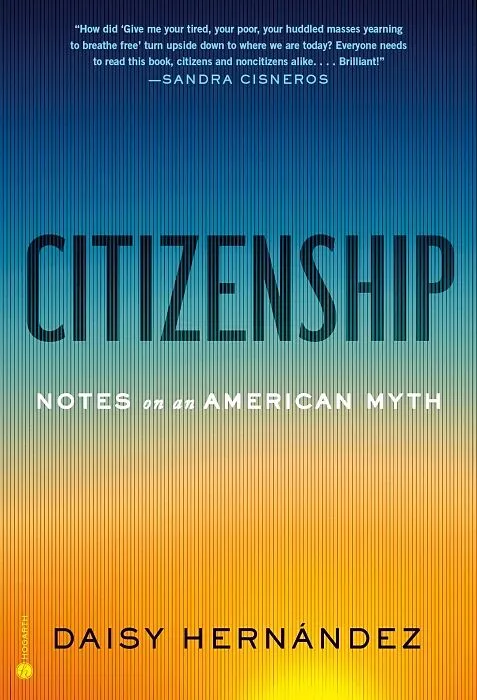
Citizenship
Beschreibung
A provocative, personal, blazingly intelligent examination of one of the most vexing questions facing the United States today--who is, and should be, a citizen? “How did ‘Give me your tired, your poor, your huddled masses yearning to breathe free&r...Format auswählen
- Fester EinbandCHF 31.90

Wird oft zusammen gekauft
Andere Kunden kauften auch
Beschreibung
A provocative, personal, blazingly intelligent examination of one of the most vexing questions facing the United States today--who is, and should be, a citizen? “How did ‘Give me your tired, your poor, your huddled masses yearning to breathe free’ turn upside down to where we are today?;Everyone needs to read this book, citizens and non-citizens alike. Brilliant!”--Sandra Cisneros “The most comprehensive book on citizenship/immigration I’ve ever read. A must-read!”--Javier Zamora In this one-of-a-kind book, Daisy Hernández fiercely interrogates one of the most complicated subjects of contemporary life and politics: citizenship. Braiding memoir, history, and cultural criticism, she exposes the truths and lies of how we define ourselves as a country and a people. Turning to her own family’s stories--her mother arrived from Colombia, her father a political refugee from Castro’s Cuba--Hernández shows how the very idea of citizenship is a myth and part of the stories we tell ourselves about the American soul and psyche. Reframing our understanding of what it means to be an American, <Notes on Citizenship< is an urgent and necessary account of the laws, customs, and language we use to include and exclude, especially those who come from Latin America. With her scholar’s mind and memoirist’s gift for narrative, Hernández weaves a story both personal and national, while reckoning with our country’s ongoing debate about who belongs and providing fresh ways of thinking about citizenship. At once bracing, fearless, and tender, <Notes on Citizenship <is a powerful portrait of one family’s experiences in the borderlands of citizenship and an honest illumination of the country in which we live.
Autorentext
Daisy Hernández is the author of The Kissing Bug, winner of the PEN/Jean Stein Book Award and the inaugural title for the National Book Foundation’s Science + Literature Program. Her memoir, A Cup of Water Under My Bed, won Lambda Literary’s Dr. Betty Berzon Emerging Writer Award and was a Publishing Triangle Award finalist. She co-edited the classic feminist anthology Colonize This! and is an associate professor of creative writing at Northwestern University.
Leseprobe
Invitations
The year I turned forty, my mother, sister, and I flew north to Toronto, and together, almost giddy, we marched to the United States consulate. We squinted in the morning sun, and I took selfies with the consulate’s glass door in the background until a security guard jogged over and said, You can’t take photos here. You have to erase them.
My mother’s eyes narrowed at me. She did not understand the man’s English, but she knew from his tone that I was the guilty party.
It’s a selfie, I stammered.
Doesn’t matter, the guard said. It’s a security issue. You can’t take pictures.
I tried, but failed, to find the words to tell the guard that once upon a time my mother had needed to exist beyond the borders of the United States to receive a fiancé visa, and she had come here to Toronto, to this building. She had been pregnant with me. I wanted to tell the man that my Colombian mother was an extremely shy woman, but once when I asked her how she had convinced immigration officials that she was not marrying my Cuban father for a green card, that she actually did love the man, Mami had puffed her chest and exclaimed, I was pregnant! What more proof is there?
The sun dazzled overhead, and I wanted to tell the security guard: There’s a story here about citizenship and language, about the policies of the state and the bodies of women. There’s a story here about defiance. A story about the narratives we, as a nation, tell about who we are. For my mother and me, it started at this gray building with the hard glass and an American flag sagging in the morning light. But I glimpsed my mother’s face: her dark, worried eyes, her lips a firm line insisting that I follow the rules, as if the uniformed man were my father. I bit my lip and deleted the photographs, erasing Mami’s smile, my sister’s curls, the gloss of my red lipstick, and the doors to the consulate.
Satisfied, the guard turned away, and I tucked the phone into my pocketbook. I had managed to keep twenty-one photographs.
In northern New Jersey, in the early 1970s, my mother looked like a young Cher. She had thick black hair and a face that could be interpreted as Italian or Greek, Armenian or Jewish. When she wasn’t cleaning offices or working at a clothing factory, she sauntered through Jersey City in bell-bottoms and fitted tops. Those who didn’t understand Spanish probably mistook her for one of the most recent arrivals in that part of the state: the women fleeing Fidel Castro’s new Cuba.
A decade later, in 1981, at the age of six, I began silently recording my mother’s stories about citizenship. She did not use the terminology of those years: resident aliens, nonresident aliens, illegal aliens. She did not even tell me about visas or green cards. She spoke only of invitations.
Her stories were told at night, in the bedroom she shared with Papi, when he was working at the factory until dawn and it was only her, me, and my sister. All the lights off, we huddled under the comforter, my toddler sister on one side of Mami and my six-year-old body on the other, in that bedroom at the end of our railroad apartment in Union City. I must have said, Tell me a story, and she started with the first invitation.
My mother was in her twenties in this story. At the factory in Bogotá, during the late 1960s, she and a friend bent their heads over men’s blazers, day after day, the tailor’s chalk in their hands. They marked the fabric so the seamstresses would know where to stitch the pockets, so the men would have a place for their secrets. My mother and her friend lunched together with their co-workers, sometimes feasting on sopas brimming with potatoes and carne, and other times delighting in freshly baked buñuelos and pandebono. One day, her friend announced that she was joining her son in Jersey City. In the dark, my mother whispered, She said to me, When I get to the United States, I’ll send for you.
The woman kept her promise. She mailed a letter, and here the story took a difficult turn. My mother did not want to go north, but everyone told her not to be stupid. There was money to be made in the United States, more than she could imagine. She could work and come back. No one spoke about the recession in the United States, because the worst moments inside the empire were better than those at the edges, and besides, over there, the factories paid in dollars. Mami hesitated. An older sister urged her to go, and before Mami could decide, her sister bought the airline ticket with her own savings. What could I do? my mother asked in the dark. I left, she said with a sigh.
Cocooned under blankets, her sad voice in my black hair, I made a note to not trust the invitations of women, not even the ones I liked.
My mother did not tell me that she had to apply for a visa to the United States. She did not mention that procuring such a visa was not easy. People were routinely turned away. She did not tell me about the papers she submitted and the man at the United States consulate in Bogotá who approved her request. She did not speculate, at least not to me, on what that man thought when he looked at her: twenty-eight, childless, unmarried, living at home with her parents, a woman who would return or a woman the country did not need. She arrived in New York City, at John F. Kennedy International Airport, in the winter of 1970.
My mother never spoke of colonialism. She said nothing of fea…