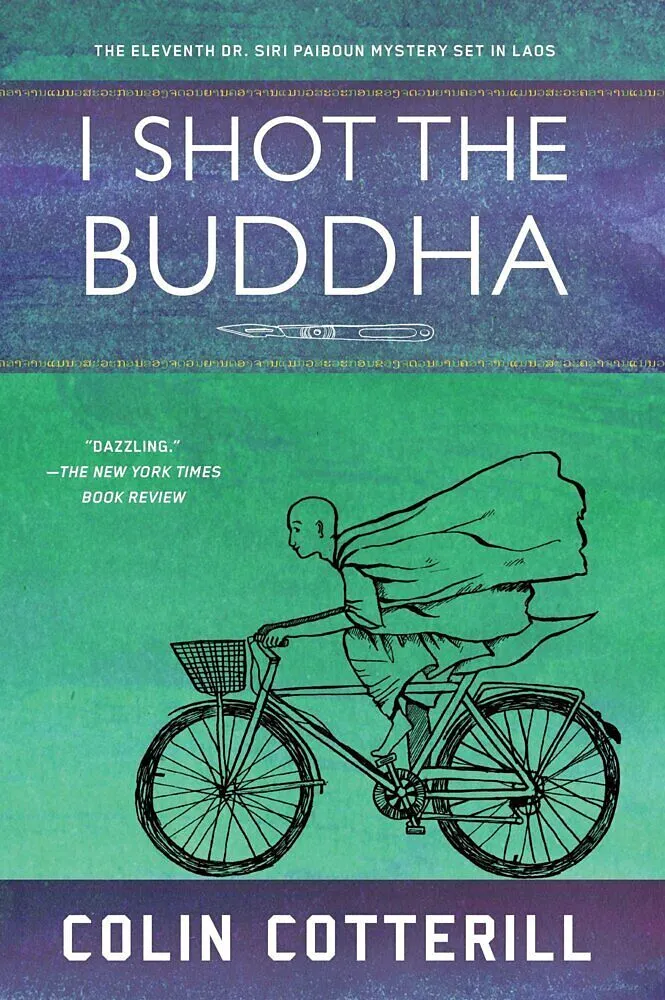
I shot the Buddha
Beschreibung
A fiendishly clever mystery in which Dr. Siri and his friends investigate three interlocking murders--and the ungodly motives behind them Laos, 1979: Retired coroner Siri Paiboun and his wife, Madame Daeng, have never been able to turn away a misfit. As a resu...Format auswählen
- Kartonierter EinbandCHF 23.10

Wird oft zusammen gekauft
Andere Kunden kauften auch
Beschreibung
A fiendishly clever mystery in which Dr. Siri and his friends investigate three interlocking murders--and the ungodly motives behind them Laos, 1979: Retired coroner Siri Paiboun and his wife, Madame Daeng, have never been able to turn away a misfit. As a result, they share their small Vientiane house with an assortment of homeless people, mendicants, and oddballs. One of these oddballs is Noo, a Buddhist monk, who rides out on his bicycle one day and never comes back, leaving only a cryptic note in the refrigerator: a plea to help a fellow monk escape across the Mekhong River to Thailand. Naturally, Siri can’t turn down the adventure, and soon he and his friends find themselves running afoul of Lao secret service officers and famous spiritualists. Buddhism is a powerful influence on both morals and politics in Southeast Asia. In order to exonerate an innocent man, they will have to figure out who is cloaking terrible misdeeds in religiosity.
Praise for I Shot the Buddha
A BookPage Best Mystery of 2016
"Dazzling."
—Marilyn Stasio, The New York Times Book Review
“Terrifically entertaining.”
—Adam Woog, The Seattle Times
"[Siri] is the most wonderfully human of heroes."
—The Christian Science Monitor
"Filled with magic and quirkiness... A madcap and international caper."
—Ellery Queen Mystery Magazine
"Cotterill's twisty mystery plot will entertain readers while his cast of eccentric characters charms."
—Shelf-Awareness
"Highly unusual and immensely appealing."
—Alfred Hitchcock Mystery Magazine
“Stunning . . . This series offers unfailingly satisfying reading, especially so for the glimpses we get into the still-revolutionary characters of Siri and Madame Daeng, both bursting with caustic wit and adventurous spirit.”
—Booklist, Starred Review
“Cotterill excels in the portrayal of potentially serious and momentous topics with lighthearted humor, imbuing his characters with grace and empathy in the midst of a particularly difficult chapter of Southeast Asia's history.”
—BookPage, Top Pick in Mystery
"Highly entertaining."
—Publishers Weekly, Starred Review
****Praise for Six and a Half Deadly Sins
"Dr. Siri and his misfit friends have relied on caustic humor to stay sane . . . The question is: Can his cynical sense of humor get him out of this jam?"
—The New York Times Book Review
"A gladdening complement to many mystery-reader's table . . . If you are unfamiliar with Paiboun works, it is time to crawl out of whatever cave you have been living in. This is for you."
**—The Christian Science Monitor **
"Always delightful . . . the doctor and his profoundly eccentric friends, wife and (now former) colleagues retain their sardonic senses of humor in a vexing and sometimes scary time."
—The Seattle Times
"A rollicking installment . . . Guaranteed to delight fans and new readers alike."
—BookPage, Top Pick
Autorentext
Colin Cotterill is the author of eleven other books in the Dr. Siri Paiboun series: The Coroner’s Lunch, Thirty-Three Teeth, Disco for the Departed, Anarchy and Old Dogs, Curse of the Pogo Stick, The Merry Misogynist, Love Songs from a Shallow Grave, Slash and Burn, The Woman Who Wouldn’t Die, Six and a Half Deadly Sins, and The Rat-Catchers’ Olympics. His fiction has won a Dilys Award and a CWA Dagger in the Library. He lives in Chumphon, Thailand, with his wife and five deranged dogs.
Leseprobe
1
Goodnight, Ladies
It was midnight to the second with a full moon overhead when three women were being killed in three separate locations. Had this been the script of a film such a twist of fate would have been the type of cinematic plot device that annoyed Comrades Siri and Civilai immensely. In their book, coincidences came in a close third behind convenient amnesia and the sudden appearance of an identical twin. But this was real life, so there was no argument to be had.
The first woman died. She was elderly, was in bad health, and was an alcoholic. But it wasn’t angina or alcohol that killed her. It was a sledgehammer. For much of her life she’d scratched a living repairing clothing on an old French sewing machine. When her hands weren’t shaking she didn’t do such a bad job of it, and hers was the only functioning sewing machine for a hundred kilometers. There was a time when she’d divide her income: half for food, half for rice whisky. But she figured rice whisky was rice, right? What was the point of paying twice for rice? She had papayas and bananas growing naturally around her hut, so, although she spent much of her day in the latrine, she decided she got enough nutrition for someone who wasn’t expecting to grow. From then on, every kip she made taking up or taking down the hems of phasin skirts was spent on drink.
And that night, that cloudless full moon night, she lay pickled on the bamboo bench her father had made with his own hands and she fancied she could see Hanuman’s face in the moon. And then a shadow fell across it and for a second she saw the only love of her life, then a smile, then a sledgehammer.
A second woman died. She had bathed from a bucket of rainwater behind her hut and washed her hair with a sachet of the latest Sunsilk shampoo, a free sample from the company. She was still wearing her damp sarong and deciding whether to keep it on and say, “Ooh, you caught me by surprise,” or to put on her yellow sundress, the one he’d mentioned made her look sexy in the light of her little wax candle. She’d climbed the bamboo ladder, creaked through the open doorway and across to the wooden potato box where she kept her clothes. She was changing—she’d decided to go for the sundress—when she heard another creak on the balcony. Her dress was only halfway over her head. She struggled to pull it down. Her Vietnamese driver beau had come early, although it was odd she hadn’t heard the truck pull off the road.
“Give me a sec,” she said. “I’m half naked. You’ve spoiled the surprise.”
The footsteps creaked behind her, and she anticipated the feel of his hand on her suety breast. But she hadn’t anticipated the knife. From the tiny naked candle flame she could see the glint of the blade. She watched frozen as the tip entered her belly and the hilt twisted left and right the way the samurai killed themselves in the movies she used to love so much before they closed down the last cinema.
A third woman died. This was obviously a bad night to be a woman. There are illnesses that make you feel like death but are unlikely to dispatch you there. There are illnesses that are unpleasant but not necessarily uncomfortable, yet without the right treatment at the right moment you’re gone as quickly as a sparrow in a jet engine. Hepatitis falls into that latter category. You think you’ve got the flu, a few aches and pains, no energy, so you sleep all day waiting for it to pass. Then you wake up, and you’re dead.
But she’d awoken to see the nice old doctor sitting beside her sleeping mat. He’d given her some pills, and she’d thanked him and fallen back asleep. But the next time she woke it was night and a big old moon was smiling through the window. She felt so well she even considered getting up, giving her stiff legs a walk around the hut. Perhaps a little skip or two. But she …