
IHR WARENKORB IST AKTUELL LEER.
Haben Sie noch nichts passendes gefunden? Stöbern Sie durch unser komplettes Sortiment.
Oder melden Sie sich an bzw. registrieren Sie sich.
- Kostenlose Lieferung
- Kauf auf Rechnung
- Ex Libris Tiefpreis
- Filiallieferung und 650+ Abholorte
- Rabatt-Bons als Club-Mitglied
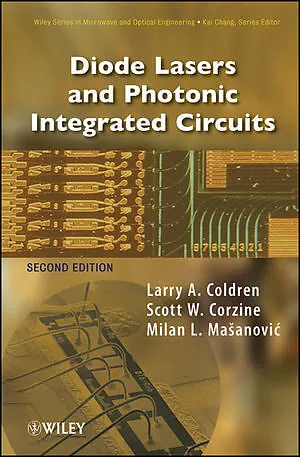
Diode Lasers and Photonic Integrated Circuits
Beschreibung
"Diode Lasers and Photonic Integrated Circuits, Second Edition provides a comprehensive treatment of optical communication technology, its principles and theory, treating students as well as experienced engineers to an in-depth exploration of this field.Diode ...Format auswählen
- Fester EinbandCHF 182.00

Wird oft zusammen gekauft
Andere Kunden kauften auch
Beschreibung
"Diode Lasers and Photonic Integrated Circuits, Second Edition provides a comprehensive treatment of optical communication technology, its principles and theory, treating students as well as experienced engineers to an in-depth exploration of this field.Diode lasers are still of significant importance in the areas of optical communication, storage, and sensing. Using the the same well received theoretical foundations of the first edition, the Second Edition now introduces timely updates in the technology and in focus of the book. After 15 years of development in the field, this book will offer brand new and updated material on GaN-based and quantum-dot lasers, photonic IC technology, detectors, modulators and SOAs, DVDs and storage, eye diagrams and BERconcepts, and DFB lasers. Appendices will also be expanded to include quantum-dot issues and more on the relation between spontaneous emission and gain"--
Autorentext
Larry A. Coldren is the Fred Kavli Professor of Optoelectronics and Sensors at the University of California, Santa Barbara. He has authored or coauthored over a thousand journal and conference papers, seven book chapters, and a textbook, and has been issued sixty-three patents. He is a Fellow of the IEEE, OSA, and IEE, the recipient of the 2004 John Tyndall and 2009 Aron Kressel Awards, and a member of the National Academy of Engineering. Scott W. Corzine obtained his PhD from the University of California, Santa Barbara, Department of Electrical and Computer Engineering, for his work on vertical-cavity surface-emitting lasers (VCSELs). He worked for ten years at HP/Agilent Laboratories in Palo Alto, California, on VCSELs, externally modulated lasers, and quantum cascade lasers. He is currently with Infinera in Sunnyvale, California, working on photonic integrated circuits.
Milan L. Mashanovitch obtained his PhD in the field of photonic integrated circuits at the University of California, Santa Barbara (UCSB), in 2004. He has since been with UCSB as a scientist working on tunable photonic integrated circuits and as an adjunct professor, and with Freedom Photonics LLC, Santa Barbara, which he cofounded in 2005, working on photonic integrated circuits.
Klappentext
Current and comprehensive coverage of fundamentals and advanced topics for students and professionals Owing to their small size and mass-producibility, high efficiency, and amazing useful life of hundreds of years, diode lasers remain essential in data transmission and data storage applications and consumer products, while appearing in new applications, like medical imaging and remote sensing. This new edition of Diode Lasers and Photonic Integrated Circuits is an in-depth and fully up-to-date resource for students in electrical engineering and applied physics as well as professional engineers and researchers in optoelectronics and related fields. Diode Lasers and Photonic Integrated Circuits, Second Edition features: * Expanded treatment of GaN-based materials, DFBs and VCSELs, quantum dots, mode and injection locking, tunable lasers and new photonic IC technology * Many worked examples throughout that illustrate how to apply the principles and theory discussed * Online access to important tools such as BPM and S and T matrix computation code, DFB laser code, mode solving code, and more * Study problems and solutions at the end of each chapter * Consistent notation throughout all chapters and appendices that allow for self-contained treatment and varied levels of study Complete with extensive appendices that provide review and advanced material as well as details of derivations, Diode Lasers and Photonic Integrated Circuits, Second Edition is an excellent resource for anyone studying or working in the field.
Zusammenfassung
Optical communication technology, like diode lasers used in optical storage devices, is vital to the optoelectronics industry. Since the first edition, Diode Lasers and Photonic Integrated Circuits presents up-to-date information on optical communication technology principles and theories.
Inhalt
Preface xvii
Acknowledgments xxi
List of Fundamental Constants xxiii
1 Ingredients 1
1.1 Introduction 1
1.2 Energy Levels and Bands in Solids 5
1.3 Spontaneous and Stimulated Transitions: The Creation of Light 7
1.4 Transverse Confinement of Carriers and Photons in Diode Lasers: The Double Heterostructure 10
1.5 Semiconductor Materials for Diode Lasers 13
1.6 Epitaxial Growth Technology 20
1.7 Lateral Confinement of Current, Carriers, and Photons for Practical Lasers 24
1.8 Practical Laser Examples 31
References 39
Reading List 40
Problems 40
2 A Phenomenological Approach to Diode Lasers 45
2.1 Introduction 45
2.2 Carrier Generation and Recombination in Active Regions 46
2.3 Spontaneous Photon Generation and LEDs 49
2.4 Photon Generation and Loss in Laser Cavities 52
2.5 Threshold or Steady-State Gain in Lasers 55
2.6 Threshold Current and Power Out Versus Current 60
2.6.1 Basic P-I Characteristics 60
2.6.2 Gain Models and Their Use in Designing Lasers 64
2.7 Relaxation Resonance and Frequency Response 70
2.8 Characterizing Real Diode Lasers 74
2.8.1 Internal Parameters for In-Plane Lasers: * i** *, i , and g versus J 75
2.8.2 Internal Parameters for VCSELs: i and g versus J, * i** *, and m 78
2.8.3 Efficiency and Heat Flow 79
2.8.4 Temperature Dependence of Drive Current 80
2.8.5 Derivative Analysis 84
References 86
Reading List 87
Problems 87
3 Mirrors and Resonators for Diode Lasers 91
3.1 Introduction 91
3.2 Scattering Theory 92
3.3 S and T Matrices for Some Common Elements 95
3.3.1 The Dielectric Interface 96
3.3.2 Transmission Line with No Discontinuities 98
3.3.3 Dielectric Segment and the Fabry-Perot Etalon 100
3.3.4 S-Parameter Computation Using Mason's Rule 104
3.3.5 Fabry-Perot Laser 105
3.4 Three- and Four-Mirror Laser Cavities 107
3.4.1 Three-Mirror Lasers 107
3.4.2 Four-Mirror Lasers 111
3.5 Gratings 113
3.5.1 Introduction 113
3.5.2 Transmission Matrix Theory of Gratings 115
3.5.3 Effective Mirror Model for Gratings 121
3.6 Lasers Based on DBR Mirrors 123
3.6.1 Introduction 123
3.6.2 Threshold Gain and Power Out 124
3.6.3 Mode Selection in DBR-Based Lasers 127
3.6.4 VCSEL Design 128
3.6.5 In-Plane DBR Lasers and Tunability 135
3.6.6 Mode Suppression Ratio in DBR Laser 139
3.7 DFB Lasers 141
3.7.1 Introduction 141
3.7.2 Calculation of the Threshold Gains and Wavelengths 143
3.7.3 On Mode Suppression in DFB Lasers 149
References 151
Reading List 151
Problems 151
4 Gain and Current Relations 157
4.1 Introduction 157
4.2 Radiative Transitions 158
4.2.1 Basic Definitions and Fundamental Relationships 158
4.2.2 Fundamental Description of the Radiative Transition Rate 162
4.2.3 Transition Matrix Element 165
4.2.4 Reduced Density of States 170
4.2.5 Correspondence with Einstein's Stimulated Rate Constant 174
4.3 Optical Gain 174
4.3.1 General Expression for Gain 174
4.3.2 Lineshape Broadening 181
4.3.3 General Features of the Gain Spectrum 185
4.3.4 Many-Body Effects 187
4.3.5 Polarization and Piezoelectricity 190
4.4 Spontaneous Emission 192
4.4.1 Single-Mode Spontaneous Emission Rate 192
4.4.2 Total Spontaneous Emission Rate 193
4.4.3 Spontaneous Emission Factor 198
4.4.4 Purcell Effect 198
4.5 Nonradiative Transitions 199
4.5.1 Defect and Impurity Recombination 199
4.5.2 Surface and Interface Recombination 202
4.5.3 Auger Recombination 211
4.6 Active Materials and Their Characteristics 218
4.6.1 Strained Materials and Doped Materials 218
4.6.2 Gain Spectra of Common Active Materials 220
4.6.3 Gain versus Carrier Density 223
4.6.4 Spontaneous Emission Spectra and Current versus Carrier Density 227
4.6.5 Gain versus Current Density 229
4.6.6 Experimental Gain Curves 233
4.6.7 Dep…