Beschreibung
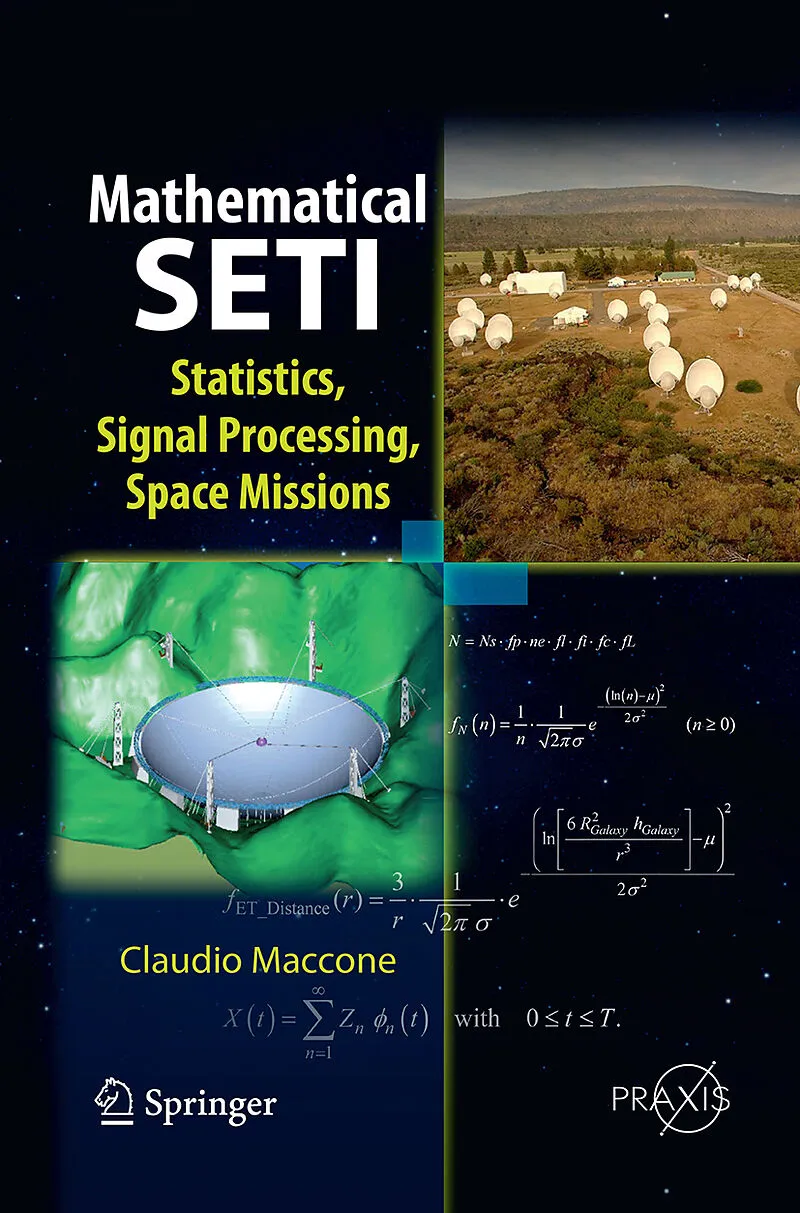
This book reviews the past 50 years of SETI searches. It demonstrates high level mathematical techniques for the solution of a variety of SETI problems. Includes a full mathematical derivation of the Statistical Drake Equation and describes its applications. T...This book reviews the past 50 years of SETI searches. It demonstrates high level mathematical techniques for the solution of a variety of SETI problems. Includes a full mathematical derivation of the Statistical Drake Equation and describes its applications.
This book introduces the Statistical Drake Equation where, from a simple product of seven positive numbers, the Drake Equation is turned into the product of seven positive random variables. The mathematical consequences of this transformation are demonstrated and it is proven that the new random variable N for the number of communicating civilizations in the Galaxy must follow the lognormal probability distribution when the number of factors in the Drake equation is allowed to increase at will.Mathematical SETI also studies the proposed FOCAL (Fast Outgoing Cyclopean Astronomical Lens) space mission to the nearest Sun Focal Sphere at 550 AU and describes its consequences for future interstellar precursor missions and truly interstellar missions. In addition the author shows how SETI signal processing may be dramatically improved by use of the Karhunen-Loève Transform (KLT) rather than Fast Fourier Transform (FFT). Finally, he describes the efforts made to persuade the UnitedNations to make the central part of the Moon Far Side a UN-protected zone, in order to preserve the unique radio-noise-free environment for future scientific use.
The first book to include a full mathematical derivation of the Statistical Drake Equation and describe its many applications Demonstrates high level mathematical techniques for the solution of a variety of SETI problems Describes how use of the Karhunen-Loeve Transform leads to a dramatic improvement in SETI signal processing Discusses important topics of current SETI research relating to exoplanet searches and civilizations within the Galaxy
Autorentext
Claudio Maccone is a SETI astronomer, space scientist and mathematician. From 2012 to 2021 he chaired the SETI Permanent Committee of the International Academy of Astronautics (IAA) which is based in Paris. Author of over 100 scientific articles, he published 6 books about future Space Missions, SETI and Astrobiology. He is now Chair of the IAA Moon Farside Protection Permanent Committee which aims to preserve (at United Nations) the radio silence still existing on the other side of the moon, before it is destroyed by the political rivalries between the various spatial countries today. Andrea M.F. Valli, biophysicist and paleontologist. He was scientific advisor for the "Conseil général de l'Allier". Associated with the "Société Scientifique du Bourbonnais" (Allier), he participated in the cultural dissemination with conferences on paleontology and the evolution of life. Eugenio Mieli, degree in physics. He has always worked in TLC. Noting the relevance between Maccone's work in the book "Mathematical Seti" and the biological scenario described by Valli in the book "Bactéries, Dinosaures et Kangourous - Brève Histoire de la Biodiversité", has decided to face Drake's entire equation together with the two other authors.
Inhalt
Part 1 MATHEMATICAL STATISTICS FOR SETI.- Introduction to SETI.- The Drake Equation summarizing five billions years of Evolution in this Galaxy.- The Statistical Drake Equation (SDE).- The Statistical Equation of the Habitables (SHE).- Is there a Galactic Habitable Zone?.- Part 2 ACTUAL SETI SEARCHES AND STRATEGIES.- Summary of Fifty Years of SETI Searches (1960-2010).- Searching for Beacons in 2010: the Benford's approach.- The Hipparcos Star Catalogue of the Nearest 118,218 Stars in the Galaxy.- The Turnbull-Tarter 'HabCat' Catalogue of the Nearest 17,129 Habitable Stars.- Future Space Missions yielding more Star Catalogues: SIM, GAIA, TPF.- Current SETI Searches from the ground: ATA and the Berkeley SETI Program.- Future SETI Searches from the ground: ATA, LOFAR, ALMA, SKA.- Part 3 IMPROVING THE SETI SIGNAL PROCESSING BY THE KLT.- A Simple Introduction to the KLT.- KLT from sources in uniform and decelerated motion.- KLT from sources in hyperbolic motion.- KLT from sources inarbitrary motion.- Part 4 MATHEMATICAL MODELS OF THE PAST FOR EXTRAPOLATION INTO THE FUTURE.- SETI, Exoplanet Searches and Interstellar Flight: When are They Going to Merge?.- Human Expected Lifetime Increase from Upper Paleolithic up to Now and Beyond.- The 'Coral' Model for the Expansion of a Civilization in this Galaxy.- Prospects for Human Interstellar Flight as of 2010.-Trying to Infer Humanity's Future Expansion in the Galaxy on the HabCat basis.