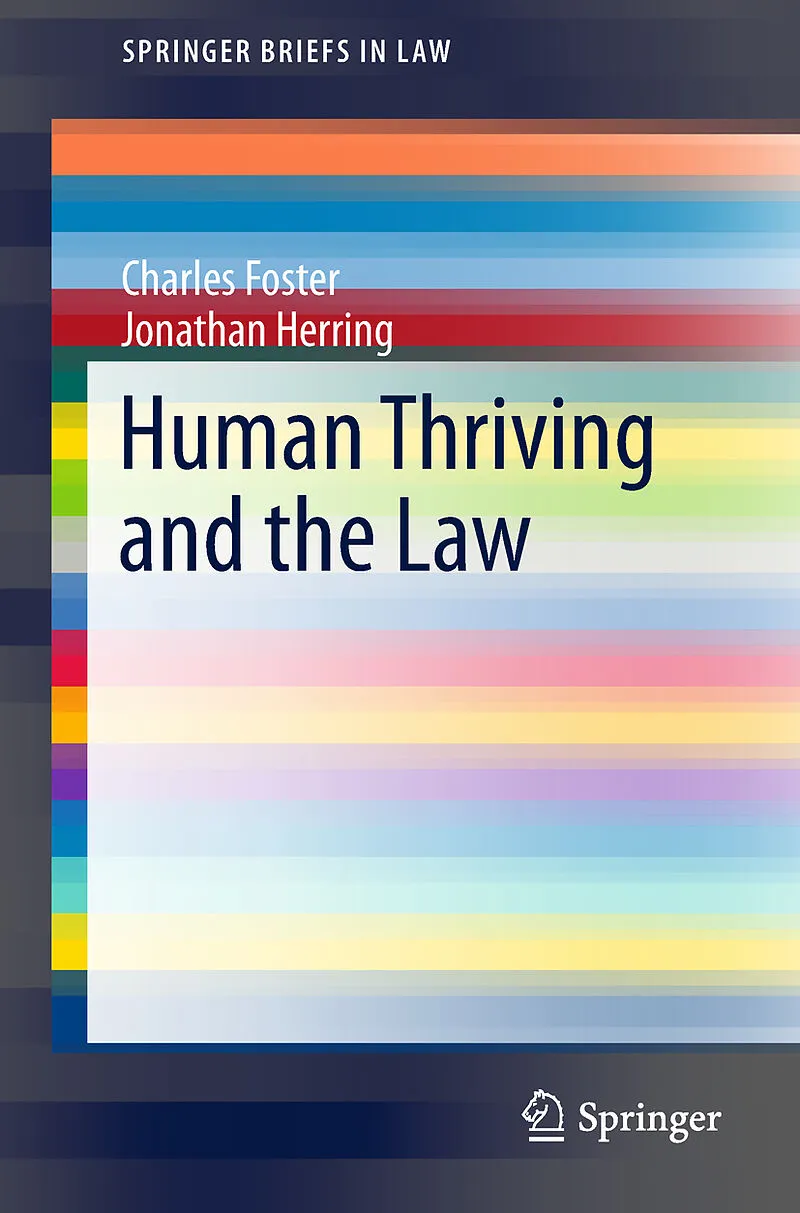
Beschreibung
The idea of the Good Life of what constitutes human thriving, is, implicitly, the foundation and justification of the law. The law exists to hold societies together; to hold in tension the rights of individuals as against individuals, the rights of individual...
The idea of the Good Life of what constitutes human thriving, is, implicitly, the foundation and justification of the law. The law exists to hold societies together; to hold in tension the rights of individuals as against individuals, the rights of individuals as against various types of non-humans such as corporations (and vice versa), and the rights of individuals individuals as against the state (and vice versa). In democratic states, laws inhibit some freedoms in the name of greater, or more desirable freedoms. The only justification for law is surely that it tends to promote human thriving.
But what is the Good Life? What does it mean to live a thriving life? There has been no want of discussion, at least since the great Athenians. But surprisingly, since human thriving is its sole raison d'etre, the law has been slow to contribute to the conversation.
This book aims to start and facilitate this conversation.
It aims to:
-make lawyers ask: 'What is the law for?', and conclude that it is to maximise human thriving
-make lawyers ask: 'But what does human thriving mean?'
-make judges and advocates ask: 'How can a judgment about the best interests of a patient be satisfactory unless its basis is made clear?'
Provides an in depth analysis of the concept of human flourishing Practical applications of the significance for the law of human flourishing Written accessibly and engagingly
Autorentext
Andrew McGee is Associate Professor in law at Queensland University of Technology. He holds a PhD in philosophy from the University of Essex. Before joining QUT, he completed a post-doctoral research fellowship in philosophy at University College Dublin. His main research interests are in the realm of bioethics. He has published widely on ethical issues in leading peer reviewed philosophy and ethics journals including Metaphilosophy, Philosophy, Psychiatry & Psychology, Journal of Medicine and Philosophy, and the Journal of Medical Ethics. Charles Foster is a Fellow of Exeter College, University of Oxford, a Senior Research Associate at the Uehiro Institute of Practical Ethics within the Faculty of Philosophy at the University of Oxford, and a Visiting Professor at the Oxford University Law Faculty.He too has published widely in leading philosophy and law journals. Previous books include, amongst many others, Being a Human (Profile and Henry Holt, 2021), The Law asa Moral Agent: Making people good (Springer, 2021, with Jonathan Herring), Human Thriving and the Law (Springer, 2018, with Jonathan Herring), Identity, Personhood and the Law (Springer, 2017, with Jonathan Herring), Being a Beast (Profile and Henry Holt, 2016), Altruism, Welfare and the Law (Springer, 2015, with Jonathan Herring), Human dignity in bioethics and law (Hart, 2012), Choosing Life, Choosing Death: The tyranny of autonomy in medical law and ethics (Hart, 2009), and The Selfless Gene (Hodder, 2008).
Klappentext
The idea of the Good Life of what constitutes human thriving, is, implicitly, the foundation and justification of the law. The law exists to hold societies together; to hold in tension the rights of individuals as against individuals, the rights of individuals as against various types of non-humans such as corporations (and vice versa), and the rights of individuals individuals as against the state (and vice versa). In democratic states, laws inhibit some freedoms in the name of greater, or more desirable freedoms. The only justification for law is surely that it tends to promote human thriving. But what is the Good Life? What does it mean to live a thriving life? There has been no want of discussion, at least since the great Athenians. But surprisingly, since human thriving is its sole raison d etre, the law has been slow to contribute to the conversation. This book aims to start and facilitate this conversation. It aims to: -make lawyers ask: What is the law for? , and conclude that it is to maximise human thriving -make lawyers ask: But what does human thriving mean? -make judges and advocates ask: How can a judgment about the best interests of a patient be satisfactory unless its basis is made clear?
Inhalt
Preface.- Chapter 1: What does the law say about human thriving?.- Chapter 2: The idea of human thriving: A brief history.- Chapter 3: What makes humans happy?.- Chapter 4: Thriving, care, and vulnerability.- Chapter 5: Making it work: ideas of human thriving in practice.- Chapter 6: Conclusion.