
IHR WARENKORB IST AKTUELL LEER.
Haben Sie noch nichts passendes gefunden? Stöbern Sie durch unser komplettes Sortiment.
Oder melden Sie sich an bzw. registrieren Sie sich.
- Kostenlose Lieferung
- Kauf auf Rechnung
- Ex Libris Tiefpreis
- Filiallieferung und 650+ Abholorte
- Rabatt-Bons als Club-Mitglied
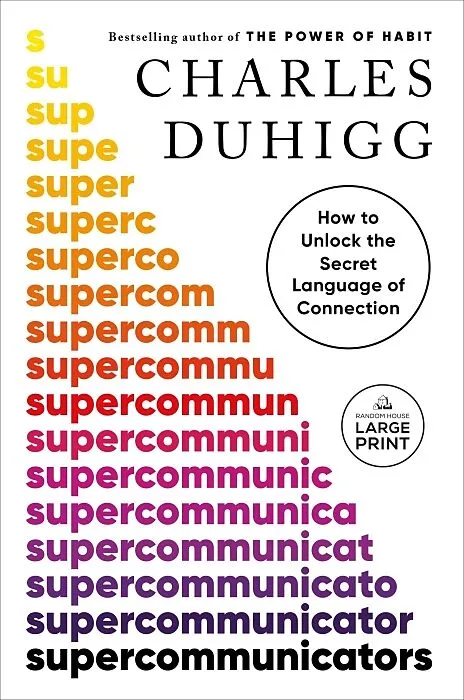
Supercommunicators
Beschreibung
Informationen zum Autor Charles Duhigg Klappentext NEW YORK TIMES BESTSELLER • From the author of The Power of Habit , a fascinating exploration of what makes conversations workand how we can all learn to be supercommunicators at work and in life A winnin...Format auswählen
- BroschiertCHF 30.50
- Kartonierter EinbandCHF 13.10

Wird oft zusammen gekauft
Andere Kunden kauften auch
Beschreibung
Informationen zum Autor Charles Duhigg Klappentext NEW YORK TIMES BESTSELLER • From the author of The Power of Habit , a fascinating exploration of what makes conversations workand how we can all learn to be supercommunicators at work and in life A winning combination of stories, studies, and guidance that might well transform the worst communicators you know into some of the best.Adam Grant, author of Think Again and Hidden Potential ONE OF NPR'S BEST BOOKS OF THE YEAR • FINALIST FOR THE SABEW BEST IN BUSINESS BOOK AWARD Come inside a jury room as one juror leads a starkly divided room to consensus. Join a young CIA officer as he recruits a reluctant foreign agent. And sit with an accomplished surgeon as he tries, and fails, to convince yet another cancer patient to opt for the less risky course of treatment. In Supercommunicators , Charles Duhigg blends deep research and his trademark storytelling skills to show how we can all learn to identify and leverage the hidden layers that lurk beneath every conversation. Communication is a superpower and the best communicators understand that whenever we speak, we're actually participating in one of three conversations: practical ( What's this really about? ), emotional ( How do we feel? ), and social ( Who are we? ). If you don't know what kind of conversation you're having, you're unlikely to connect. Supercommunicators know the importance of recognizingand then matchingeach kind of conversation, and how to hear the complex emotions, subtle negotiations, and deeply held beliefs that color so much of what we say and how we listen. Our experiences, our values, our emotional livesand how we see ourselves, and othersshape every discussion, from who will pick up the kids to how we want to be treated at work. In this book, you will learn why some people are able to make themselves heard, and to hear others, so clearly. With his storytelling that takes us from the writers' room of The Big Bang Theory to the couches of leading marriage counselors, Duhigg shows readers how to recognize these three conversationsand teaches us the tips and skills we need to navigate them more successfully. In the end, he delivers a simple but powerful lesson: With the right tools, we can connect with anyone. Leseprobe 1 The Matching Principle How to Fail at Recruiting Spies If Jim Lawler was being honest with himself, he had to admit that he was terrible at recruiting spies. So bad, in fact, that he spent most nights worrying about getting fired from the only job he had ever loved, a job he had landed two years earlier as a case officer for the Central Intelligence Agency. It was 1982 and Lawler was thirty years old. He had joined the CIA after attending law school at the University of Texas, where he had gotten mediocre grades, and then cycling through a series of dull jobs. One day, unsure what to do with his life, he telephoned a CIA headhunter he had once met on campus. A job interview followed, then a polygraph test, then a dozen more interviews in various cities, and then a series of exams that seemed designed to ferret out everything Lawler didn't know. (Who, he wondered, memorizes rugby world champions from the 1960s?) Eventually, he made it to the final interview. Things weren't looking good. His exam performances had been poor to middling. He had no overseas experience, no knowledge of foreign languages, no military service or special skills. Yet, the interviewer noted, Lawler had flown himself to Washington, D.C., for this interview on his own dime; had persisted through each test, even when it was clear he didn't have the first clue how to answer most questions; had responded to every setback with what seemed like admirable, if misplaced, optimism. Why, the man...
Autorentext
Charles Duhigg
Klappentext
**NEW YORK TIMES BESTSELLER • From the author of The Power of Habit, a fascinating exploration of what makes conversations work—and how we can all learn to be supercommunicators at work and in life
**
“A winning combination of stories, studies, and guidance that might well transform the worst communicators you know into some of the best.”—Adam Grant, author of Think Again and Hidden Potential
**ONE OF NPR’S BEST BOOKS OF THE YEAR • FINALIST FOR THE SABEW BEST IN BUSINESS BOOK AWARD
Come inside a jury room as one juror leads a starkly divided room to consensus. Join a young CIA officer as he recruits a reluctant foreign agent. And sit with an accomplished surgeon as he tries, and fails, to convince yet another cancer patient to opt for the less risky course of treatment. In Supercommunicators, Charles Duhigg blends deep research and his trademark storytelling skills to show how we can all learn to identify and leverage the hidden layers that lurk beneath every conversation.
Communication is a superpower and the best communicators understand that whenever we speak, we’re actually participating in one of three conversations: practical (What’s this really about?), emotional (How do we feel?), and social (Who are we?). If you don’t know what kind of conversation you’re having, you’re unlikely to connect.
Supercommunicators know the importance of recognizing—and then matching—each kind of conversation, and how to hear the complex emotions, subtle negotiations, and deeply held beliefs that color so much of what we say and how we listen. Our experiences, our values, our emotional lives—and how we see ourselves, and others—shape every discussion, from who will pick up the kids to how we want to be treated at work. In this book, you will learn why some people are able to make themselves heard, and to hear others, so clearly.
With his storytelling that takes us from the writers’ room of The Big Bang Theory to the couches of leading marriage counselors, Duhigg shows readers how to recognize these three conversations—and teaches us the tips and skills we need to navigate them more successfully.
In the end, he delivers a simple but powerful lesson: With the right tools, we can connect with anyone.
Leseprobe
**1
The Matching Principle**
How to Fail at Recruiting Spies
If Jim Lawler was being honest with himself, he had to admit that he was terrible at recruiting spies. So bad, in fact, that he spent most nights worrying about getting fired from the only job he had ever loved, a job he had landed two years earlier as a case officer for the Central Intelligence Agency.
It was 1982 and Lawler was thirty years old. He had joined the CIA after attending law school at the University of Texas, where he had gotten mediocre grades, and then cycling through a series of dull jobs. One day, unsure what to do with his life, he telephoned a CIA headhunter he had once met on campus. A job interview followed, then a polygraph test, then a dozen more interviews in various cities, and then a series of exams that seemed designed to ferret out everything Lawler didn’t know. (Who, he wondered, memorizes rugby world champions from the 1960s?)
Eventually, he made it to the final interview. Things weren’t looking good. His exam performances had been poor to middling. He had no overseas experience, no knowledge of foreign languages, no military service or special skills. Yet, the interviewer noted, Lawler had flown himself to Washington, D.C., for this interview on his own dime; had persisted through each test, even when it was clear he didn’t have the first clue how to answer most questions; had responded to every setback with what seemed like admirable, if misplaced, optimism. Why, the man asked, did he want to join the CIA so badly?
“I’ve wanted to do something important my entire life,” Lawler replied. He wanted to serve his country and &l…