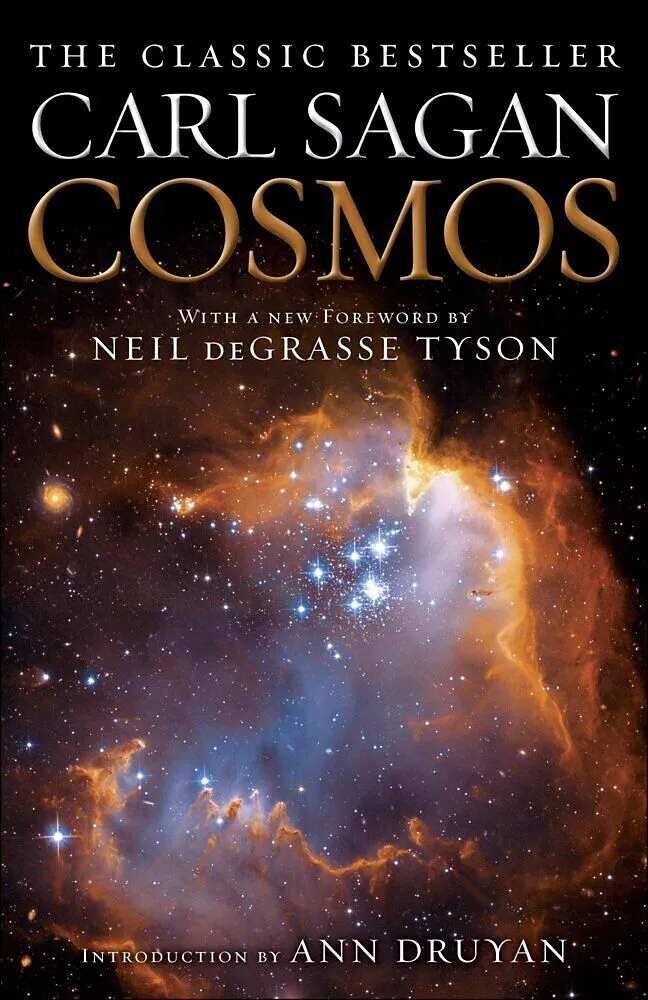
Cosmos
Beschreibung
Zusatztext Magnificent . . . With a lyrical literary style! and a range that touches almost all aspects of human knowledge! Cosmos often seems too good to be true. The Plain Dealer Sagan is an astronomer with one eye on the stars! another on history! and a thi...Format auswählen
- Kartonierter EinbandCHF 20.30

Wird oft zusammen gekauft
Andere Kunden kauften auch
Beschreibung
Zusatztext Magnificent . . . With a lyrical literary style! and a range that touches almost all aspects of human knowledge! Cosmos often seems too good to be true. The Plain Dealer Sagan is an astronomer with one eye on the stars! another on history! and a thirdhis mind'son the human condition. Newsday Brilliant in its scope and provocative in its suggestions . . . shimmers with a sense of wonder. The Miami Herald Sagan dazzles the mind with the miracle of our survival! framed by the stately galaxies of space. Cosmopolitan Enticing . . . iridescent . . . imaginatively illustrated. The New York Times Book Review Informationen zum Autor Carl Sagan Klappentext Renowned astronomer Carl Sagan's classic bestseller that dives into the past, present, and future of science, dealing with the mind-staggering enormity of the cosmos in which we exist (Associated Press)with an Introduction by Ann Druyan and a Foreword by Neil deGrasse Tyson Sagan dazzles the mind with the miracle of our survival, framed by the stately galaxies of space. Cosmopolitan THE INSPIRATION FOR THE FOX MINISERIES COSMOS: POSSIBLE WORLDS , HOSTED BY NEIL DEGRASSE TYSON AND STARRING SETH MACFARLANE AND SIR PATRICK STEWART In clear-eyed prose, Carl Sagan reveals a jewel-like blue world inhabited by a life form that is just beginning to discover its own identity and to venture into the vast ocean of space. Featuring full-color illustrations, Cosmos retraces the fourteen billion years of cosmic evolution that have transformed matter into consciousness, exploring such topics as the origin of life, the human brain, Egyptian hieroglyphics, spacecraft missions, the death of the Sun, the evolution of galaxies, and the forces and individuals who helped shape modern science.Chapter I The Shores of the Cosmic Ocean The first men to be created and formed were called the Sorcerer of Fatal Laughter, the Sorcerer of Night, Unkempt, and the Black Sorcerer .?.?. They were endowed with intelligence, they succeeded in knowing all that there is in the world. When they looked, instantly they saw all that is around them, and they contemplated in turn the arc of heaven and the round face of the earth .?.?. [Then the Creator said]: They know all .?.?. what shall we do with them now? Let their sight reach only to that which is near; let them see only a little of the face of the earth! .?.?. Are they not by nature simple creatures of our making? Must they also be gods? The Popol Vuh of the Quiché Maya The known is finite, the unknown infinite; intellectually we stand on an islet in the midst of an illimitable ocean of inexplicability. Our business in every generation is to reclaim a little more land. T. H. Huxley, 1887 The Cosmos is all that is or ever was or ever will be. Our feeblest contemplations of the Cosmos stir usthere is a tingling in the spine, a catch in the voice, a faint sensation, as if a distant memory, of falling from a height. We know we are approaching the greatest of mysteries. The size and age of the Cosmos are beyond ordinary human understanding. Lost somewhere between immensity and eternity is our tiny planetary home. In a cosmic perspective, most human concerns seem insignificant, even petty. And yet our species is young and curious and brave and shows much promise. In the last few millennia we have made the most astonishing and unexpected discoveries about the Cosmos and our place within it, explorations that are exhilarating to consider. They remind us that humans have evolved to wonder, that understanding is a joy, that knowledge is prerequisite to survival. I believe our future depends on how well we know this Cosmos in which we float like a mote of dust in the morning sky. <b...
ldquo;Magnificent . . . With a lyrical literary style, and a range that touches almost all aspects of human knowledge, Cosmos often seems too good to be true.”—The Plain Dealer
“Sagan is an astronomer with one eye on the stars, another on history, and a third—his mind’s—on the human condition.”—Newsday
“Brilliant in its scope and provocative in its suggestions . . . shimmers with a sense of wonder.”—The Miami Herald
“Sagan dazzles the mind with the miracle of our survival, framed by the stately galaxies of space.”—Cosmopolitan
“Enticing . . . iridescent . . . imaginatively illustrated.”—The New York Times Book Review
Autorentext
Carl Sagan
Klappentext
Renowned astronomer Carl Sagan’s classic bestseller that “dives into the past, present, and future of science, dealing with the mind-staggering enormity of the cosmos in which we exist” (Associated Press)—with an Introduction by Ann Druyan and a Foreword by Neil deGrasse Tyson
“Sagan dazzles the mind with the miracle of our survival, framed by the stately galaxies of space.”—Cosmopolitan
THE INSPIRATION FOR THE FOX MINISERIES COSMOS: POSSIBLE WORLDS, HOSTED BY NEIL DEGRASSE TYSON AND STARRING SETH MACFARLANE AND SIR PATRICK STEWART
In clear-eyed prose, Carl Sagan reveals a jewel-like blue world inhabited by a life form that is just beginning to discover its own identity and to venture into the vast ocean of space. Featuring full-color illustrations, Cosmos retraces the fourteen billion years of cosmic evolution that have transformed matter into consciousness, exploring such topics as the origin of life, the human brain, Egyptian hieroglyphics, spacecraft missions, the death of the Sun, the evolution of galaxies, and the forces and individuals who helped shape modern science.
Leseprobe
Chapter I
The Shores of the Cosmic Ocean
The first men to be created and formed were called the Sorcerer of Fatal Laughter, the Sorcerer of Night, Unkempt, and the Black Sorcerer . . . They were endowed with intelligence, they succeeded in knowing all that there is in the world. When they looked, instantly they saw all that is around them, and they contemplated in turn the arc of heaven and the round face of the earth . . . [Then the Creator said]: “They know all . . . what shall we do with them now? Let their sight reach only to that which is near; let them see only a little of the face of the earth! . . . Are they not by nature simple creatures of our making? Must they also be gods?”
—The Popol Vuh of the Quiché Maya
The known is finite, the unknown infinite; intellectually we stand on an islet in the midst of an illimitable ocean of inexplicability. Our business in every generation is to reclaim a little more land.
—T. H. Huxley, 1887
The Cosmos is all that is or ever was or ever will be. Our feeblest contemplations of the Cosmos stir us—there is a tingling in the spine, a catch in the voice, a faint sensation, as if a distant memory, of falling from a height. We know we are approaching the greatest of mysteries.
The size and age of the Cosmos are beyond ordinary human understanding. Lost somewhere between immensity and eternity is our tiny planetary home. In a cosmic perspective, most human concerns seem insignificant, even petty. And yet our species is young and curious and brave and shows much promise. In the last few millennia we have made the most astonishing and unexpected discoveries about the Cosmos and our place within it, explorations that are exhilarating to consider. They remind us that humans have evolved to wonder, that understanding is a joy, that knowledge is prerequisite to survival. I believe our future depends on how well we know this Cosmos in which we float like a mote of dust in the morning sky.
Those explorations required skepticism and imagination both. Imagination will often carry us to worlds that never were. But without it, we go nowhere. Skepticism enables us t…